Quantum Subgroups

Let C(G) be a the algebra of functions on a finite or perhaps compact quantum group (with comultiplication \Delta) and \nu\in M_p(G) a state on C(G). We say that a quantum group H with algebra of function C(H) (with comultiplication \Delta_H) is a quantum subgroup of G if there exists a surjective unital *-homomorphism \pi:C(G)\rightarrow C(H) such that:

\displaystyle \Delta_H\circ \pi=(\pi\otimes \pi)\circ \Delta.

The Classical Case

In the classical case, where the algebras of functions on G and H are commutative,
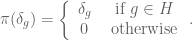
\displaystyle \pi(\delta_g)=\left\{\begin{array}{cc}\delta_g & \text{ if }g\in H \\ 0 & \text{ otherwise}\end{array}\right..

There is a natural embedding, in the classical case, if H is open (always true for G finite) (thanks UwF) of \imath: C(H) \xrightarrow\, C(G),

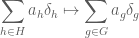
\displaystyle \sum_{h\in H}a_h \delta_h \mapsto \sum_{g\in G} a_g \delta_g,

with a_g=a_h for h\in G, and a_g=0 otherwise.

Furthermore, \pi is has the property that

\pi\circ\imath\circ \pi=\pi,

which resembles \pi^2=\pi.

In the case where \nu is a probability on a classical group G, supported on a subgroup H, it is very easy to see that convolutions \nu^{\star k} remain supported on H. Indeed, \nu^{\star k} is the distribution of the random variable

\xi_k=\zeta_k\cdots \zeta_2\cdot \zeta_1,

where the i.i.d. \zeta_i\sim \nu. Clearly \xi_k\in H and so \nu^{\star k} is supported on H.

We can also prove this using the language of the commutative algebra of functions on G, C(G). The state \nu\in M_p(G) being supported on H implies that

\nu\circ\imath\circ \pi=\nu\imath\pi=\nu.

Consider now two probabilities on G but supported on H, say \mu,\,\nu. As they are supported on H we have

\mu=\mu\imath\pi and \nu=\nu\imath\pi.

Consider

(\mu\star \nu)\imath\pi=(\mu\otimes \nu)\circ \Delta\circ \imath\pi

=((\mu\imath\pi)\otimes(\nu\imath\pi))\circ \Delta\circ\imath\pi =(\mu\imath\otimes \nu\imath)(\pi\circ \pi)\Delta\circ\imath\pi

=(\mu\imath\otimes\nu\imath)(\Delta_H\circ \pi\circ \imath\circ \pi)=(\mu\imath\otimes\nu\imath)(\Delta_H\circ \pi)

=(\mu\imath\otimes \nu\imath)\circ (\pi\circ \pi)\circ\Delta=(\mu\imath\pi\otimes \nu\imath\pi)\circ\Delta

=(\mu\otimes\nu)\circ\Delta=\mu\star \nu,

that is \mu\star \nu is also supported on H and inductively \nu^{\star k}.

Some Questions

Back to quantum groups with non-commutative algebras of functions.

  • Can we embed C(H) in C(G) with a map \imath and do we have \pi\circ \imath\circ \pi=\pi, giving the projection-like quality to \pi?
  • Is \nu\circ\imath\circ \pi=\nu a suitable definition for \nu being supported on the subgroup H.

If this is the case, the above proof carries through to the quantum case.

  • If there is no such embedding, what is the appropriate definition of a \nu\in M_p(G) being supported on a quantum subgroup H?
  • If \pi does not have the property of \pi\circ \imath\circ \pi=\pi, in this or another definition, is it still true that \nu being supported on H implies that \nu^{\star k} is too?

Edit

UwF has recommended that I look at this paper to improve my understanding of the concepts involved.

Week 7

In Week 7 we started delving more into algebra and started talking about equations.

Week 8

In Week 8 we will finish talking about equations and start studying quadratics.

Read the rest of this entry »

Assessment 1 – Results

I will have the assignments with me tomorrow and next Friday if you want to see your work.

Assessment 2

Assessment 2 is on p.136. It has a hand-in time of 16:00 Monday 26 November.

Week 7

We finished looking at Chapter 2 by looking at the Three Term Taylor Method for approximating solutions of ordinary differential equations.

We started Chapter 3 (Probability and Statistics) by looking at some general concepts in probability and then we looked at random variables with a binomial distribution.

Week 8

We will look at the Poisson distribution and perhaps the Normal distribution.

Read the rest of this entry »

Week 7

We looked at Parametric Differentiation and Related Rates

Week 8

We will look at Implicit Differentiation and Partial Differentiation. If you are interested in a very “mathsy” approach to curves you can look at this.

Test 2

On Chapter 3, not until Week 11: perhaps Monday 26 November.

Study

Please feel free to ask me questions about the exercises via email or even better on this webpage.

Student Resources

Please see the Student Resources tab on the top of this page for information on the Academic Learning Centre, etc.

Assessment 1 – Results

I am starting corrections today and will get the results to you as soon as I can. I cannot give an accurate day at this stage: it could be Monday but just as easily could be a few days after this – I can’t make any promises.

Assessment 2

Assessment 2 is on p.136. It has a hand-in date of Monday 26 November and we have already covered everything that will be asked and so you have over five weeks to complete the assignment.

MicDrop Project

On Monday you will be sent a 15 minute survey that you will take on a mobile internet device — such as your mobile phone — during Monday’s lecture.

This survey is part of a larger project the Mathematics Department is undertaking —  Mathematics in Context: Developing Relevancy-Orientated Problems — in an effort to improve our teaching.

If you do not have an internet ready device you may leave class early.

Reading Break, etc.

Maths Classes will be going full steam ahead on Monday 22 October as well as Wednesday, Thursday, Friday 1, 2, 3 November. I will call the next two weeks by Week 7.

Week 6

In Week 6 we finished looking at cantilvers and then summarised what we learnt about beams. We had one lecture as a tutorial but then looked at numerical approximations to solutions of differential equations that we cannot solve exactly.

After the storm last year I recorded some examples. If you missed some classes this week you could do worse than watch this cantilever example and this summary of beams to catch up

Week 7

In Week 7 we will look at the Three Term Taylor Method and begin Chapter 3 on Probability and Statistics.

Read the rest of this entry »

Transposition Project

On Monday you will be sent a 20 minute quiz that you will take on a mobile internet device — such as your mobile phone — during Monday’s lecture. You will have another quiz again after we finish studying algebra.

These quizzes do not affect your MATH6055 grade but are part of a larger project the Mathematics Department is undertaking in an effort to improve our teaching.

If you do not have an internet ready device you may leave class early.

Test 1 Results

Have been emailed to you. I will have your scripts with me in tutorials and will send out the marking scheme next week.

Reading Break, etc.

Classes will be going full steam ahead on Monday and Tuesday 22/23 October as well as Wednesday and Friday 31 October and 2 November. I will call the next two weeks by Week 7.

Week 6

In Week 6 we had our first test and finished our our study of functions and their properties. We started looking at algebra by looking first at number sets. We learnt, for example, that division by zero is undefined. See here for more.

Week 7

In Week 7 we will start really getting to grips with algebra.

Read the rest of this entry »

Test 1 Results

Have been emailed to you. I will have your scripts with me in tutorials.

Room Change

BioEng2A’s tutorial on Thursdays has been moved to E4.

Reading Break, etc.

Classes will be going full steam ahead on Monday and Tuesday 22/23 October as well as Thursday 1 November. I will class the next two weeks by Week 7.

Week 6

We finished Chapter 2 by looking at Cramer’s Rule and then we started Chapter 3 with a quick review of differentiation and linear operators.

I actually have videos from last year if you missed some classes from Week 6:

Week 7

Over 22 October – 2 November we have three lectures and one tutorial each, as normal.

We will start looking at Parametric Differentiation and then look at related rates.

Test 2

On Chapter 3, not until Week 11 or early Week 12.

Study

Please feel free to ask me questions about the exercises via email or even better on this webpage.

Student Resources

Please see the Student Resources tab on the top of this page for information on the Academic Learning Centre, etc.

Test 1

Test 1, worth 15% of your final grade, will take place in the usual D160 lecture venue at 10:00 on Tuesday 16 October. You have been sent a sample paper. The names of Laws of Sets on the sample is the same as how they will be named on the test and final exam.

Test 1 will cover the contents of Chapter 1 and the sample will give an idea of the layout and length of the test. The following types of questions are examinable:

  • Stuff on the sample test
  • P.20, Q. 1, 3 [note \mathcal{P}(X) is a typo: it should be \mathcal{P}(U)], 4, 6-7, 9, 13-14
  • P.26, Q. 1-4
  • P.30, Q. 2
  • P. 36, Q.1-3

Questions like those exercises not listed here will not appear on your exam paper but are still useful to help your learning and understanding. For example, working with truth tables should help your understanding of the Laws of Sets.

I have also sent on some additional exercises on equivalence relations via email.

The Lee Fields Medal — CIT Maths Challenge

Maths Competition on next Wednesday with cash prizes. Poster below.

posterimage.jpg

Week 5

In Week 5 we continued our study of functions and their properties. We considered the composition of functions — and inverse functions. We started looking at examples of functions.

Week 6

In Week 6 we will complete our study of functions.

Read the rest of this entry »

Assessment 1

If you haven’t started this you seriously need to get cracking.

  • The hand in deadline is 17:30 on Tuesday 16 October 2018.
  • Hand it in class at 13:00 on Monday or else drop it into my office, A283. I should be here Monday 14:00-16:00, Tuesday 11:00-15:00 and 17:00-17:30.
  • Hand in whatever you have done by the deadline: work handed in late will be assigned a mark of zero.
  • Email me your Excel work.
  • Print off a hard copy of your excel and submit this with any other written work.
  • Further instructions in the manual.

The Lee Fields Medal — CIT Maths Challenge

Maths Competition on next Wednesday with cash prizes. Poster below.

posterimage.jpg

Week 5

In Week 5 we finished looking at simply supported beams. We then looked at fixed end beams and cantilevered beams.

Week 6

In Week 6 we will finish looking at cantilvers and then summarise what we learnt about beams but then look at numerical approximations to solutions of differential equations that we cannot solve exactly.

Read the rest of this entry »

The Lee Fields Medal — CIT Maths Challenge

Maths Competition on next Wednesday with cash prizes. Poster below.

posterimage.jpg

Week 5

We looked at linear systemsdeterminants, and Cramer’s Rule.

Week 6

We will finish looking at Cramer’s Rule and then we will start Chapter 3 with a quick review of differentiation followed by looking at Parametric Differentiation.

Test 1

The 15% Test 1 will take place at 16:00 on Monday 15 October, Week 6, in B263. There is a sample test in the notes, p.44. Chapter 1: Vectors is going to be examined. A Summary of Vectors (p.40): you will want to know this stuff very well.

Test 2

On Chapter 3, not until Week 11 or early Week 12.

Study

Please feel free to ask me questions about the exercises via email or even better on this webpage.

Student Resources

Please see the Student Resources tab on the top of this page for information on the Academic Learning Centre, etc.