Assignment 2

Assignment 2 based on Chapter 2 is on Canvas now: Canvas —> MATH7019 —> Assignments. It is due this week.

Assignment 1

In Winter 2021, this was the Final Grade vs Assignment 1:

graph.jpg

What we see is that, roughly, on average, is that a prediction for your final grade, based on your Assignment 1 performance, is half of your Test 1 score +14. This means that people who got below about 52% on Assignment 1 are predicted to fail. I want the people in this area to push themselves to the green region. These are students who are predicted to fail but go on to pass. To do this, students have to continue coming to lecture and tutorials, and perhaps also look at attending the Academic Learning Centre Links to an external site.. They will also want to do very well on Assignment 2.

I also want people in the 50-80% range not to get complacent. Students in this range are predicted to pass, but you can see students in the orange region who did OK in Assignment 1 but went on to fail or nearly fail. These students need to continue coming to class, especially tutorials.

Assignment 2 is now available. Ye can do start Problems A to C already. If you want to start Problem D ahead of Week 8 you can learn about Euler’s Method in videos 27 to 29 in the lecture video playlist.

Week 9

We looked at the normal distribution (more calculation focused), and then looked at at sampling.

We had no tutorial.

Week 10

We will finish Chapter 3 and start Chapter 4 on Friday.

We will have tutorial time on Wednesday and again on Thursday.

Academic Learning Centre

I would urge anyone having any problems with material that isn’t being addressed in the tutorial communication to use the Academic Learning Centre. If you are a little worried about your maths this semester you need to be aware of this resource. You will get best results if you come to the helpers there with specific questions.

Student Resources

Please see the Student Resources tab on the top of this page for information on the Academic Learning Centre, etc.

Study

Please feel free to ask me questions about the exercises via email.

Test 2

Test 2 is booked for the Wednesday of Week 11:

29/11/202318.00-19.00MATH6040Technological Maths 20160+A – D

See Canvas —> MATH6055 —> Assignments, for more information, including sample tests.

Week 9

We drove into Chapter 4, with a revision class on differentiation, then talking about transforms, and then functions of several variables and partial differentiation. We should have been able to look at applications of partial differentiation to error analysis, but unfortunately nobody told me our Friday lecture venue was being used for the MTU Open Day, and we lost out on a class.

Week 10

We will look at applications of partial differentiation to error analysis. Then we will look at parametric differentiation.

The tutorials will again be focused on Chapter 3. We might get some tutorial time on Chapter 4 in lectures.

Week 11

We will hopefully finish Chapter 4 by looking at Related Rates and Implicit Differentiation.

Week 12

We will finish the manual and then start revision.

Students will receive one-to-one help in tutorial, but it will be up to students to decide what they want to look at; be it Vectors, Matrices, or Further Differentiation.

Students who don’t know what to do might be invited to look at the exam paper at the back of the manual.

Week 13

We will have all classes scheduled up to and including 12 December. These will all be tutorials

Tutorials

The most important thing in your MATH6040 world is to attend tutorials regularly.

If BioEng2B students genuinely cannot make the Friday tutorial, they may come to the BioEng2A tutorial at 3 pm on Wednesdays in B260. This can continue as long as the number of students in that tutorial stays at 20 or below.

Study

Please feel free to ask me questions about the exercises via email.

Student Resources

Please see  Student Resources for information on the Academic Learning Centre, etc.

…and why it doesn’t work for a quantum alternating group

Despite problems around its existence being well-known, the Google search “quantum alternating group” only gets one (relevant) hit. This is to a paper of Freslon, Teyssier, and Wang, which states:

We therefore have to resort to another idea, which is to compare the process with the so-called pure quantum transposition random walk and prove that they asymptotically coincide. This is a specifically quantum phenomenon connected to the fact that the pure quantum transposition walk has no periodicity issue because there is no quantum alternating group.

Let us explain this a little. Take a deck of N cards, say in some known order. What we are going to do is take two (different) cards at random, and swap them. The question is, does this mix up the deck of cards? What does this question mean? Let \xi_k\in S_{N} be the order of the cards after k of these pure random transposition shuffles. If the shuffles mix up the cards then:

\displaystyle \lim_{k\to\infty}\mathbb{P}[\xi_k=\sigma]=\frac{1}{N!}\qquad(\sigma\in S_{N}).

The random variable \xi_k is a product of k transpositions and using the sign group homomorphism:

\mathrm{sgn}(\xi_k)=(-1)^k.

Take a permutation \sigma\in S_N of odd sign, then:

\displaystyle \lim_{k\to\infty}\mathbb{P}[\xi_{2k}=\sigma]=0,

and so this pure random transposition shuffle cannot mix up the deck of cards. The order of the deck alternates (geddit) between \xi_{2k}\in A_N, the alternating group, and \xi_{2k+1}\in A_N^c, the complement of A_N in S_N (if we allow the two cards to be chosen independently, so that there is a chance we pick the same card twice, and do a do-nothing shuffle, then this barrier disappears and this random transposition shuffle does mix up the cards. See Diaconis & Shahshahani).

Amaury Freslon instigated a study of a quantum version of the above random walk. The probability distribution of the shuffles above is:
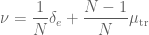
\displaystyle \nu=\frac{1}{N}\delta_e+\frac{N-1}{N}\mu_{\text{tr}}.

The measure \mu_{\text{tr}} is the measure uniform on transpositions in S_{N}. No such measure makes direct sense in the quantum setting, but if we recast this measure as the measure constant on permutations with N-2 fixed points there is a direct analogue, \varphi_{N-2} (see Section 4 for details).

If u\in M_N(C(S_N^+)) is the fundamental representation, and u^c=[\mathbf{1}_{j\to i}]_{i,n=1,...,N}, an element of M_N(C(S_N)), the entry-wise abelianisation, the trace \mathrm{tr}(u^c)\in C(S_N) counts the number of fixed points. The functions \mathbf{1}_{j\to i} asking of a permutation, do you map j\to i? One for yes, zero for no:

\displaystyle \mathrm{tr}(u^c)(\sigma)=\sum_{k=1}^N\mathbf{1}_{k\to k}(\sigma)=\text{ number of fixed points in }\sigma.

Freslon’s \varphi_{N-2} can be thought of as the measure uniform on those quantum permutations that satisfy \mathrm{tr}(u)=N-2.

If you shuffle according to classical \mu_{\text{tr}}, you meet the periodicity issue associated with \mathrm{sgn}. However, there is no such periodicity issue in the quantum case, because there is nothing analogous to a quantum sign homomorphism:

\mathrm{sgn}^+:S_N^+\to\{-1,1\}.

The classical alternating group is:

\displaystyle A_N=\{\sigma\in S_N\,\colon\,\mathrm{sgn}(\sigma)=1\},

but with no quantum sign, we don’t seem to be able to define a quantum alternating group in the same way.

This is related to difficulties around the determinant (equal to the sign for permutation matrices). I think, but would have to check, that we can quotient C(S_N) by the relation \mathrm{det}(u^c)=1, and you get C(A_N) in that case… but problems with the determinant mean this cannot happen in the quantum case.

Private communication has shown me a proof that if you quotient any compact matrix quantum group with \mathrm{det}(u)=1, then you get a commutative algebra, that is, a classical group. In particular,

\displaystyle C(S_N^+)/(\mathrm{det}(u)=1)=C(A_N),

and not something non-commutative, corresponding to a quantum alternating group C(A_N^+).

Another way?

This no-go result, which is cool but unpublished, doesn’t rule out a quantum alternating group of the form:

\displaystyle A_N\subsetneq A_N^+\subsetneq S_N^+.

There is indeed for every N a genuine quantum group \mathbb{G}_N with A_N\subsetneq \mathbb{G}_N, but this quantum group does not sit nicely as a quantum subgroup of S_N^+ (from here, Section 4).

Given a quantum permutation group \mathbb{G}\subset S_N^+, the set of characters on universal C(\mathbb{G}) forms a group G, the classical version of \mathbb{G}. The group law is convolution:

\displaystyle \varphi_1\star\varphi_2=(\varphi_1\otimes\varphi_2)\Delta.

I have a particular interest in characters, and have a pre-print (Section 4) doing some analysis on them. Let \varphi:C(\mathbb{G})\to \mathbb{C} be a character. Then, applying what I call the Birkhoff slice (Section 4.1), \Phi:\mathcal{S}(C(\mathbb{G}))\to M_N(\mathbb{C}), applying a state to the fundamental magic representation component-wise, gives a permutation matrix:


\displaystyle \Phi(\varphi)=P_\sigma\qquad (\sigma\in S_N).

In this case we write \varphi=\mathrm{ev}_\sigma, and where \pi_{\text{ab}} is the abelianisation, u_{ij}\mapsto \mathbf{1}_{j\to i}:

\displaystyle \mathrm{ev}_\sigma(f)=\pi_{\text{ab}}(f)(\sigma)\qquad (f\in C(\mathbb{G})).

The characters have support projections, and these in general do not live in C(\mathbb{G}) but in the bidual C(\mathbb{G})^{**}. These support projections live in the strong closure of C(\mathbb{G}) in its bidual. Briefly, let:

f_\sigma=u_{\sigma(1),1}u_{\sigma(2),2}\cdots u_{\sigma(N),N}.

(as an aside, if we transpose in f_{\sigma} the indices, so u_{k,\sigma(k)} instead of u_{\sigma(k),k}, then \mathrm{det}(u)=\sum_{\sigma\in S_N}\mathrm{sgn}(\sigma)f_\sigma.)

It turns out that the support projection p_\sigma of \mathrm{ev}_\sigma is the strong limit of (f_\sigma^n)_{n\geq 1}and if (f_\tau^n)_{n\geq 1} converges to zero… then \mathrm{ev}_{\tau} is zero, not a character, and \tau is not in the classical version of \mathbb{G}.

Enter this talk by Gilles Gonçalves De Castro (Universidade Federal de Santa Catarina, Brazil), who teaches us with his coauthor Giulioano Boava that it is possible to include (admissible) strong as well as norm relations in defining a universal \mathrm{C}^*-algebra.

An idea!

So, why not take S_N^+, or rather C(S_N^+), and quotient out the characters in the complement of A_N in S_N? We can do this via the relations p_\tau=0 for \tau\in A_N^c, they are admissible. So… define the following algebra:

\displaystyle C(A_N^+)=C(S_N^+)/\langle p_\tau=0,\,\tau\in A_N^c\rangle

There is a lot of work to do here to prove that this is a quantum group… have we a *-homomorphism \Delta(u_{ij})=\sum_{k=1}^N u_{ik}\otimes u_{kj}? But at least we have a candidate algebra.

Failure

Actually we don’t. In fact, either the algebra does not admit a quantum group structure OR

C(A_N^+)=C(S_N^+),

Unfortunately, because of non-coamenability issues, lots of algebras of continuous functions on quantum permutation groups also have p_\sigma=0 for all \sigma\in S_{N}… not because they have no classical versions, but because classical versions are defined on the universal level… where there are always characters… at the reduced level the algebras admit no characters.

In particular, the reduced algebra of functions C_{\text{r}}(S_N^+) satisfies p_\sigma=0 for all \sigma\in S_N, and so, if we assume that C(A_N^+) DOES have a quantum group structure, we have a comultiplication preserving quotient:

C(A_N^+)\to C_{\text{r}}(S_N^+).

Then with the help of J. De Ro, this means we have a Hopf*-algebra morphism on the level of the dense Hopf*-algebras, saying that S_N^+ is a quantum subgroup of A_N^+. But of course this A_N^+ is a quantum subgroup of S_N^+ and so it follows in this case that the two quantum groups coincide.

This isn’t a great no-go theorem: but a log of something that doesn’t work. And of course this approach doesn’t work for any subgroup of S_N.

Alice, Bob and Carol are hanging around, messing with playing cards.

Alice and Bob each have a new deck of cards, and Alice, Bob, and Carol all know what order the decks are in.

Carol has to go away for a few hours.

Alice starts shuffling the deck of cards with the following weird shuffle: she selects two (different) cards at random, and swaps them. She does this for hours, doing it hundreds and hundreds of times.

Bob does the same with his deck.

Carol comes back and asked “have you mixed up those decks yet?” A deck of cards is “mixed up” if each possible order is approximately equally likely:

\displaystyle \mathbb{P}[\text{ deck in order }\sigma\in S_{52}]\approx \frac{1}{52!}

She asks Alice how many times she shuffled the deck. Alice says she doesn’t know, but it was hundreds, nay thousands of times. Carol says, great, your deck is mixed up!

Bob pipes up and says “I don’t know how many times I shuffled either. But I am fairly sure it was over a thousand”. Carol was just about to say, great job mixing up the deck, when Bob interjects “I do know that I did an even number of shuffles though.“.

Why does this mean that Bob’s deck isn’t mixed up?

15% Test 2 – Equivalence Relations & Graphs

Wednesday 6 pm in the Melbourn Exam Hall.

There is a sample test on p.90 of the test. This is only to give you an idea of the type of content (but not specific questions) that will be examined. The test may be a little longer and/or harder.

More relevant exercises to be found on p.52, 66, 79, 83. We are very short for time for tutorials: students are advised to spend some time outside tutorials working on exercises. Particularly in preparation for Test 2 and the final exam.

Study Plan

As discussed in class, it might not be a great idea for students to spend all of the tutorials up to Test 2 on Test 2 material. Doing this leaves very little time for tutorials on Chapter 3 to 5 (which makes up 35% of your final grade).

I am going to recommend at this point that you spend some time outside tutorials doing exercises. Ideally getting ahead of the following proposed schedule:

Week 8

We drove into Chapter 4 Algebra, spending a lot of time talking about algebra in general, and the axioms of the real numbers.

In tutorial, C-X looked at p. 83/52, while C-Y looked at the sample test.

Week 9

We will spend time on equations and maybe spend a lecture talking about indices/exponentials.

In tutorial, C-X will look at sample test 2, and C-Y move onto functions. We are very short for time for tutorials: students are advised to spend some time outside tutorials working on exercises.

Week 10

Then we will introduce logs as inverses of exponential functions. We might get to fly through mini-Chapter 5. We have two lectures in Week 11. Hopefully at least one of these will be a tutorial.

Academic Learning Centre

Have you heard about Maths Online on Canvas? It’s full of helpful Maths and Stats resources, notes, quizzes and videos to help you throughout the whole year. 

 We also use the Maths Online module on Canvas to offer Maths and Stats support to you and answer as many student questions as possible. 

Please log on to Maths online to book a maths appointment, book a place in a supported maths study session or request a workshopLinks to an external site..

 Supported Maths Study is on every Monday from 3.30pm – 5.30pm in B231.

Supported Statistics Study is on every Wednesday from 3pm – 4pm in B231.

 If you have any other question about our Maths and Stats supports email us on Academic.Learning@mtu.ie 

Student Resources

Please see the Student Resources tab on the top of this page for information on the Academic Learning Centre, etc.

Test 2

Test 2 is booked for the Wednesday of Week 11:

29/11/202318.00-19.00MATH6040Technological Maths 20160+A – D

See Canvas —> MATH6055 —> Assignments, for more information, including sample tests.

Week 8

After the break, we will finish talking about integration by parts, and then start talking applications (some of which you have seen before).

Week 9

We will drive into Chapter 4, with a revision class on differentiation, then talking about transforms, and then functions of several variables and partial differentiation. We should be able to look at applications of partial differentiation to error analysis.

The tutorials will be focused on Chapter 3. We might get some tutorial time on Chapter 4 in lectures.

Outlook

We will complete Chapter 4 over Weeks 10 and 11. The tutorials in Week 11 will be focused on Chapter 3/Test 2, but Week 11 and possibly Week 12 will be focused on Chapter 4. Week 12 lectures might be revision in the form of tutorials.

Tutorials

The most important thing in your MATH6040 world is to attend tutorials regularly.

If BioEng2B students genuinely cannot make the Friday tutorial, they may come to the BioEng2A tutorial at 3 pm on Wednesdays in B260. This can continue as long as the number of students in that tutorial stays at 20 or below.

Study

Please feel free to ask me questions about the exercises via email.

Student Resources

Please see  Student Resources for information on the Academic Learning Centre, etc.

Assignment 2

Assignment 2 based on Chapter 2 is on Canvas now: Canvas —> MATH7019 —> Assignments. It is due in two weeks.

Assignment 1

In Winter 2021, this was the Final Grade vs Assignment 1:

graph.jpg

What we see is that, roughly, on average, is that a prediction for your final grade, based on your Assignment 1 performance, is half of your Test 1 score +14. This means that people who got below about 52% on Assignment 1 are predicted to fail. I want the people in this area to push themselves to the green region. These are students who are predicted to fail but go on to pass. To do this, students have to continue coming to lecture and tutorials, and perhaps also look at attending the Academic Learning Centre Links to an external site.. They will also want to do very well on Assignment 2.

I also want people in the 50-80% range not to get complacent. Students in this range are predicted to pass, but you can see students in the orange region who did OK in Assignment 1 but went on to fail or nearly fail. These students need to continue coming to class, especially tutorials.

Assignment 2 is now available. Ye can do start Problems A to C already. If you want to start Problem D ahead of Week 8 you can learn about Euler’s Method in videos 27 to 29 in the lecture video playlist.

Week 8

We did some Euler’s Method on Monday. A lot of students had a catch up tutorial later on Monday. We had some other tutorial time, but then also had a Concept MCQ and finished Chapter 2 and began Chapter 3, by talking about probability theory, notably mutual exclusivity and independence of events (and of random variables).

Week 9

We will look at the normal distribution (more calculation focused), and then start looking at sampling.

We will probably have no tutorial.

Academic Learning Centre

I would urge anyone having any problems with material that isn’t being addressed in the tutorial communication to use the Academic Learning Centre. If you are a little worried about your maths this semester you need to be aware of this resource. You will get best results if you come to the helpers there with specific questions.

Student Resources

Please see the Student Resources tab on the top of this page for information on the Academic Learning Centre, etc.

Study

Please feel free to ask me questions about the exercises via email.

15% Test 2 – Equivalence Relations & Graphs

We have now completed the material for Test 2. Everything in Chapters 1 and 2 is examinable, with the emphasis on equivalence relations as well as Chapter 2.

There is a sample test on p.90 of the test. This is only to give you an idea of the type of content (but not specific questions) that will be examined. The test may be a little longer and/or harder.

Please note:

• Do not to congregate outside the Melbourn Hall until 10 minutes before the assessment is due to commence and do wait outside until you are ready to begin your assessment.

• Be mindful of groups already in the hall when entering the exam hall.

• Do not congregate in the waiting area of the Melbourn building when the assessment has finished as the noise can disrupt the students completing their assessment.

• Leave their bags in the shelved area just inside the exam hall doors – not on the floor in the exam hall lobby.  As we get busier, space will become scarce in the shelved area so if possible, only bring essential items (pens, calculators etc.) to the venue.

Week 7

We spoke about compositions, and inverses, and looked at some examples of invertible functions that we will use in the chapter on Algebra.

In tutorial we focused on Test 2 material.

Week 8

We will drive into Chapter 4 Algebra.

Academic Learning Centre

Have you heard about Maths Online on Canvas? It’s full of helpful Maths and Stats resources, notes, quizzes and videos to help you throughout the whole year. 

 We also use the Maths Online module on Canvas to offer Maths and Stats support to you and answer as many student questions as possible. 

Please log on to Maths online to book a maths appointment, book a place in a supported maths study session or request a workshopLinks to an external site..

 Supported Maths Study is on every Monday from 3.30pm – 5.30pm in B231.

Supported Statistics Study is on every Wednesday from 3pm – 4pm in B231.

 If you have any other question about our Maths and Stats supports email us on Academic.Learning@mtu.ie 

Student Resources

Please see the Student Resources tab on the top of this page for information on the Academic Learning Centre, etc.

Formula Booklet/Tables

I recommend that you get your hands on a state formulae booklet… even if you print off the relevant pages from the below. I have a sheet to keep you going, and will offer it out during class… but it isn’t the below, not the one you will have in Test 2 and the final exam.

Week 7

We finished our revision of integration and antidifferentiation, and then looked at completing the square and integration by parts. Integration by parts comes from running the product rule of differentiation backwards.

Week 8

After the break, we will finish talking about integration by parts, and then start talking applications (some of which you have seen before).

Outlook

In Weeks 8 and 9 we will look at some applications. We will start Chapter 4 in Week 9/10.

Tutorials

The most important thing in your MATH6040 world is to attend tutorials regularly.

If BioEng2B students genuinely cannot make the Friday tutorial, they may come to the BioEng2A tutorial at 3 pm on Wednesdays in B260. This can continue as long as the number of students in that tutorial stays at 20 or below.

Study

Please feel free to ask me questions about the exercises via email.

Student Resources

Please see  Student Resources for information on the Academic Learning Centre, etc.

Test 2

Test 2 is provisionally booked for the Wednesday of Week 11:

29/11/202318.00-19.00MATH6040Technological Maths 20160+A – D

I have added materials (sample tests, etc.) to Canvas (Assignments –> Test 2)

Week 7

We finished looking at fixed ends and cantilevers, with some tutorial time, maybe a class and a half. 

We had planned to look at Euler’s Method on Friday so that any student could in theory do all of Assignment 2 over the reading break. We changed our mind on this to have an extra tutorial

Assessment

Assignment 1 corrections will be completed at some point in the reading week.

Assignment 2 is now available. Ye can do start Problems A to C already. If you want to start Problem D ahead of Week 8 you can learn about Euler’s Method in videos 27 to 29 in the lecture video playlist.

Week 8

We will have a tutorial on Monday, and then possibly a catch up tutorial at 3 pm in B241L (watch your email).

But then we have to cover Euler’s Method and start Chapter 3.

Academic Learning Centre

I would urge anyone having any problems with material that isn’t being addressed in the tutorial communication to use the Academic Learning Centre. If you are a little worried about your maths this semester you need to be aware of this resource. You will get best results if you come to the helpers there with specific questions.

Student Resources

Please see the Student Resources tab on the top of this page for information on the Academic Learning Centre, etc.

Study

Please feel free to ask me questions about the exercises via email.


