…and why it doesn’t work for a quantum alternating group

Despite problems around its existence being well-known, the Google search “quantum alternating group” only gets one (relevant) hit. This is to a paper of Freslon, Teyssier, and Wang, which states:

We therefore have to resort to another idea, which is to compare the process with the so-called pure quantum transposition random walk and prove that they asymptotically coincide. This is a specifically quantum phenomenon connected to the fact that the pure quantum transposition walk has no periodicity issue because there is no quantum alternating group.

Let us explain this a little. Take a deck of N cards, say in some known order. What we are going to do is take two (different) cards at random, and swap them. The question is, does this mix up the deck of cards? What does this question mean? Let \xi_k\in S_{N} be the order of the cards after k of these pure random transposition shuffles. If the shuffles mix up the cards then:

\displaystyle \lim_{k\to\infty}\mathbb{P}[\xi_k=\sigma]=\frac{1}{N!}\qquad(\sigma\in S_{N}).

The random variable \xi_k is a product of k transpositions and using the sign group homomorphism:

\mathrm{sgn}(\xi_k)=(-1)^k.

Take a permutation \sigma\in S_N of odd sign, then:

\displaystyle \lim_{k\to\infty}\mathbb{P}[\xi_{2k}=\sigma]=0,

and so this pure random transposition shuffle cannot mix up the deck of cards. The order of the deck alternates (geddit) between \xi_{2k}\in A_N, the alternating group, and \xi_{2k+1}\in A_N^c, the complement of A_N in S_N (if we allow the two cards to be chosen independently, so that there is a chance we pick the same card twice, and do a do-nothing shuffle, then this barrier disappears and this random transposition shuffle does mix up the cards. See Diaconis & Shahshahani).

Amaury Freslon instigated a study of a quantum version of the above random walk. The probability distribution of the shuffles above is:
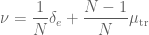
\displaystyle \nu=\frac{1}{N}\delta_e+\frac{N-1}{N}\mu_{\text{tr}}.

The measure \mu_{\text{tr}} is the measure uniform on transpositions in S_{N}. No such measure makes direct sense in the quantum setting, but if we recast this measure as the measure constant on permutations with N-2 fixed points there is a direct analogue, \varphi_{N-2} (see Section 4 for details).

If u\in M_N(C(S_N^+)) is the fundamental representation, and u^c=[\mathbf{1}_{j\to i}]_{i,n=1,...,N}, an element of M_N(C(S_N)), the entry-wise abelianisation, the trace \mathrm{tr}(u^c)\in C(S_N) counts the number of fixed points. The functions \mathbf{1}_{j\to i} asking of a permutation, do you map j\to i? One for yes, zero for no:

\displaystyle \mathrm{tr}(u^c)(\sigma)=\sum_{k=1}^N\mathbf{1}_{k\to k}(\sigma)=\text{ number of fixed points in }\sigma.

Freslon’s \varphi_{N-2} can be thought of as the measure uniform on those quantum permutations that satisfy \mathrm{tr}(u)=N-2.

If you shuffle according to classical \mu_{\text{tr}}, you meet the periodicity issue associated with \mathrm{sgn}. However, there is no such periodicity issue in the quantum case, because there is nothing analogous to a quantum sign homomorphism:

\mathrm{sgn}^+:S_N^+\to\{-1,1\}.

The classical alternating group is:

\displaystyle A_N=\{\sigma\in S_N\,\colon\,\mathrm{sgn}(\sigma)=1\},

but with no quantum sign, we don’t seem to be able to define a quantum alternating group in the same way.

This is related to difficulties around the determinant (equal to the sign for permutation matrices). I think, but would have to check, that we can quotient C(S_N) by the relation \mathrm{det}(u^c)=1, and you get C(A_N) in that case… but problems with the determinant mean this cannot happen in the quantum case.

Private communication has shown me a proof that if you quotient any compact matrix quantum group with \mathrm{det}(u)=1, then you get a commutative algebra, that is, a classical group. In particular,

\displaystyle C(S_N^+)/(\mathrm{det}(u)=1)=C(A_N),

and not something non-commutative, corresponding to a quantum alternating group C(A_N^+).

Another way?

This no-go result, which is cool but unpublished, doesn’t rule out a quantum alternating group of the form:

\displaystyle A_N\subsetneq A_N^+\subsetneq S_N^+.

There is indeed for every N a genuine quantum group \mathbb{G}_N with A_N\subsetneq \mathbb{G}_N, but this quantum group does not sit nicely as a quantum subgroup of S_N^+ (from here, Section 4).

Given a quantum permutation group \mathbb{G}\subset S_N^+, the set of characters on universal C(\mathbb{G}) forms a group G, the classical version of \mathbb{G}. The group law is convolution:

\displaystyle \varphi_1\star\varphi_2=(\varphi_1\otimes\varphi_2)\Delta.

I have a particular interest in characters, and have a pre-print (Section 4) doing some analysis on them. Let \varphi:C(\mathbb{G})\to \mathbb{C} be a character. Then, applying what I call the Birkhoff slice (Section 4.1), \Phi:\mathcal{S}(C(\mathbb{G}))\to M_N(\mathbb{C}), applying a state to the fundamental magic representation component-wise, gives a permutation matrix:

\displaystyle \Phi(\varphi)=P_\sigma\qquad (\sigma\in S_N).

In this case we write \varphi=\mathrm{ev}_\sigma, and where \pi_{\text{ab}} is the abelianisation, u_{ij}\mapsto \mathbf{1}_{j\to i}:

\displaystyle \mathrm{ev}_\sigma(f)=\pi_{\text{ab}}(f)(\sigma)\qquad (f\in C(\mathbb{G})).

The characters have support projections, and these in general do not live in C(\mathbb{G}) but in the bidual C(\mathbb{G})^{**}. These support projections live in the strong closure of C(\mathbb{G}) in its bidual. Briefly, let:

f_\sigma=u_{\sigma(1),1}u_{\sigma(2),2}\cdots u_{\sigma(N),N}.

(as an aside, if we transpose in f_{\sigma} the indices, so u_{k,\sigma(k)} instead of u_{\sigma(k),k}, then \mathrm{det}(u)=\sum_{\sigma\in S_N}\mathrm{sgn}(\sigma)f_\sigma.)

It turns out that the support projection p_\sigma of \mathrm{ev}_\sigma is the strong limit of (f_\sigma^n)_{n\geq 1}and if (f_\tau^n)_{n\geq 1} converges to zero… then \mathrm{ev}_{\tau} is zero, not a character, and \tau is not in the classical version of \mathbb{G}.

Enter this talk by Gilles Gonçalves De Castro (Universidade Federal de Santa Catarina, Brazil), who teaches us with his coauthor Giulioano Boava that it is possible to include (admissible) strong as well as norm relations in defining a universal \mathrm{C}^*-algebra.

An idea!

So, why not take S_N^+, or rather C(S_N^+), and quotient out the characters in the complement of A_N in S_N? We can do this via the relations p_\tau=0 for \tau\in A_N^c, they are admissible. So… define the following algebra:

\displaystyle C(A_N^+)=C(S_N^+)/\langle p_\tau=0,\,\tau\in A_N^c\rangle

There is a lot of work to do here to prove that this is a quantum group… have we a *-homomorphism \Delta(u_{ij})=\sum_{k=1}^N u_{ik}\otimes u_{kj}? But at least we have a candidate algebra.

Failure

Actually we don’t. In fact, either the algebra does not admit a quantum group structure OR

C(A_N^+)=C(S_N^+),

Unfortunately, because of non-coamenability issues, lots of algebras of continuous functions on quantum permutation groups also have p_\sigma=0 for all \sigma\in S_{N}… not because they have no classical versions, but because classical versions are defined on the universal level… where there are always characters… at the reduced level the algebras admit no characters.

In particular, the reduced algebra of functions C_{\text{r}}(S_N^+) satisfies p_\sigma=0 for all \sigma\in S_N, and so, if we assume that C(A_N^+) DOES have a quantum group structure, we have a comultiplication preserving quotient:

C(A_N^+)\to C_{\text{r}}(S_N^+).

Then with the help of J. De Ro, this means we have a Hopf*-algebra morphism on the level of the dense Hopf*-algebras, saying that S_N^+ is a quantum subgroup of A_N^+. But of course this A_N^+ is a quantum subgroup of S_N^+ and so it follows in this case that the two quantum groups coincide.

This isn’t a great no-go theorem: but a log of something that doesn’t work. And of course this approach doesn’t work for any subgroup of S_N.







