
You are currently browsing the category archive for the ‘MATH7016’ category.
Remaining Assessment
Expect updates early next week giving information about the final two assessments.
Oh, and there is one more round to go in the MCQ with cash prizes available.
Written Assessment Solutions
See here:
Week 9
We finished our work on Laplace’s Equation and then started – and finished looking at the Heat Equation.
Students who missed the lecture on Wednesday can catch up with the Lecture videos on Canvas.
We looked at Lab 7, based on Laplace’s Equation
Here on is provisional on when I go on paternity leave
Week 10
We will have tutorial time towards the 40% Written Assessment on Tuesday and Wednesday.
For Lab 8, the theory is examinable in the final written assessment but the VBA not examinable outside of Autumn repeat exam.
If I go on paternity leave a number of videos will have been produced:
- an intro to Lab 8,
- and outro to Lab 8,
- four hours and 10 minutes of worked examples
You will be instructed to replace your four hours of lab and lecture time with engagement with these materials.
Week 11
I will almost certainly be on paternity leave. Your VBA 2 assessment will take place and it will be invigilated. NOTE DME2D will have their assessment at A285 and NOT B151 (at the usual time slot)
You will be instructed to replace your two hours of lecture time with engagement with the four hours and 10 minutes of worked examples.
Week 12
I will probably be on paternity leave. Your Written Assessment 2 will take place in the Melbourne.
You will be instructed to replace your Tuesday lecture time with engagement with the four hours and 10 minutes of worked examples.
If I am back from paternity leave your Tuesday lecture will be a tutorial.
Study
Study should consist of
- doing exercises from the notes
- completing VBA exercises
Student Resources
Please see the Student Resources tab on the top of this page for information on the Academic Learning Centre, etc..
Assessment Corrections
The VBA results have been released and all groups will have one chance to get some quick feedback on what they submitted. If this doesn’t or hasn’t worked for you, please feel free to send an email.
I have set a target of Week 9 for your Written Assessment results.
Week 8
We continued with Chapter 2, describing the implementation of the Gauss-Seidel method. We have stopped (geddit) short of giving the stopping rule, ye will see this on Tuesday.
We did Lab 6 on boundary value problems, and it is relevant for VBA Assessment 2 in Week 11.
Week 9
We will finish our work on Laplace’s Equation and then start looking at the Heat Equation.
We will look at Lab 7, based on Laplace’s Equation
Because every lab counts, the Bank Holiday labs of DME2A are going to be rescheduled to Tuesday: on Tuesday March 19 we will have the following:
- DME2A, 14:40-16:20, DME2E 16:20-18:00, A285
Here on is provisional on when I go on paternity leave
Week 10
We will finish our work on the Heat Equation and have tutorial time on Wednesday.
For Lab 8, the theory is examinable in the final written assessment but the VBA not examinable outside of Autumn repeat exam.
If I go on paternity leave a number of videos will have been produced:
- a video covering the last lecture of new material,
- an intro to Lab 8,
- and outro to Lab 8
- two hours and 40 minutes of worked examples
You will be instructed to replace your four hours of lab and lecture time with engagement with these materials.
Week 11
I will almost certainly be on paternity leave. Your VBA 2 assessment will take place and it will be invigilated.
You will be instructed to replace your two hours of lecture time with engagement with the two hours and 40 minutes of worked examples.
Week 12
I will probably be on paternity leave. Your Written Assessment 2 will take place in the Melbourne.
You will be instructed to replace your Tuesday lecture time with engagement with the two hours and 40 minutes of worked examples.
If I am back from paternity leave your Tuesday lecture will be a tutorial.
Assessment
See Canvas for the assessment schedule.
Study
Study should consist of
- doing exercises from the notes
- completing VBA exercises
Student Resources
Please see the Student Resources tab on the top of this page for information on the Academic Learning Centre, etc..
Room Change this Week
MF1 is unavailable on Wednesday afternoon, the 13th of March. Check communication from your 14:00 and 15:00 lecturers. We are in B282 at 4 pm.
Week 7
We finished looking at boundary value problems and then started Chapter 2, Partial Differential Equations.
We had Written Assessment 1.
In VBA we finished what we are doing on Lab 4 and then looked at Lab 5. Lab 5 is not examinable as VBA but the theory of it, the theory of RK, that is examinable in Written Assessments 1 and 2. Some students instead used the time to prepare for Written Assessment 1.
Assessment Corrections
Let us set a target of Week 8 for your VBA results and Week 9 for your Written Assessment results.
Week 8
We will continue with Chapter 2.
Lab 6 is on boundary value problems and relevant for VBA Assessment 2 in Week 11.
Week 9
Section 2.1
Lab 7
Because every lab counts, the Bank Holiday labs of DME2A are going to be rescheduled to Tuesday: on Tuesday March 19 we will have the following:
- DME2A, 14:40-16:20, DME2E 16:20-18:00, A285
Here on is provisional:
Week 10
Section 2.2
Lab 8 (theory examinable in final written assessment but VBA not examinable outside of Autumn repeat exam)
Week 11
Finish Section 2.2 and then tutorial time
Assessment
See Canvas for the assessment schedule.
Study
Study should consist of
- doing exercises from the notes
- completing VBA exercises
Student Resources
Please see the Student Resources tab on the top of this page for information on the Academic Learning Centre, etc..
20% VBA 1 Assessment, Week of 26 February to 1 March
Please see Canvas for more information.
20% Written Assessment 1, 6 March
Please see Canvas for more information.
Week 6
We look at the Felix Baumgartner example before moving onto Boundary Value Problems.
In VBA you will have your assessment.
Week 7
We will finish looking at boundary value problems and then start Chapter 2, Partial Differential Equations.
In VBA we will finish what we are doing on Lab 4 and then look at Lab 5.
Week 8
Continue Chapter 2.
Lab 6
Week 9
Section 2.1
Lab 7
Because every lab counts, the Bank Holiday labs of DME2A are going to be rescheduled to Tuesday: on Tuesday March 19 we will have the following:
- DME2A, 14:40-16:20, DME2E 16:20-18:00, A285
Here on is provisional:
Week 10
Section 2.2
Lab 8 (material examinable in final assessment)
Week 11
Finish Section 2.2 and then tutorial time
Assessment
See Canvas for the assessment schedule.
Study
Study should consist of
- doing exercises from the notes
- completing VBA exercises
Student Resources
Please see the Student Resources tab on the top of this page for information on the Academic Learning Centre, etc..
20% VBA 1 Assessment, Week of 26 February to 1 March
Please see Canvas for more information.
20% Written Assessment 1, 6 March
Please see Canvas for more information.
Week 5
Lots of case studies of second order differential equations. We will also introduce methods even more accurate than Heun’s Method: the general Runge–Kutta methods.
In VBA we worked towards Heun’s Method for second order differential equations.
Week 6
We will look at the Felix Baumgartner situation before moving onto Boundary Value Problems.
In VBA you will have your assessment.
Week 7
We will continue looking at boundary value problems (in particular the Shooting Method and Goal Seek) before you have your written assessment on Wednesday.
In VBA we will finish what we are doing on Lab 4 and then look at Lab 5.
Week 8
Finish Section 1.10 and start Chapter 2.
Lab 6
Week 9
Section 2.1
Lab 7
Because every lab counts, the Bank Holiday labs of DME2A are going to be rescheduled to Tuesday: on Tuesday March 19 we will have the following:
- DME2A, 14:40-16:20, DME2E 16:20-18:00, A285
Here on is provisional:
Week 10
Section 2.2
Lab 8 (material examinable in final assessment)
Week 11
Finish Section 2.2 and then tutorial time
Assessment
See Canvas for the assessment schedule.
Study
Study should consist of
- doing exercises from the notes
- completing VBA exercises
Student Resources
Please see the Student Resources tab on the top of this page for information on the Academic Learning Centre, etc..
20% VBA 1 Assessment, Week of 26 February to 1 March
Please see Canvas for more information.
Week 4
We did more on Heun’s Method, and also looked at “Taylor Methods”.
We also introduced second order differential equations and how to attack them numerically.
In VBA we look at Lab 3, on Heun’s Method. If you have not completed this lab you are strongly urged to do so as the 20% VBA 1 Assessment will be based on this lab. There are lab videos on Canvas to help you outside the lab.
Read the rest of this entry »DME2A and DME2E in Bank Holiday Weeks
Because every lab counts, the two Bank Holiday labs of DME2A are going to be rescheduled to Tuesday and on those two dates Tuesdays February 6 and March 19 we will have the following:
- DME2A, 14:40-16:20, DME2E 16:20-18:00, A285
Week 3
We did some further study on the Euler Method. The global error with the Euler Method is 
We started this by looking at Huen’s Method,.
In VBA we finished off the Euler Method Lab 2. People who have not complete this lab in the two labs of Weeks 2 and 4 should really complete this in their own time. Help here.
Week 4
We will do more on Heun’s Method, and also look at “Taylor Methods”.
We might also introduce second order differential equations and how to attack them numerically.
In VBA we look at Lab 3, on Heun’s Method.
Assessment
See Canvas for the assessment schedule.
MCQ League
See how you are getting on vs your peers on Canvas.
Study
Study should consist of
- doing exercises from the notes
- completing VBA exercises
Student Resources
Please see the Student Resources tab on the top of this page for information on the Academic Learning Centre, etc..
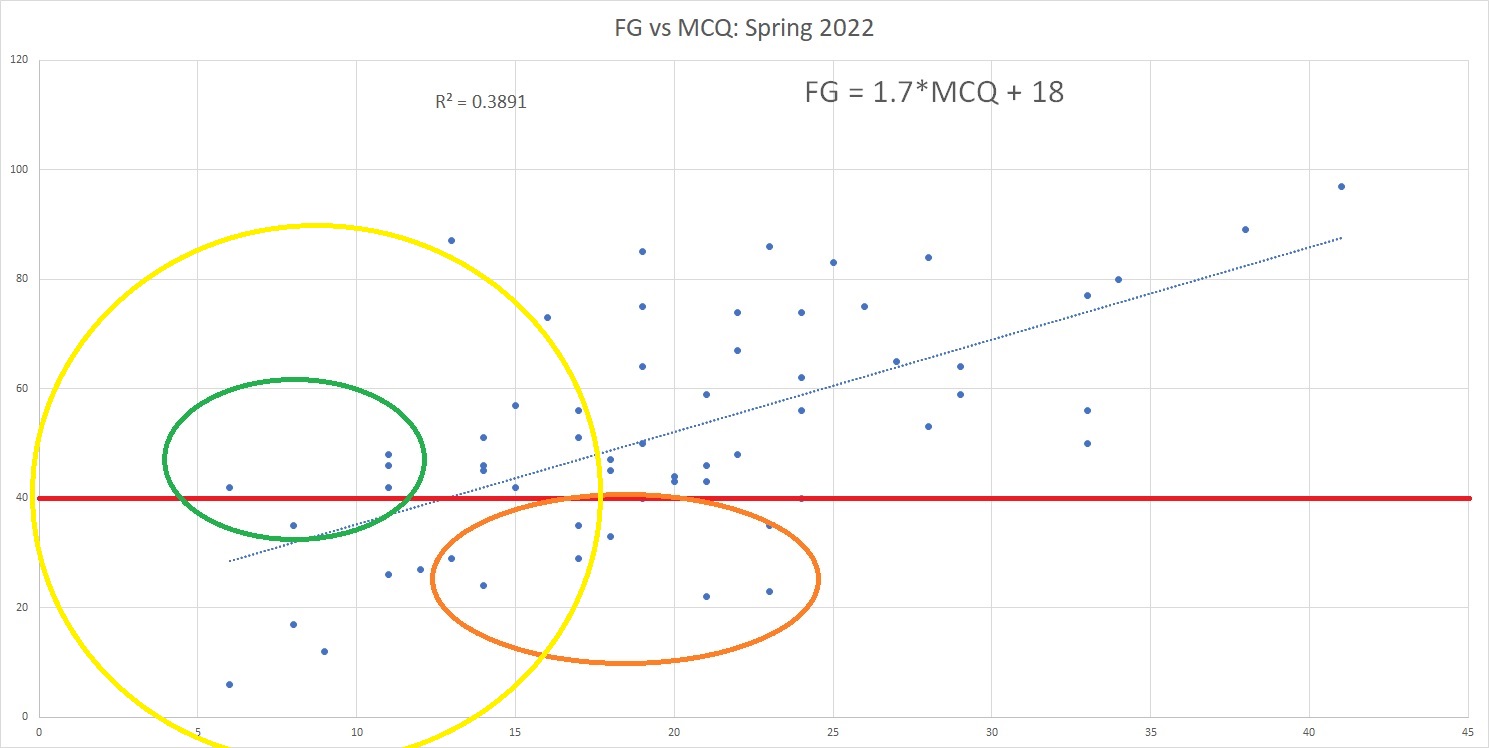
Here is a graph showing the relationship between Concept MCQ Performance and Final Grade:
Week 2
We looked at the Euler Method, and then started looking at big 
In VBA we started programming the Euler Method.
Read the rest of this entry »In the first instance, there is a challenge in that DME2A’s lab takes earlier in the week than I have ever had before. This means that sometimes we might have to rush, or go back and forwards, to do our best to have material covered so that DME2A’s lab can be fruitful for them. They also have their two Bank Holiday labs rescheduled (see below – this also affects DME2E).
Week 1
In Week 1, by briefly looking at a number of examples (many of which we have seen before), we had a review of some central ideas from approximation theory such as approximation, measurement error, accuracy & precision, iteration, convergence, error, etc.
To help DME2A, we looked ahead at the Euler Method,
Then we started looking at where ordinary differential equations come into Engineering. This will continue in Week 2.
In VBA we had a quick review lab, focusing on plotting, the use of a dashboard, and then basic structure of our code:
- Define variables,
- Give variables initial values (from a dashboard),
A do loop that:
- prints the current values of (relevant) variables and
- calculates the next values.
If you have not completed Lab 1 (p.117), I recommend that you do at least up to Debugging to get you back in the VBA groove.
Hopefully, the first MCQ results will be on Canvas on Monday.
Read the rest of this entry »Weeks 9-10
In lectures we finished off the material. The Wednesday of Week 10 will be a tutorial for the second written assessment.
In VBA, in Week 9, students did the first part of Lab 7 (the second part, the arrays, will not be examinable).
In Week 10, some students looked at Lab 8 to help their understanding of the Heat Equation. for Written Assessment 2.
20% VBA Assessment 2
See Canvas for the assessment information.
40% Written Assessment 2
See Canvas for the assessment information.
Week 11
The two lecture slots will be tutorials.
The lab slot will be VBA Assessment 2.
Week 12
Tutorial-like class in the Tuesday lecture. The Written Assessment is 16:00-18:00. There will be no labs.
MCQ League
The final MCQ will (probably) be corrected this week and the cash-money prizes given out after Easter.
Study
Study should consist of
- doing exercises from the notes
- completing VBA exercises
Student Resources
Please see the Student Resources tab on the top of this page for information on the Academic Learning Centre, etc..

 J.P. McCarthy: Math Page
Recent Comments