You are currently browsing the category archive for the ‘C*-Algebras & Operator Theory’ category.

The following is an approach to the maximality conjecture for S_N\subset S_N^+ which asks what happens to a counterexample S_N\subsetneq \mathbb{G}_N\subsetneq S_N^+ when you quotient C(\mathbb{G}_N)\to C(\mathbb{G}_N)/\langle 1-u_{NN}\rangle. If C(\mathbb{G}_N)/\langle 1-u_{NN}\rangle is noncommutative, you generate another counterexample S_{N-1}\subsetneq \mathbb{G}_{N-1}\subsetneq S_{N-1}^+.}

Most of my attempts at using this approach were doomed to fail as I explain below.

Let \mathbb{G}\subseteq S_N^+ be a quantum permutation group with (universal) algebra of continuous functions C(\mathbb{G}) generated by a fundamental magic representation u\in M_N(C(\mathbb{G})). Say that \mathbb{G} is classical when C(\mathbb{G}) is commutative and genuinely quantum when C(\mathbb{G}) is noncommutative.


Definition 1 (Commutator and Isotropy Ideals)

Given \mathbb{G}\subseteq S_N^+, the commutator ideal J_N\subset C(\mathbb{G}) is given by:


\displaystyle J_N=\langle [u_{ij},u_{kl}]\,\mid\, 1\leq i,j,k,l\leq N\rangle.

The isotropy ideal I_N\subset C(\mathbb{G}) is given by:

\displaystyle I_N=\langle 1-u_{NN}\rangle.

Lemma 1

The commutator ideal J_N\subset C(\mathbb{G}) is equal to the ideal

\displaystyle K_N:=\langle u_{i_1j_1}u_{i_2j_2}u_{i_1j_3},u_{i_1j_1}u_{i_2j_2}u_{i_3j_1}\,\mid \, 1\leq i_k,j_k\leq N,\,j_1\neq j_3,i_1\neq i_3\rangle.

Proof:

\begin{aligned} [u_{i_2j_2},u_{i_3j_1}] & =u_{i_2j_2}u_{i_3j_1}-u_{i_3j_1}u_{i_2j_2} \\ \implies u_{i_1j_1}[u_{i_2j_2},u_{i_3j_1}] & = u_{i_1j_1}u_{i_2j_2}u_{i_3j_1}\qquad (i_1\neq i_3)\\ \implies u_{i_1j_1}u_{i_2j_2}u_{i_3j_1} & \in J_N, \end{aligned}
with a similar statement for u_{i_1j_1}u_{i_2j_2}u_{i_1j_3}.

On the other hand:
\begin{aligned} [u_{i_1j_1},u_{i_2j_2}] & =u_{i_1j_1}u_{i_2j_2}-u_{i_2j_2}u_{i_1j_1} \\ & =u_{i_1j_1}u_{i_2j_2}\sum_{k=1}^Nu_{i_1k}-\sum_{l=1}^{N}u_{i_1l}u_{i_2j_2}u_{i_1j_1} \\ & = u_{i_1j_1}u_{i_2j_2}u_{i_1j_1}+u_{i_1j_1}u_{i_2j_2}\sum_{k\neq j_1}u_{i_1j_1}u_{i_2j_2}u_{i_1k}-\\&u_{i_1j_1}u_{i_2j_2}u_{i_1j_1}\sum_{l\neq j_1}u_{i_1l}u_{i_2j_2}u_{i_1j_1}\\ \implies [u_{i_1j_1},u_{i_2j_2}]& \in K_N \end{aligned}

Proposition 1

The commutator and isotropy ideals are Hopf*-ideals. The quotient C(\mathbb{G})\to C(\mathbb{G})/J_N gives a classical permutation group G\subset S_N, the classical version G\subseteq \mathbb{G}, and the quotient C(\mathbb{G})\to C(\mathbb{G})/I_N giving an isotropy quantum subgroup. If \mathbb{G} is classical, this quotient is the isotropy subgroup of N for the action \mathbb{G}\curvearrowright {1,2,\dots,N}.

Via C(S_N^+)\to C(S_N^+)/J_N, the classical permutation group is a quantum subgroup S_N\subset S_N^+. It is conjectured that for all N it is a maximal subgroup.


Theorem 1 (Wang/Banica/Bichon)

S_N\subseteq S_N^+ is maximal for 1\leq N\leq 5.

Read the rest of this entry »

This paper referenced in the title (preprint here) tries to establish some very basic properties of a so-called exotic quantum permutation group, one intermediate to the classical and quantum permutation groups:

\displaystyle S_N\subsetneq \mathbb{G}\subsetneq S_N^+.

If a compact matrix quantum subgroup \mathbb{H}\subseteq \mathbb{G} (here \mathbb{G} is generic, not exotic) given by a quotient \pi:C(\mathbb{G})\to C(\mathbb{H}), is such that for all monomials f in the generators u_{ij}\in C(\mathbb{G}):

\displaystyle h_{C(\mathbb{H})}(\pi(f))=h_{C(\mathbb{G})}(f),

then in fact \mathbb{H}=\mathbb{G}. In the paper above I explored calculating the Haar state on C(S_N^+) using invariances related to the inclusion S_N\subseteq S_N^+… the point being that the Haar measure on exotic \mathbb{G} shares these invariances too… and perhaps, very speculatively, we could show that these Haar states coincide on such monomials… and a famous open problem in the theory would be solved.

The paper above fails at generators of length four though. The invariances do not determine the Haar measure on S_N^+ and we have to include a representation theory result around the law of the main character to give the explicit formulae. If we leave out the representation theory input, we have the Haar state up to a parameter.

However, a very basic algebraic result, that a product of three generators in exotic C(\mathbb{G}) can be zero for trivial reasons only, allows us to put bounds on the Haar state. If these bounds could force the fourth moment of the main character (with respect to the Haar state) to equal 14, then the Haar state on length four monomials would be equal for both. Alas… they only bound them less than or equal to 15. At this point the paper gives up… but this moment is a whole number, either 14 or 15… so I added the relation that the fourth moment is 15… and what comes out is that the parameter above is zero… but when this parameter is zero we find, in exotic \mathbb{G}:

\displaystyle h(|u_{22}u_{11}u_{23}|^2)=0,

but this is not the case, as u_{22}u_{11}u_{23} is not zero for trivial reasons, and the Haar state is faithful… the fourth moment equal to 15 gives classical S_N\subseteq S_N^+. Therefore the fourth moment for exotic \mathbb{G}\subset S_N^+ is forced equal to 14, giving the same explicit formula for length four generators as for S_N^+. Further work needed here.

Idea and Intuition

Let \mathcal{G}=\{g_i\}_{i\geq 1} be a (usually finite) set of generators and \mathcal{R} a (usually finite) set of relations between the generators. The generators at this point are indeterminates, and we will be momentarily vague about what is and isn’t a relation. We write (if it exists!) \mathrm{C}^*(\mathcal{G}\mid \mathcal{R}) for the universal \mathrm{C}^*-algebra generated by generators \mathcal{G} and relations \mathcal{R}.

It has the following universal property. Suppose |\mathcal{G}|=n. Let A be a \mathrm{C}^*-algebra with elements f_1,\dots,f_n that satisfy the relations \mathcal{R}, then there is a (unique) *-homomorphism \mathrm{C}^*(\mathcal{G}\mid\mathcal{R})\to A mapping g_i\mapsto f_i. This map will be a surjective *-homomorphism \mathrm{C}^*(\mathcal{G}\mid\mathcal{R})\to \mathrm{C}^*(f_1,\dots,f_n) (aka a quotient map and \mathrm{C}^*(f_1,\dots,f_n) a quotient of \mathrm{C}^*(\mathcal{G}\mid\mathcal{R})).

If the f_i\in A generate A, \mathrm{C}^*(f_1,\dots,f_n), then \mathrm{C}^*(\mathcal{G}\mid\mathcal{R})\to A is a surjective *-homomorphism.

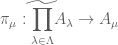
My (highly non-rigourous, the tilde reminding of hand-waving) intuition for this object is that you collect all (really all, not just isomorphism classes, we want below C([0,1]) and e.g. C([0,2]) of \mathrm{C}^*-algebras A_\lambda generated by n generators satisfying the relations \mathcal{R} and forming a “big direct sum/product thingy” out of all of them:

\displaystyle \mathrm{C}^*(\mathcal{G}\mid\mathcal{R})\sim \widetilde{\prod_{\lambda\in \Lambda}}A_\lambda.

Then the *-homomorphism \pi_\mu:A\to A_\mu given by the universal property is given by projection onto that factor (which is a surjective *-homomorphism, a quotient):

\displaystyle\pi_\mu:\widetilde{\prod_{\lambda\in \Lambda}}A_\lambda\to A_\mu.

This intuition works well but we should give a brief account of things are done properly.

First off, not every relation will give a universal \mathrm{C}^*-algebra. For example, consider \mathcal{G}=\{g\} and \mathcal{R}=\{g=g^*\}. The problem here is one of norm. Recall our rough intuition from above. What is the norm on a\in \mathrm{C}^*(\mathcal{G}\mid\mathcal{R}), this big thing \widetilde{\prod_{\lambda\in\Lambda}}A_\lambda? It should be something like, where the norm of A_\lambda is \|\cdot\|_\lambda the supremum over the factors:

\displaystyle \|f\|\sim\sup_{\lambda\in \Lambda}\|\pi_{\lambda}(f)\|_{\lambda}\qquad (f\in \mathrm{C}^*(\mathcal{G}\mid\mathcal{R})).

The first approach to show that \mathrm{C}^*(g\mid g=g^*) does not exist is to consider for each \alpha\in [0,\infty) the \mathrm{C}^*-algebra A_\alpha=C([0,\alpha]) which is singly-generated by the self-adjoint f_\alpha:=t\mapsto t. But the norm \|\cdot \|_\alpha in A_\alpha is the supremum norm, so we find \|f_\alpha\|_{\alpha}=\alpha. From here:

\displaystyle \|g\|\sim\sup_{\lambda\in \Lambda}\|\pi_{\lambda}(g)\|_{\lambda}\geq \sup_{\alpha\in [0,\infty)}\|f_{\alpha}\|_{\alpha}=\sup_{\alpha\in [0,\infty)}\alpha,

which is unbounded. The relations must give a bounded norm to the generators.

As an example of relations that do bound the generators, consider, n self-adjoint generators such that the sum of their squares is the identity:

\displaystyle \mathrm{C}^*\left(g_1,\dots,g_n\mid g_i=g_i^*,\,\sum_i g_i^2=1\right).

These relations bounds the norm of the generators \|g_i\|\leq 11, and this gives existence to this algebra, using the Gelfand philosophy giving the “algebra of continuous functions on the free sphere”, C(\mathcal{S}^{n-1}_+) (I think first considered by Banica and Goswami).

Note here the relations are given by polynomial relations. If the polynomial relations are suitably admissible (i.e. give a bound to the generators), in this setting there is a real construction (real vs our ridiculous \widetilde{\prod}) of \mathrm{C}^*(\mathcal{G}\mid\mathcal{R}). See p.885 (link to *.pdf quantum group lecture notes of Moritz Weber).

In fact, this is only a small class of the possible relations. I suggest there are at least two more types:

  • \mathrm{C}^* relations that would be (admissible) norm relations (for example, in one generator, adding \|g\|\leq 1, a non-polynomial relation, to the polynomial relation g=g^* gives an admissible set of relations, and \mathrm{C}^*(g\mid g=g^*,\|g\|\leq 1)\cong C([-1,1]). For \mathrm{C}^*/norm relations see here and maybe here.
  • (admissible) strong relations (see here for a use of this, with reference)

The constructions in one or both of cases might be constructive, as in the case (admissible) polynomial relations, but there is also an approach using category theory. But the main feature in all such definitions is the universal property, whose use could be summarised as follows:

Let \mathrm{C}^*(\mathcal{G}\mid\mathcal{R}) be a universal \mathrm{C}^*-algebra. The universal property can be used to answer questions about \mathrm{C}^*(\mathcal{G}\mid\mathcal{R}) such as:

  • is some polynomial p(g_1,\dots,g_n) in the generators non-zero,
  • is \mathrm{C}^*(\mathcal{G}\mid\mathcal{R}) infinite dimensional,
  • is \mathrm{C}^*(\mathcal{G}\mid\mathcal{R}) non-commutative;

because, if A is a \mathrm{C}^*-algebra with elements f_1,\dots,f_n that satisfy the relations then there is a unique *-homomorphism \pi:\mathrm{C}^*(\mathcal{G}\mid\mathcal{R})\to \mathrm{C}^*(f_1,\dots,f_n). So, for example, where B is some such \mathrm{C}^*(f_1,\dots,f_n) then

  • if p(f_1,\dots,f_n)\neq 0, then p(g_1,\dots,g_n)\neq 0 as \pi(p(g_1,\dots,g_n))=p(f_1,\dots,f_n),
  • if B is infinite dimensional then \pi is a surjective *-homomorphism onto an infinite dimensional algebra, and so the domain \mathrm{C}^*(\mathcal{G}\mid\mathcal{R}) is infinite dimensional too.
  • if the commutator [f_i,f_j]\neq 0, so that B is non-commutative, then so is \mathrm{C}^*(\mathcal{G}\mid\mathcal{R}) as \pi([g_i,g_j])=[f_i,f_j]

These quotients B can be considered models of \mathrm{C}^*(\mathcal{G}\mid\mathcal{R}).

Two Examples

A projection p in a \mathrm{C}^*-algebra is such that p=p^2=p^*. Consider

A:=\mathrm{C}^*(p,q,1\mid p\text{ and }q\text{ are projections}).

Existence is easy, because the norm of a non-zero projection is one. To answer questions about this algebra consider the infinite dihedral group D_\infty=\langle a,b\mid a^2=b^2=e\rangle. This has group algebra \mathbb{C}D_\infty and group \mathrm{C}^*-algebra \mathrm{C}^*(D_\infty). Note that a and b in \mathrm{C}^*(D_\infty) satisfy the relations of A, and so we have a *-homomorphism (in fact a *-isomorphism) \pi:A\to \mathrm{C}^*(D_\infty). This tells us that any monomial in the generators of A is non-zero, A is infinite dimensional, and A is non-commutative.

A partition of unity is a finite set of projections that sum to the identity, \sum_{i}p_i=1. A magic unitary in a \mathrm{C}^*-algebra A is a matrix u\in M_N(A) such that the entries along any one row or column form a partition of unity. Consider (notation to be kept mysterious):

\displaystyle C(S_N^+)=\mathrm{C}^*\left(u_{ij}\mid u\text{ an }N\times N\text{ magic unitary}\right).

Consider the following magic unitary:

\displaystyle v=\begin{bmatrix}p & 1-p & 0 & 0 \\ 1-p & p & 0 & 0 \\ 0 & 0 & q & 1-q \\ 0 & 0 & 1-q & q\end{bmatrix}.

Note that the v_{ij} satisfy the relations of C(S_N^+) and in fact generate A=\mathrm{C}^*(p,q) from above. Thus we have a quotient \pi:C(S_4^+)\to A which shows that C(S_4^+) is infinite dimensional and noncommutative.

It is possible to show using a magic unitary with entries in M_N(\mathbb{C}) that for N>3, a monomial with entries in u\in M_N(C(S_N^+)) is zero for trivial reasons only (link to *.pdf, from Theorem 1 on).

In addition it can be shown that for u (and similarly v) the matrix in M_N(C(S_N^+)\otimes_{\min} C(S_N^+)) with (i,j)– entries

\displaystyle \sum_{k=1}^Nu_{ik}\otimes u_{kj}

is a magic unitary, and thus by the universal property u_{ij}\mapsto \sum_{k=1}^Nu_{ik}\otimes u_{kj} is a *-homomorphism… the comultiplication giving C(S_N^+) the structure of a compact quantum group.

Commutative Examples

If a universal \mathrm{C}^* algebra is commutative (as in commutativity, [g_i,g_j]=0, is one of the relations, vs the relations imply commutativity, as in C(S_3^+) (nice exercise)), we write \mathrm{C}^*_{\text{comm}}(\mathrm{G}\mid \mathrm{R}). In this case Gelfand’s Theorem, that \mathrm{C}^*_{\text{comm}}(\mathrm{G}\mid \mathrm{R})\cong C(\text{characters}), often allows us to easily identity the algebra (vs the noncommutative case where the universal algebra is mostly studied via models, quotients).

Theorem

If A is a (polynomial) universal commutative \mathrm{C}^*-algebra, then it of the form C(X), and X is given by the tuples (z_1,\dots,z_n)\subset\mathbb{C}^n that satisfy the relations of of A.

Proof: Characters are *-homomorphisms A\to \mathbb{C}.

Suppose that z_1,\dots,z_n satisfy the relations. Then by the universal property, \varphi(g_i)=z_i is a *-homomorphism.

On the contrary, suppose that \varphi is a character. Then the relations are preserved under a *-homomorphism.

Examples

For A_0:=\mathrm{C}_{\text{comm}}^*(p,q,1\mid p\text{ and }q\text{ are projections}), projections in \mathbb{C} are just the scalars zero and one. Thus the spectrum is \{(0,0),(1,0),(0,1),(1,1)\} and A_0 is the algebra of continuous functions on four points.

For \mathrm{C}_{\text{comm}}^*\left(u_{ij}\mid u\text{ an }N\times N\text{ magic unitary}\right) collect the tuple of N^2 generators in a matrix. The relations imply that each such tuple is in fact a permutation matrix, and so the universal algebra above is the algebra of continuous functions on S_N.

For

\displaystyle \mathrm{C}_{\text{comm}}^*\left(g_1,\dots,g_n\mid g_i=g_i^*,\,\sum_i g_i^2=1\right)

you end up with tuples of n real numbers in [-1,1] whose sum of squares is one… otherwise known as the sphere \mathcal{S}^{n-1}.

Liberations

An interesting business here is to start with a universal commutative \mathrm{C}^* algebra, say one of the three examples above… and see do you get something strictly bigger, necessarily non-commutative, if you drop commutativity. In the above, yes you do. Gelfand’s theorem says that a commutative unital \mathrm{C}^*-algebra is the algebra of continuous functions on a compact space X (which we call a classical space). The Gelfand Philosophy says therefore that a noncommutative unital \mathrm{C}^*-algebra A can be thought of as the algebra of continuous functions on a compact quantum space \mathbb{X}. Note here \mathbb{X} is not a set-of-points, but a virtual object, and strictly A=C(\mathbb{X}) is just notation (but see here).

Liberating the second example above from commutativity is the passage from the permutation group S_N to the quantum permutation group S_N^+. Liberating the third example above gives the passage from the real sphere \mathcal{S}^{n-1} to a quantum sphere called the free sphere \mathcal{S}^{n-1}_+.

We can also, of course, work in the other direction, imposing commutativity on not-necessarily universal \mathcal{A}. If we write \mathcal{A}=C(\mathbb{X}), then imposing commutativity (qotienting by commutator ideal) gives us the classical version X of \mathbb{X}.

Imposing commutativity is not so scary: using the above you just get \mathrm{C}^*(\mathcal{G}\mid\mathcal{R})\to C(\text{characters})… and everything we said above about identifying characters on \mathrm{C}_{\text{comm}}^*(\mathcal{G}\mid\mathcal{R}) holds for \mathrm{C}^*(\mathcal{G}\mid\mathcal{R}) too.

This can be used: for example if a quantum group acts on a structure S, then its classical version acts on S. This idea was used by Banica and I to show that not every quantum permutation group is the quantum automorphism group of a finite graph (link to *.pdf).

  1. If you have positive elements f_i in a \mathrm{C}^*-algebra with bounded sum, say \|\sum_i f_i\|\leq C then we can bound the summands \|f_i\|\leq C. Write \sum_if_i=f. Note f is positive with norm C. Let \varphi be a state such that \varphi(f_j)=\|f_j\| and apply this to f, \varphi(\sum_i f_i)=\varphi(f) which yields, with \varphi bounded of norm one, \varphi(f_j)+\sum_{i\neq j}\varphi(f_i)\leq C. The result follows by positivity of the sum and the state. To apply to the above play with the \mathrm{C}^* identity. Incidentally, I cannot remember how Murphy proves the existence of \varphi but I like for positive f in a \mathrm{C}^*-algebra, \mathrm{C}^*(f)\cong C(\sigma(f)). Then let x:=\max_{\lambda\in\sigma(f)}\lambda and define a state \mathrm{ev}_x on \mathrm{C}^*(f)\cong C(\sigma(f)). It is the case that \mathrm{ev}_x(f)=f(x)=\|f\|_{C(\sigma(f))}=x, also equal to the norm of f in the ambient algebra (by a spectral radius theorem). Extend the evaluation functional to the whole algebra by Hahn-Banach. ↩︎

I am or rather was interested in the following problem: while we cannot hope to measure with infinite precision in the real world, in the mathematical world can I measure a continuous-spectrum self-adjoint operator given a fixed state? That is measure it with infinite precision?

Let A=:C(\mathbb{X}) be a unital \mathrm{C}^*-algebra, and \varphi\in\mathcal{S}(C(\mathbb{X})) a state on it… actually I will use the Gelfand–Birkhoff picture:

\varphi\in \mathbb{X} \iff \varphi\in\mathcal{S}(C(\mathbb{X}))

Note that \varphi has an extension to a \sigma-weakly continuous state \omega_\varphi on the bidual, C(\mathbb{X})^{**}. The algebra C(\mathbb{X}) sits isometrically in the bidual: the bidual as a von Neumann algebra contains the spectral projections of any self-adjoint f\in C(\mathbb{X}). We use the notation \mathbf{1}_E(f) for Borel E\subseteq\sigma(f).

Let \varepsilon> 0. Define:

p_\varepsilon(f)=\mathbf{1}_{(\lambda-\varepsilon,\lambda+\varepsilon)}(f).

Suppose for a state \varphi\in\mathbb{X} that for all \varepsilon>0:

\omega_\varphi(p_\varepsilon(f))>0.

(the situation where \omega_\varphi(p_\varepsilon(f))=0 will be moot).

Then we want to consider the entity:

\displaystyle \varphi_\lambda(g)=\lim_{\varepsilon\to0^+}\frac{\omega_\varphi(p_\varepsilon(f)gp_\varepsilon(f))}{\omega_\varphi(p_\varepsilon(f)}\qquad (g\in C(\mathbb{X})).

If this limit exists then it is a state.

Alas, this limit does not exist in general. There is a commutative counterexample by Nik Weaver on MO, which we will share here.

Let A=L^{\infty}([0,1]) and f\in A given by f(x)=x and \varphi integration against Lesbesgue measure. Let \lambda=0 and p_{\varepsilon}=\mathbf{1}_{[0,\varepsilon)}.

Define

\displaystyle S=\bigcup_{n=0}^{\infty} [10^{-(2n+1)},10^{-2n}],

and g=\mathbf{1}_S, an element of L^{\infty}([0,1]).

Consider \varphi_0(g) and let \varepsilon =10^{-2m}, with m\in \mathbb{N}. It is possible to show that in this case:

\displaystyle \frac{\varphi(p_\varepsilon gp_\varepsilon)}{\varphi(p_\varepsilon)}=\frac{90}{99}.

However, at \varepsilon=10^{-(2m+1)}, we get 1/99. This means that the limit \varphi_0 above does not exist.

Now, without proof we could expect that for A=C([0,1]), and the same f and \varphi, we could expect that in fact \varphi_0 exists, and \varphi_0(g)=g(0).

The problem here is that for L^{\infty}([0,1]), functions that disagree on a set of measure zero are identified and in general g(0) does not make sense for g\in L^\infty([0,1]).

The best we can do is measure f\in C(\mathbb{X}) up to tolerance \varepsilon>0. Say we measure f\in(\lambda-\varepsilon,\lambda+\varepsilon) with a state \varphi\in \mathbb{X}. Then we get conditioning of \varphi to a state:

\displaystyle \varphi_{\lambda,\varepsilon}(g)=\frac{\varphi(p_{\varepsilon}gp_{\varepsilon})}{\varphi(p_{\varepsilon})}\qquad (g\in C(\mathbb{X}))

In the commutative case, this is giving the average of g on the interval (\lambda-\varepsilon,\lambda+\varepsilon).

I had hoped to use \varphi_\lambda to explain why classical spheres don’t admit quantum symmetry. Alas the above means my argument probably cannot work (well, maybe I can use the \varepsilon of room?)

Perhaps we could try and understand in which \mathrm{C}^*-algebras the state \varphi_\lambda is well-defined… but we can say at least for today that we cannot measure continuous observables with infinite precision… even mathematically.

…and why it doesn’t work for a quantum alternating group

Despite problems around its existence being well-known, the Google search “quantum alternating group” only gets one (relevant) hit. This is to a paper of Freslon, Teyssier, and Wang, which states:

We therefore have to resort to another idea, which is to compare the process with the so-called pure quantum transposition random walk and prove that they asymptotically coincide. This is a specifically quantum phenomenon connected to the fact that the pure quantum transposition walk has no periodicity issue because there is no quantum alternating group.

Let us explain this a little. Take a deck of N cards, say in some known order. What we are going to do is take two (different) cards at random, and swap them. The question is, does this mix up the deck of cards? What does this question mean? Let \xi_k\in S_{N} be the order of the cards after k of these pure random transposition shuffles. If the shuffles mix up the cards then:

\displaystyle \lim_{k\to\infty}\mathbb{P}[\xi_k=\sigma]=\frac{1}{N!}\qquad(\sigma\in S_{N}).

The random variable \xi_k is a product of k transpositions and using the sign group homomorphism:

\mathrm{sgn}(\xi_k)=(-1)^k.

Take a permutation \sigma\in S_N of odd sign, then:

\displaystyle \lim_{k\to\infty}\mathbb{P}[\xi_{2k}=\sigma]=0,

and so this pure random transposition shuffle cannot mix up the deck of cards. The order of the deck alternates (geddit) between \xi_{2k}\in A_N, the alternating group, and \xi_{2k+1}\in A_N^c, the complement of A_N in S_N (if we allow the two cards to be chosen independently, so that there is a chance we pick the same card twice, and do a do-nothing shuffle, then this barrier disappears and this random transposition shuffle does mix up the cards. See Diaconis & Shahshahani).

Amaury Freslon instigated a study of a quantum version of the above random walk. The probability distribution of the shuffles above is:
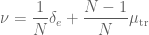
\displaystyle \nu=\frac{1}{N}\delta_e+\frac{N-1}{N}\mu_{\text{tr}}.

The measure \mu_{\text{tr}} is the measure uniform on transpositions in S_{N}. No such measure makes direct sense in the quantum setting, but if we recast this measure as the measure constant on permutations with N-2 fixed points there is a direct analogue, \varphi_{N-2} (see Section 4 for details).

If u\in M_N(C(S_N^+)) is the fundamental representation, and u^c=[\mathbf{1}_{j\to i}]_{i,n=1,...,N}, an element of M_N(C(S_N)), the entry-wise abelianisation, the trace \mathrm{tr}(u^c)\in C(S_N) counts the number of fixed points. The functions \mathbf{1}_{j\to i} asking of a permutation, do you map j\to i? One for yes, zero for no:

\displaystyle \mathrm{tr}(u^c)(\sigma)=\sum_{k=1}^N\mathbf{1}_{k\to k}(\sigma)=\text{ number of fixed points in }\sigma.

Freslon’s \varphi_{N-2} can be thought of as the measure uniform on those quantum permutations that satisfy \mathrm{tr}(u)=N-2.

If you shuffle according to classical \mu_{\text{tr}}, you meet the periodicity issue associated with \mathrm{sgn}. However, there is no such periodicity issue in the quantum case, because there is nothing analogous to a quantum sign homomorphism:

\mathrm{sgn}^+:S_N^+\to\{-1,1\}.

The classical alternating group is:

\displaystyle A_N=\{\sigma\in S_N\,\colon\,\mathrm{sgn}(\sigma)=1\},

but with no quantum sign, we don’t seem to be able to define a quantum alternating group in the same way.

This is related to difficulties around the determinant (equal to the sign for permutation matrices). I think, but would have to check, that we can quotient C(S_N) by the relation \mathrm{det}(u^c)=1, and you get C(A_N) in that case… but problems with the determinant mean this cannot happen in the quantum case.

Private communication has shown me a proof that if you quotient any compact matrix quantum group with \mathrm{det}(u)=1, then you get a commutative algebra, that is, a classical group. In particular,

\displaystyle C(S_N^+)/(\mathrm{det}(u)=1)=C(A_N),

and not something non-commutative, corresponding to a quantum alternating group C(A_N^+).

Another way?

This no-go result, which is cool but unpublished, doesn’t rule out a quantum alternating group of the form:

\displaystyle A_N\subsetneq A_N^+\subsetneq S_N^+.

There is indeed for every N a genuine quantum group \mathbb{G}_N with A_N\subsetneq \mathbb{G}_N, but this quantum group does not sit nicely as a quantum subgroup of S_N^+ (from here, Section 4).

Given a quantum permutation group \mathbb{G}\subset S_N^+, the set of characters on universal C(\mathbb{G}) forms a group G, the classical version of \mathbb{G}. The group law is convolution:

\displaystyle \varphi_1\star\varphi_2=(\varphi_1\otimes\varphi_2)\Delta.

I have a particular interest in characters, and have a pre-print (Section 4) doing some analysis on them. Let \varphi:C(\mathbb{G})\to \mathbb{C} be a character. Then, applying what I call the Birkhoff slice (Section 4.1), \Phi:\mathcal{S}(C(\mathbb{G}))\to M_N(\mathbb{C}), applying a state to the fundamental magic representation component-wise, gives a permutation matrix:

\displaystyle \Phi(\varphi)=P_\sigma\qquad (\sigma\in S_N).

In this case we write \varphi=\mathrm{ev}_\sigma, and where \pi_{\text{ab}} is the abelianisation, u_{ij}\mapsto \mathbf{1}_{j\to i}:

\displaystyle \mathrm{ev}_\sigma(f)=\pi_{\text{ab}}(f)(\sigma)\qquad (f\in C(\mathbb{G})).

The characters have support projections, and these in general do not live in C(\mathbb{G}) but in the bidual C(\mathbb{G})^{**}. These support projections live in the strong closure of C(\mathbb{G}) in its bidual. Briefly, let:

f_\sigma=u_{\sigma(1),1}u_{\sigma(2),2}\cdots u_{\sigma(N),N}.

(as an aside, if we transpose in f_{\sigma} the indices, so u_{k,\sigma(k)} instead of u_{\sigma(k),k}, then \mathrm{det}(u)=\sum_{\sigma\in S_N}\mathrm{sgn}(\sigma)f_\sigma.)

It turns out that the support projection p_\sigma of \mathrm{ev}_\sigma is the strong limit of (f_\sigma^n)_{n\geq 1}and if (f_\tau^n)_{n\geq 1} converges to zero… then \mathrm{ev}_{\tau} is zero, not a character, and \tau is not in the classical version of \mathbb{G}.

Enter this talk by Gilles Gonçalves De Castro (Universidade Federal de Santa Catarina, Brazil), who teaches us with his coauthor Giulioano Boava that it is possible to include (admissible) strong as well as norm relations in defining a universal \mathrm{C}^*-algebra.

An idea!

So, why not take S_N^+, or rather C(S_N^+), and quotient out the characters in the complement of A_N in S_N? We can do this via the relations p_\tau=0 for \tau\in A_N^c, they are admissible. So… define the following algebra:

\displaystyle C(A_N^+)=C(S_N^+)/\langle p_\tau=0,\,\tau\in A_N^c\rangle

There is a lot of work to do here to prove that this is a quantum group… have we a *-homomorphism \Delta(u_{ij})=\sum_{k=1}^N u_{ik}\otimes u_{kj}? But at least we have a candidate algebra.

Failure

Actually we don’t. In fact, either the algebra does not admit a quantum group structure OR

C(A_N^+)=C(S_N^+),

Unfortunately, because of non-coamenability issues, lots of algebras of continuous functions on quantum permutation groups also have p_\sigma=0 for all \sigma\in S_{N}… not because they have no classical versions, but because classical versions are defined on the universal level… where there are always characters… at the reduced level the algebras admit no characters.

In particular, the reduced algebra of functions C_{\text{r}}(S_N^+) satisfies p_\sigma=0 for all \sigma\in S_N, and so, if we assume that C(A_N^+) DOES have a quantum group structure, we have a comultiplication preserving quotient:

C(A_N^+)\to C_{\text{r}}(S_N^+).

Then with the help of J. De Ro, this means we have a Hopf*-algebra morphism on the level of the dense Hopf*-algebras, saying that S_N^+ is a quantum subgroup of A_N^+. But of course this A_N^+ is a quantum subgroup of S_N^+ and so it follows in this case that the two quantum groups coincide.

This isn’t a great no-go theorem: but a log of something that doesn’t work. And of course this approach doesn’t work for any subgroup of S_N.

I gave the same talk to the Non local games seminar and C*-Days in Prague:

Abstract: The first part of the talk will give a post hoc motivation for Banica’s 2005 definition of the quantum automorphism group of a finite graph, and in doing so attempt to build a good intuition for quantum automorphism. Frucht in 1939 showed that every finite group is the automorphism group of a finite graph, and a natural  pursuit in the theory of quantum automorphism groups is to establish quantum analogues of this result.  Based  on a joint work with Banica, the second part of the talk will address this question.

Slides below, video here from the Prague NCGT Group’s YouTube:

The slides are subtly different: the one for C*-Days is the latest version:

Abstract: Using a suitably non-commutative flat matrix model, it is shown that the quantum permutation group has free orbitals: that is, a monomial in the generators of the algebra of functions can be zero for trivial reasons only. It is shown that any strict intermediate quantum subgroup between the classical and quantum permutation groups must have free three orbitals, and this is used to derive some elementary bounds for the Haar state on degree four monomials in such quantum permutation groups.

Link to arXiv

Abstract: Woronowicz proved the existence of the Haar state for compact quantum groups under a separability assumption later removed by Van Daele in a new existence proof. A minor adaptation of Van Daele’s proof yields an idempotent state in any non-empty weak*-compact convolution-closed convex subset of the state space. Such subsets, and their associated idempotent states, are studied in the case of quantum permutation groups.

Link to arxiv.

BCRI Mini-Symposium: Noncommutative Probability & Quantum Information

Monday, 10th October 2022 from 12:00 to 15:00

Organizers: Claus Koestler (UCC), Stephen Wills (UCC)

SPEAKER: J.P. McCarthy (Munster Technological University)
TITLE: The Kawada-Itô theorem for finite quantum groups.
ABSTRACT: Necessary and sufficient conditions for a Markov chain to be ergodic are that the chain is irreducible and aperiodic. This result is manifest in the case of random walks on finite groups by a statement about the support of the driving probability: a random walk on a finite group is ergodic if and only if the support is not concentrated on a proper subgroup, nor on a coset of a proper normal subgroup. The study of random walks on finite groups extends naturally to the study of random walks on compact quantum groups, where a state on the algebra of functions plays the role of the driving probability. A random walk on a compact quantum group can fail to be irreducible without being concentrated on a proper quantum subgroup. In this talk we will explore this phenomenon. Time allowing, we will talk about periodicity, and as a conclusion, I give necessary and sufficient conditions for ergodicity of a random walk on a finite quantum group in terms of the support projection of the driving state.

In the end the talk (below) didn’t quite match the abstract.

Quantum Group Seminar, Monday 24 January, 2022.

Abstract: A classical theorem of Frucht states that every finite group is the automorphism group of a finite graph. Is every quantum permutation group the quantum automorphism group of a finite graph? In this talk we will answer this question with the help of orbits and orbitals.

This talk is based on joint work with Teo Banica.