
Updated on May 24th 2011.
The results are down the bottom. You are identified by the last three digits of your student number. If there is a zero is means that you did not write down your student number. The results are in alphabetical order but if you are unsure email me and I will tell you what you got.
The scores are itemized as you can see. At the bottom there are some average scores. Finally the last column displays your Continuous Assessment mark for Test 2 (out of 15).
If you would like to see your paper or have it discussed please email me at jippo@campus.ie
|
St No |
One |
Two |
Three |
Four |
Five |
Six |
/40 |
% |
CA/15 |
||
|
390 |
10 |
5 |
10 |
3 |
5 |
2 |
35 |
88 |
13.2 |
||
|
000 |
10 |
5 |
10 |
3 |
3 |
4 |
35 |
88 |
13.2 |
||
|
928 |
7 |
4 |
9 |
5 |
5 |
5 |
35 |
88 |
13.2 |
||
|
136 |
10 |
5 |
10 |
2 |
0 |
4 |
31 |
78 |
11.7 |
||
|
669 |
10 |
5 |
8 |
3 |
1 |
0 |
27 |
68 |
10.2 |
||
|
784 |
9 |
5 |
10 |
0 |
2 |
0 |
26 |
65 |
9.75 |
||
|
051 |
10 |
5 |
5 |
3 |
1 |
2 |
26 |
65 |
9.75 |
||
|
817 |
9 |
5 |
5 |
3 |
0 |
2 |
24 |
60 |
9 |
||
|
417 |
9 |
5 |
4 |
3 |
2 |
1 |
24 |
60 |
9 |
||
|
933 |
9 |
2 |
10 |
0 |
0 |
0 |
21 |
53 |
7.95 |
||
|
175 |
5 |
5 |
10 |
0 |
0 |
0 |
20 |
50 |
7.5 |
||
|
465 |
6 |
2 |
9 |
0 |
0 |
0 |
17 |
43 |
6.45 |
||
|
000 |
9 |
2 |
2 |
0 |
0 |
0 |
13 |
33 |
4.95 |
||
|
917 |
0 |
2 |
4 |
0 |
0 |
0 |
6 |
15 |
2.25 |
||
|
812 |
3 |
0 |
3 |
0 |
0 |
0 |
6 |
15 |
2.25 |
||
|
828 |
2 |
1 |
5 |
0 |
0 |
0 |
8 |
20 |
3 |
||
|
163 |
5 |
4 |
5 |
3 |
0 |
4 |
21 |
53 |
7.95 |
||
|
953 |
3 |
2 |
0 |
0 |
0 |
0 |
5 |
13 |
1.95 |
||
|
513 |
2 |
0 |
2 |
0 |
0 |
0 |
4 |
10 |
1.5 |
||
|
000 |
2 |
0 |
0 |
0 |
0 |
0 |
2 |
5 |
0.75 |
||
|
Ave |
6.5 |
3.2 |
6.05 |
1.4 |
0.95 |
1 |
19 |
49 |
7.275 |
||
|
Ave % |
65 |
64 |
60.5 |
28 |
19 |
24 |
|
|
|
||
 be normal elements of a C*-algebra
  , and
, and  an element of
  . Show that
  , using Fuglede’s theorem and the fact that the element
 and commutes with
 .
. is a normal element commuting with some
  , then
  also commutes with
  using the normality of
  . We can also show that
  and
and  commute. Hence by the theorem
  commute. This yields:
 .
. ,
,
 .
. .
. by hand (or by memory or by the Binomial Theorem (in tables)) to get:
 .
. instead of
  . To get a nice inverse Laplace transform symbol I have to type \mathcal{L}^{-1} — along with some dollar signs and I’m sick of it! — no keyboard shortcuts on this page — the notes have shortcuts.)
 .
. .
.
 .
. .
. .
.
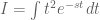 .
. and
and  . Now
. Now , and
, and .
. is a constant and it will be handy to have it out the front so it can be easily taken out of an integral (
 .) Hence using the integration by parts formula:
 .
.
 .
. :
: .
.
 .
. between the limits
  and
and  :
: .
. :
: .
. .
. term disappears so we have a differential equation in
  and
and  — in other words a function and it’s derivative. This can then be integrated in the usual way.
 is a solution to the second order ODE
 (*)
(*) and
and  . Hence

 is a solution.
 J.P. McCarthy: Math Page
Recent Comments