The purpose of this post is to briefly discuss parallelism and perpendicularity of lines in both a geometric and algebraic setting.
Lines
What is a line? In Euclidean Geometry we usually don’t define a line and instead call it a primitive object (the properties of lines are then determined by the axioms which refer to them). If instead points and line segments – defined by pairs of points  –
– ![[PQ]](https://s0.wp.com/latex.php?latex=%5BPQ%5D&bg=ffffff&fg=545454&s=0&c=20201002) are taken as the primitive objects, the following might define lines:
are taken as the primitive objects, the following might define lines:
Geometric Definition Candidate
A line,  , is a set of points with the property that for each pair of points in the line,
  ,
,
![[PQ]\cap \ell=[PQ]](https://s0.wp.com/latex.php?latex=%5BPQ%5D%5Ccap+%5Cell%3D%5BPQ%5D&bg=ffffff&fg=545454&s=0&c=20201002) .
.
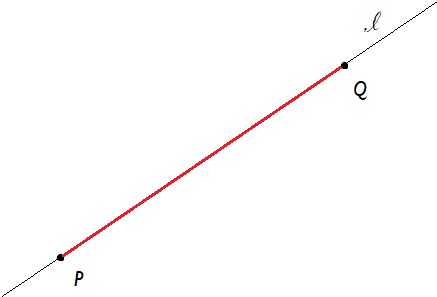
In terms of a picture this just says that when you have a line, that if you take two points in the line (the language in comes from set theory), that the line segment is a subset of the line:
Exercise:
Why is this objectively not a good definition of a line.
Once we move into Cartesian\Coordinate Geometry we can perhaps do a similar trick. We can use line segments, and their lengths to define slope, (slope = rise over run) and then define a line as follows:
Algebraic Definition Candidate
A line, , is a set of points such that for all pairs of distinct points  , the slope is a constant.
This means that if you take two pairs of distinct points in a line , and then calculate the slopes between them, you get the same answer, and therefore it makes sense to talk about the slope of a line,  .
.
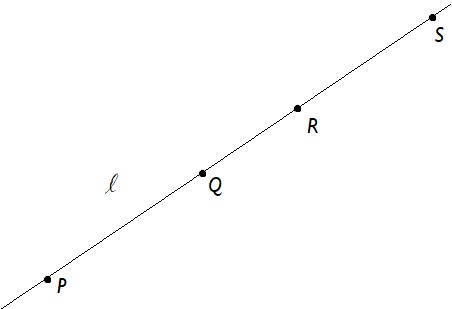
This definition, however, has exactly the same problem as the previous. The definition we use isn’t too important but I do want to use a definition that considers the line a set of points.
The Equation of a Line
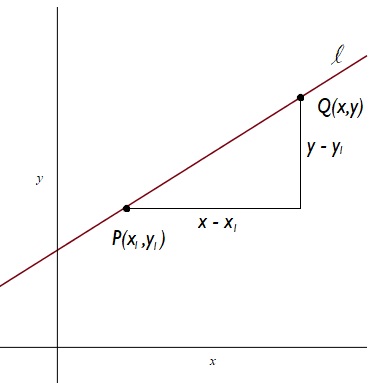
We can use such a definition to derive the equation of a line ‘formula’ for a line of slope containing a point  .
.
Suppose first of all that we have an  axis and a point
  in the line. What does it take for a second point
  to be in the line?
Read the rest of this entry »


 J.P. McCarthy: Math Page
Recent Comments