
You are currently browsing the category archive for the ‘General’ category.
The Binomial Theorem is easier and more naturally proven in a combinatorics context but can be proven by induction.
Problem: Prove the Binomial Theorem by Induction.
Solution: Let 


(Binomial Theorem)


(
Now assume 

Now


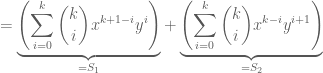
Now all terms are of the form 


![x^{k+1-j}y^j\left[{k\choose j}+{k\choose j-1}\right]](https://s0.wp.com/latex.php?latex=x%5E%7Bk%2B1-j%7Dy%5Ej%5Cleft%5B%7Bk%5Cchoose+j%7D%2B%7Bk%5Cchoose+j-1%7D%5Cright%5D&bg=ffffff&fg=545454&s=0&c=20201002)
![\Rightarrow (x+y)^{k+1}=\sum_{i=0}^{k+1}\left[{k\choose j}+{k\choose j-1}\right]x^{k+1-j}y^j](https://s0.wp.com/latex.php?latex=%5CRightarrow+%28x%2By%29%5E%7Bk%2B1%7D%3D%5Csum_%7Bi%3D0%7D%5E%7Bk%2B1%7D%5Cleft%5B%7Bk%5Cchoose+j%7D%2B%7Bk%5Cchoose+j-1%7D%5Cright%5Dx%5E%7Bk%2B1-j%7Dy%5Ej&bg=ffffff&fg=545454&s=0&c=20201002)
It is a straightforward exercise to show:

Hence

(


MATH6037 please skip to the end of this entry.
The sum, product and quotient rules show us how to differentiate a great many different functions from the reals to the reals. However some functions, such as 

Proposition 4.1.8 (Chain Rule)
Let 


Here we present the proof of assertions 3. and 4. of the following proposition. The proofs of 1. and 2. will be presented in class and here they are assumed. The proofs presented here will not be presented in class.
Proposition 3.1.4 (Calculus of Limits)
Suppose that 


for some 
-
.
- If
,
.
.
- If
,
.
- If
then
.
- Read the rest of this entry »
How can a statement like “5 is greater than 4” be quantified? Or is it just obvious? If we know anything about mathematics we know that there is no way we can assume something as obvious, there must be an axiomatical contruct that puts a rigorous meaning on “5 is greater than 4“.
The first attempt would be to say that 5=4+1 so 5 is “1 more” than 4 so must be bigger. This translates to 5-4=1: “5 is greater than 4 because 5-4 is positive“. Careful! 4=5+(-1) so 4-5=-1: “4-5 is negative“. But what does positive and negative mean? Easy? Positive is greater than zero… At this point a stronger construct is needed:
Definition: Call a set 

- Given
either
,
or


If we think carefully, this definition concurs exactly with that of the naive notion of positive. So we can say that “5 is greater than 4 because 5-4 is positive.”
Definition: Given 


 J.P. McCarthy: Math Page
Recent Comments