You are currently browsing the category archive for the ‘Research’ category.

Taken from Random Walks on Finite Quantum Groups by Franz & Gohm.

To motivate the definition of quantum Markov chains let us start with a reformulation of the classical Markov chain. Let M,\,G be finite sets. Any map b:M\times G\rightarrow M may be called an action of G on M. Let F(M) and F(G) be the *-algebra of complex functions on M and G. For all g\in G, we have unital *-homomorphisms (\checkmark) \alpha_g:F(M)\rightarrow F(M) given by (\alpha_g f)(x):=f(b(x,g)). They can be put together into a single unital *-homomorphism

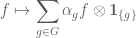
\displaystyle\beta:F(M)\rightarrow F(M)\otimes F(G)\displaystyle f\mapsto \sum_{g\in G}\alpha_g f\otimes\mathbf{1}_{\{g\}},

where \mathbf{1}_{\{g\}} is the indicator function. We get a natural non-commutative generalisation just by allowing the algebras to become non-commutative (by replacing the C*-algebras F(M) and F(G) by more general (!), not necessarily commutative C*-algebras).

Let B and A be unital C*-algebras and \beta:B\rightarrow B\otimes A a unital *-homomorphism. Here B\otimes A is the spatial tensor product. Then we can build up the following iterative scheme for n\geq 0:

j_0:B\rightarrow Bb\mapsto b

j_1:B\rightarrow B\otimes Ab\mapsto\beta(b)=b_{(0)}\otimes a_{(0)}.

(Sweedler’s notation b_{(0)}\otimes b_{(1)} stands for \sum_i b_{0i}\otimes b_{1i} and is very convenient for writing formulas).

\displaystyle j_n:B\rightarrow B\otimes\bigotimes_{1}^nAj_n=(j_{n-1}\otimes I_A)\circ\beta,

\displaystyle b\mapsto j_{n-1}(b_{(0)})\otimes b_{(1)}\in \left(B\otimes\bigotimes_1^{n-1}A\right)\otimes A.

Read the rest of this entry »

Taken from C*-algebras and Operator Theory by Gerald Murphy.

If H and K are vector spaces, we denote by H\otimes K their algebraic tensor product. This is linearly spanned by the elements x\otimes y (x\in Hy\in K).

One reason why tensor products are useful is that they turn bilinear maps (a bilinear map \varphi has \lambda\varphi(x,y)=\varphi(\lambda x,y)=\varphi(x,\lambda y)) into linear maps (\lambda\varphi(x,y)=\varphi(\lambda x,\lambda y)). More precisely, if \varphi:H\times K\rightarrow L is a bilinear map, where H,\,K and L are vector spaces, then there is a unique linear map \varphi_1:H\otimes K\rightarrow L such that \varphi_1(x\otimes y)=\varphi(x,y) for all x\in H and y\in K.

If \rho,\,\tau are linear functionals on the vector spaces H,\,K respectively, then there is a unique linear functional \rho\otimes\tau on H\otimes K such that

(\rho\otimes\tau)(x\otimes y)=\rho(x)\tau(y)

since the function

H\times K\rightarrow\mathbb{C}(x,y)\mapsto \rho(x)\tau(y),

is bilinear.

Suppose that the finite sum \sum_jx_j\otimes y_j=0, where x_j\in H and y_j\in K. If y_1,\dots,y_n are linearly independent, then x_1=\cdot=x_n=0. For, in this case, there exist linear functionals \rho_j:K\rightarrow \mathbb{C} such that \rho_j(y_i)=\delta_{ij}. If \rho:H\rightarrow\mathbb{C} is linear, we have

0=(\rho\otimes \rho_j)(\sum_i x_j\otimes y_j)=\sum_i\rho(x_i)\rho_j(y_i)=\rho(x_j).

Thus \rho(x_j)=0 for arbitrary \rho and this shows that all the x_j=0.

Similarly if the finite sum \sum_jx_j\otimes y_j=0 with the x_j linearly independent, implies that all the y_j are zero.

Read the rest of this entry »

Taken from C*-algebras and Operator Theory by Gerald Murphy.

We prepare the way for the density theorem with some useful results on strong convergence.

Theorem 4.3.1

If H is a Hilbert space, the involution T\mapsto T^* is strongly continuous when restricted to the set of normal operators of B(H).

Proof

Let x\in H and suppose that T,S are normal operators in B(H). Then

\|(S^*-T^*)(x)\|^2=\langle S^*x-T^*x,S^*x-T^*x\rangle

=\|Sx\|^2-\|Tx\|^2+\langle TT^*x,x\rangle-\langle ST^*x,x\rangle

+\langle TT^*x,x\rangle-\langle TS^*x,x\rangle

=\|Sx\|^2-\|Tx\|^2+\langle (T-S)T^*x,x\rangle+\langle x,(T-S)T^*x\rangle

\leq \|Sx\|^2-\|Tx\|^2+2\|(T-S)T^*x\|\|x\|.

If \{T_\lambda\}_{\lambda\in\Lambda} is a net of normal operators strongly convergent to a normal operator T, then the net \|T_\lambda x\|^2 is convergent to \|Tx\|^2 and the net \{(T-T_\lambda)T^*x\} is convergent to 0, so \{T_\lambda^*x-T^*x\} is convergent to 0. Therefore, \{T_\lambda^*\} is strongly convergent to T^* \bullet

Read the rest of this entry »

Taken from C*-algebras and Operator Theory by Gerald Murphy.

Preparatory to our introduction of the weak and ultraweak topologiesm we show now that L^1(H) is the dual of K(H), and B(H) is the dual of L^1(H).

Let H be a Hilbert space, and suppose that T\in L^1(H). It follows from Theorem 2.4.16 (https://jpmccarthymaths.wordpress.com/2011/01/18/c-algebras-and-operator-theory-2-4-compact-hilbert-space-operators/) that the function

\text{tr}(T\cdot):K(H)\rightarrow\mathbb{C}S\mapsto \text{tr}(TS),

is linear and bounded, and \|\text{tr}(T\cdot)\|\leq \|T\|. We therefore have a map

L^1(H)\rightarrow K(H)^\starT\mapsto \text{tr}(T\cdot),

which is clearly linear and norm-decreasing. We call this map the canonical map from L^1(H) to K(H)^\star.

Theorem 4.2.1

If H is a Hilbert space, then the canonical map from L^1(H) to K(H)^\star is an isometric linear isomorphism.

Read the rest of this entry »

Taken from C*-algebras and Operator Theory by Gerald Murphy.

A useful way of thinking of the theory of C*-algebras is as “non-commutative topology”. This is justified by the correspondence between abelian C*-algebras and locally compact Hausdorff spaces given by the Gelfand representation. The algebras studied in this chapter, von Neumann algebras, are a class of C*-algebras whose study can be thought of as “non-commutative measure theory”. The reason for the analogy in this case is that the abelian von Neumann algebras are (up to isomorphism) of the form L^\infty(\Omega,\mu), where (\Omega,\mu) is a measure space.

The theory of von Neumann algebras is a vast and very well-developed area of the theory of operator algebras. We shall be able only to cover some of the basics. The main results of this chapter are the von Neumann double commutant theorem and the Kaplansky density theorem.

Read the rest of this entry »

Question 1

Let a,b be normal elements of a C*-algebra A, and c an element of A such that ac=cb. Show that a^*c=cb^*, using Fuglede’s theorem and the fact that the element

d=\left(\begin{array}{cc}a &0\\ 0&b\end{array}\right)

is normal in M_2(A) and commutes with

d'=\left(\begin{array}{cc} 0&c\\ 0&0\end{array}\right).

This more general result is called the Putnam-Fuglede theorem.

Solution

Fuglede’s theorem states that if a is a normal element commuting with some b\in A, then b^* also commutes with a. Now we can show that d^*d=d^*d using the normality of a and b. We can also show that d and d' commute. Hence by the theorem d and d^* commute. This yields:

bc^*=c^*a.

Taking conjugates:

cb^*=a^*c,

as required \bullet

Read the rest of this entry »

In this section we introduce the important GNS construction and prove that every C*-algebra can be regarded as a C*-subalgebra of B(H) for some Hilbert space H. It is partly due to this concrete realisation of the C*-algebras that their theory is so accessible in comparison with more general Banach spaces.

A representation of a C*-algebra A is a pair (H,\varphi) where H is a Hilbert space and \varphi:A\rightarrow B(H) is a *-homomorphism. We say (H,\varphi) is faithful if \varphi is injective.

Read the rest of this entry »

For abelian C*-algebras we were able to completely determine the structure of the algebra in terms of the character space, that is, in terms of the one-dimensional representations. For the non-abelian case this is quite inadequate, and we have to look at representations of arbitrary dimension. There is a deep inter-relationship between the representations and the positive linear functionals of  a C*-algebra. Representations will be defined and some aspects of this inter-relationship investigated in the next section. In this section we establish the basis properties of positive linear functionals.

Read the rest of this entry »

I’m getting the impression that the bra-ket notation is more useful for linear ON THE LEFT!

An approximate unit for a C*-algebra is an increasing net \{u_\lambda\}_{\lambda\in\Lambda} of positive elements in the closed unit ball of A such that a= \lim_{\lambda }au_\lambda=\lim_\lambda u_\lambda a for all a\in A.

Example

Let H be a Hilbert space with infinite orthonormal basis \{e_n\}. The C*-algebra K(H) is now non-unital. If P_n is the projection onto \langle e_1,\dots,e_n\rangle, then the increasing sequence \{P_n\}\subset K(H) is an approximate unit for K(H). It will suffice to show that T=\lim_np_nT if T\in F(H), since F(H) is dense in K(H). Now if  T\in F(H), there exist x_1,\dots,x_my_1,\dots,y_m\in H such that:

T=\sum_{k=1}^m|x_k\rangle\langle y_k|.

Hence,

P_nT=\sum_{k=1}^m|P_nx_k\rangle\langle y_k|.

Since \lim_n P_nx=x for all x\in H, therefore for each $k$:

\lim_{n\rightarrow \infty}\||P_nx_k\rangle\langle y_k-|x_k\rangle\langle y_k|\|=\lim_{n\rightarrow \infty} \|P_nx_k-x_k\|\|y_k\|=0.

Hence, \lim_{n}P_nT=T.

Read the rest of this entry »

Question 1

Let A be a Banach algebra such that for all a\in A the implication

Aa=0 or aA=0 \Rightarrow a=0

holds. Let LR be linear mappings from A to itself such that for all a,b\in A,

L(ab)=L(a)bR(ab)=aR(b), and R(a)b=aL(b).

Show that L and R are necessarily continuous.

Question 2

Let A be a unital C*-algebra.

(a)

If a,b are positive elements of A, show that \sigma(ab)\subset \mathbb{R}^+.

Solution (Wills)

For elements a,b of a unital algebra A:

\sigma(ab)\cup\{0\}=\sigma(ba)\cup\{0\}

If a\in A^+ then a^{1/2}\in A^+ so that

\sigma(ab)\cup\{0\}=\sigma(a^{1/2}(a^{1/2}b))\cup\{0\}=\sigma(a^{1/2}ba^{1/2})\cup\{0\}

Now if b\in A^+, for any c\in Ac^*bc\in A^+. Hence \sigma(a^{1/2}ba^{1/2})\subset \mathbb{R^+} and the result follows (note that ab need not be hermitian) \bullet

Read the rest of this entry »