You are currently browsing the category archive for the ‘Research’ category.
Taken from Random Walks on Finite Quantum Groups by Franz & Gohm.
The most important special case of the construction from here is obtained when we choose and
. Then we have a random walk on a finite group
. Let us first show that this indeed a generalisation of a left-invariant random walk (I must be careful to remember this — I have always worked with right-invariant walks that multiply on the left: these multiply on the right.) Using the coassociativity of
we see that the transition operator
satisfies the formula (
)
.
Suppose now that consists of functions on a finite group
and
is the comultiplication which encodes the group multiplication, i.e.
.
We also have
,
where is the stochastic matrix.
This calculation makes perfect sense when and since we’ve said nothing about what
should be this makes perfect sense — and with linearity we get all the properties of the stochastic operator we could possibly want.
Now calculate
,
.
Now reindex the second sum here and at the same time map
and we may then conclude that
for all
. This is the left invariance of the random walk.
For random walks on a finite quantum groups there are some natural special choices for the initial distribution . On the one hand, one may choose
(the counit) which in the commutative case (i.e. for a group) corresponds to starting at the identity. Then the time evolution of the distributions is given by
. In other words, we get a convolution semigroup of states.
Inasmuch as I can tell, we have
.
On the other hand, stationarity of the random walk can be obtained if is chosen such that
. In particular, we may choose the unique Haar state
of the finite quantum group
.
Proposition 4.1
The random walks on a finite quantum group are stationary for all choices of if and only if
.
Proof : This follows from Proposition 3.2 together with the fact that the Haar state is characterised by its right invariance.
Taken from Condition Expectation in Quantum Probabilty by Denes Petz.
In quantum probability there are a number of fundamental questions that ask how faithfully can one quantise classical probability. Suppose that is a (classical) probability space and
a sub-
-algebra. The conditional expectation of some integrable function
(with respect to some
-space) relative to
is the orthogonal projection onto the closed subspace
:
,
.
Suppose now that is a quantum probability space and that
is some C*-subalgebra of
. Can we always define a conditional expectation with respect to
? The answer turns out to be not always, although this paper gives sufficient conditions for the existence of such a projection. Briefly, things work the other way around. Distinguished states give rise to quantum conditional expectations — and these conditional expectations define a subalgebra. We can’t necessarily start with a subalgebra and find the state which gives rise to it — Theorem 2 gives necessary conditions in which this approach does work.
Taken from Real Analysis and Probability by R.M. Dudley.
For a sequence of repeated, independent trials of an experiment, some probability distributions and variables converge as
tends to infinity. In proving such limit theorems, it is useful to be able to construct a probability space on which a sequence of independent random variables is defined in a natural way; specifically, as coordinates for a countable Cartesian product.
The Cartesian product of finitely many -finite measure spaces gives a
-finite measure space. For example, Cartesian products of Lesbesgue measure on the line give Lesbesgue measure on finite-dimensional Euclidean spaces. But suppose we take a measure space
with two points each having measure
,
, and form a countable Cartesian product of copies of this space, so that the measure of any countable product of sets equals the product of their measures. Then we would get an uncountable space in which all singletons have measure
, giving the measure usually called counting measure. An uncountable set with counting measure is not a
-finite space, although in this example it was a countable product of finite measure spaces. By contrast, the the countable product of probability measures will again be a probability space. Here are some definitions.
For each let
be a probability space. Let
be the Cartesian product
, that is, the set of all sequences
with
for all
. Let
be the natural projection of
onto
for each
:
for all
. Let
be the smallest
-algebra of subsets of
such that for all
,
is measurable from
to
. In other words,
is the smallest
-algebra containing all sets
for all
and all
.
Let be the collection of all sets
where
for all
and
except for at most finitely many values of
. Elements of
will be called rectangles. Now recall the notion of semiring.
has this property.
Taken from C*-Algebras and Operator Theory by Gerald J. Murphy.
Although the principal aim of this section is to construct direct limits of C*-algebras, we begin with direct limits of groups.
If is a sequence of groups, and if for each
we have a homomorphism
, then we call
a direct sequence of groups. Given such a sequence and positive integers
, we set
and we define
inductively on
by setting
.
If , we have
.
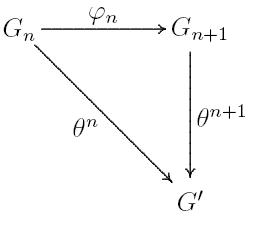
If is a group and we have homomorphisms
such that the diagram
commutes for each , that is
, then
for all
.
The following runs a thread through what I’ve looked at over the past year: Progression Report.
Taken from Hopf Algebras by Abe. I am not doing this over a commutative ring as he is doing but just over the field of complex numbers, — therefore some of my constructions will be simplified. Some of them might even be wrong.
In this section the notion of algebras will be introduced; and we will present some examples of such algebras. An algebra over is defined by giving a structure map.
Algebras
Suppose is a ring and we are given a ring morphism
. Then
can be viewed as a complex vector space. If we have
for all
and
then is said to be an algebra. Now the map defined by
turns out to be bilinear. Thus we obtain a morphism
.
From this fact, we see that an algebra can be defined in the following manner. For a complex vector space

and morphisms
,
, we have the following:
(the associative law)
(the unitary property)
Here, is said to be the multiplicative map of
,
the unit map of
, and together we call
,
the structure maps of the algebra
.
Taken from Hopf Algebras by Abe. This is not even nearly finished however I pressed publish instead of save draft… oh well.
In this section, we give the definition of Hopf algebras and present some examples. We begin by defining coalgebras, which are in a dual relationship with algebras., then bialgebras and Hopf algebras as algebraic systems in which the structures of algebras and coalgebras are interrelated by certain laws.
1.1 Coalgebras
We define a coalgebra dually to an algebra. Given an algebra and algebra homomorphisms
and
, we call
or just
a coalgebra when we have:
,
(the coassociative law).
,
(the counitary property)
The maps and
are called the comultiplication map and the counit map of
, and together they are said to be the structure maps of the coalgebra
.
Taken from C*-Algebras and Operator Theory by Gerald Murphy.
This section is concerned with positive linear functionals and representations. Pure states are introduced and shown to be the extreme points of a certain convex set, and their existence is deduced from the Krein-Milman theorem. From this the existence of irreducible representations is proved by establishing a correspondence between them and the pure states.
If is a representation of a C*-algebra
, we say
is a cyclic vector for
if
is cyclic for the C*-algebra
(This means that cyclic vector is a vector
such that the closure of the linear span of
equals
). If
admits a cyclic vector, then we say that it is a cyclic representation.
We now return to the GNS construction associated to a state to show that the representations involved are cyclic.
Theorem 5.1.1
Let be a C*-algebra and
. Then there is a unique vector
such that
, for
.
Moreover, is a unit cyclic vector for
and
, for
.
Quantisation
I had been of the understanding that a quantisation looks as follows. There is some process or property of a space
which we want to examine. Depending on the type of space
, from a suitable algebra of complex functions on
,
, we can recover and examine many of the properties of
by instead looking at
: we essentially have the identification
. When the process/ property
is about a space then it is said to be classical or commutative because for any
and
we have that
because
as the
lie in the commutative algebra
.
Now from we know about
and vice versa. Now a suitably chosen
is just a commutative C*-algebra so what about a non-commutative C*-algebra
— can we examine it’s “underlying space” in the same way?
So essentially, this means that I thought you quantised objects, such as Markov chains, by replacing a commutative C*-algebra with a not-necessarily commutative one. (This roughly follows my interpretation as per this)
Taken from Franz & Gohm.
Let return to the map considered in the beginning of the previous section. If
is a group, then
is called a left action of
on
, if it satisfies the following axioms expressing associativity and unit (
),
, and
for all ,
; and where
is the identity. As before we have the unital *-homomorphisms
. Actually, in order to get a representation of
on
, i.e.
for all
we modify the definition and use
. (Otherwise we get an anti-representation. But this is a minor point at this stage). In the associated coaction
the axioms above are turned into the coassociativity and counit properties. These make perfect sense not only for groups but also for quantum groups and we state them at once in this more general setting. We are rewarded with a particular interesting class of quantum Markov chains associated to quantum groups which we call random walks and are the subject of this lecture.


Recent Comments