For those doing Project Maths at Leaving Cert, an initial stumbling block will be on how to revise. The best way to revise mathematics is by doing exercises and a ready supply of these is traditionally found in past exam papers:

http://examinations.ie/index.php?l=en&mc=en&sc=ep&formAction=agree

However you might be under the impression that these past papers are useless with the new syllabus: not necessarily. For those doing Project Maths in 2011, the syllabus is to be found at:

http://ncca.ie/en/Curriculum_and_Assessment/Post-Primary_Education/Review_of_Mathematics/Project_Maths/LCM_str1-4_sep09_ex11.pdf

Strand 5, “Functions”, doesn’t become examinable until 2012. However this topic includes differentiation and integration, which will certainly be examinable as per the old syllabus.

Essentially the past papers may be done partially. Paper 1, Q. 6-8 is definitely fair game. Figuring out which of the other questions on past papers are still relevant involves cross-checking the new syllabus with the old.

First thing on Monday we tried to rearrange the Monday 6 December lecture. We failed miserably but someone had the bright idea to swap with MS 2003. I have emailed the lecturer and she agrees in principle so we should have a definite plan soon. The second test is also slated for Wednesday 8 December.
Anyway, we stated and proved Rolle’s Theorem. We stated and proved the Mean Value Theorem and verified the Mean Value Theorem for a quadratic.
In the tutorial nobody asked any questions, so I threw the exercises up on the projector and allowed ye work away. Ye put up your hand if ye wanted assistance. In the end I did questions 5 (iii),(iv) & 6 from http://euclid.ucc.ie/pages/staff/wills/teaching/ms2001/exercise3.pdf.
On Wednesday we proved the intuitively true theorem that the sign of a derivative determines whether the function is increasing or decreasing. We used this theorem to prove that x^n is increasing on (0,\infty); a corollary of which is the existence of positive nth roots. We defined rational powers. Finally we introduced the idea of the curve; and showed a few examples on the projector.

Problems

You need to do exercises – all of the following you should be able to attempt. Do as many as you can/ want in the following order of most beneficial:

Wills’ Exercise Sheets

Q. 11-13 from http://euclid.ucc.ie/pages/staff/wills/teaching/ms2001/exercise3.pdf

Q. 1 from http://euclid.ucc.ie/pages/staff/wills/teaching/ms2001/exercise4.pdf

Past Exam Papers

Q. 4(b) from http://booleweb.ucc.ie/ExamPapers/exams2008/Maths_Stds/MS2001Sum08.pdf

Q. 4 from http://booleweb.ucc.ie/ExamPapers/Exams2008/MathsStds/MS2001a08.pdf

Q. 4(a) from http://booleweb.ucc.ie/ExamPapers/exams2006/Maths_Stds/MS2001Sum06.pdf

Q. 5(a) from http://booleweb.ucc.ie/ExamPapers/exams2006/Maths_Stds/Autumn/ms2001Aut.pdf

Q 5(a) from http://booleweb.ucc.ie/ExamPapers/exams2004/Maths_Stds/MS2001aut.pdf

Q. 5(a) from http://booleweb.ucc.ie/ExamPapers/exams2003/Maths_Studies/MS2001.pdf

Q. 5(a) from http://booleweb.ucc.ie/ExamPapers/exams2003/Maths_Studies/ms2001aut.pdf

Q. 5(a) from http://booleweb.ucc.ie/ExamPapers/exams2001/Maths_studies/MS2001Summer01.pdf

Q. 5 from http://booleweb.ucc.ie/ExamPapers/exams/Mathematical_Studies/MS2001.pdf

From the Class

1. Prove Proposition 4.2.1 for the case that the minimum, m differs from f(a).

2. Drawings can be deceptive! Draw a function that is continuous on a closed interval but not differentiable at any point in the interval. What does your drawing suggest? Now see http://en.wikipedia.org/wiki/Weierstrass_function

3. Prove Proposition 4.2.3 (iii)

Some fairly comprehensive notes for introductory Mathematical Analysis.

(By a Dr. Kin Y. Li from the Hong Kong University of Science & Technology)

I have continued my work on Belton http://www.maths.lancs.ac.uk/~belton/www/notes/fa_notes.pdf.  I finished off exercises 6.7-6.8.

I looked at the section on Characters and Maximal Ideals. Some really nice results in this area. For example, every proper ideal of a commutative, unital complex Banach algebra A contains no invertible elements and is contained in a maximal ideal. I saw that there is a bijection between the set of characters of A and the set of all maximal ideals.

I saw the links between the characters of A and the spectrum of elements of A. The Jacobson radical was introduced; and the Gelfand topology was presented. I have done the first three exercises 7.1-3 out of 10.

When this is finished I must present a summary of the different initial topologies and review the various definitions, etc.

When I finish this I will be looking at http://books.google.com/books?id=emNvQgAACAAJ&dq=gerald+murphy+c*+algebras+and+operator+theory&hl=en&ei=6p_OTIfkJNXt4gaXv5n_Aw&sa=X&oi=book_result&ct=result&resnum=1&ved=0CCUQ6AEwAA

The second in-class test will take place on 8 December 2010. Any material presented in class, up to and including 01 December is examinable (although applied maximum and minimum problems won’t be examinable). The test is worth 12.5% of your continuous assesment mark for MS 2001. A sample test shall be posted here on 22 November 2010.

Here we present the proof of the following theorem:

Let f,g:\mathbb{R}\rightarrow\mathbb{R} be functions that are differentiable at some a\in\mathbb{R}.  If g(a)\neq 0, then f/g is differentiable at a with

\left(\frac{f}{g}\right)'(a)=\frac{f'(a)g(a)-f(a)g'(a)}{[g(a)]^2}

Quotient Rule

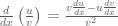
Remark: In the Leibniz notation,

\frac{d}{dx}\left(\frac{u}{v}\right)=\frac{v\frac{du}{dx}-u\frac{dv}{dx}}{v^2}

Proof: Let q=f/g:

q(a+h)-q(a)=\frac{f(a+h)}{g(a+h)}-\frac{f(a)}{g(a)}

=\frac{f(a+h)g(a)-f(a)g(a+h)}{g(a+h)g(a)}

=\frac{f(a+h)g(a)\overbrace{-f(a)g(a)+f(a)g(a)}^{=0}-f(a)g(a+h)}{g(a+h)g(a)}

=\frac{g(a)[f(a+h)-f(a)]-f(a)[g(a+h)-g(a)]}{g(a+h)g(a)}

\Rightarrow \frac{q(a+h)-q(a)}{h}=\frac{g(a)\left[\frac{f(a+h)-f(a)}{h}\right]-f(a)\left[\frac{g(a+h)-g(a)}{h}\right]}{g(a+h)g(a)}

Letting h\rightarrow 0 on both sides:

q'(a)=\left(\frac{f}{g}\right)'(a)=\frac{g(a)f'(a)-f(a)g'(a)}{[g(a)]^2} \bullet

On Monday we proved that if a function is differentiable then it is continuous (today I stated that a rough word explaining differentiable is smooth). We showed that a continuous function need not be differentiable by showing the counterexample f(x)=|x|. We presented and proved the sum, scalar, product and quotient rules of differentiation. The proof of the quotient rule is on this page. We did the derivative of x^n and x^{-n} for n\geq 1. As a corollary we showed that polynomials are differentiable everywhere. Finally we wrote down the Chain Rule.
In the tutorial nobody asked any questions, so I threw the exercises up on the projector and allowed ye work away. Ye put up your hand if ye wanted assistance. In the end I did questions 1 & 2 from http://euclid.ucc.ie/pages/staff/wills/teaching/ms2001/exercise3.pdf.
On Wednesday we wrote down the Chain rule again, stated the proof was up here and gave a very dodgy explanation of why we must multiply by the derivative of the ‘inside’ function. We stated and proved the derivatives of \sin x, \cos x, \tan x, e^x and \log x (the last two proved non-rigorously). Finally we wrote down Rolle’s Theorem.

Problems

You need to do exercises – all of the following you should be able to attempt. Do as many as you can/ want in the following order of most beneficial:

Wills’ Exercise Sheets

Q. 1-10 from http://euclid.ucc.ie/pages/staff/wills/teaching/ms2001/exercise3.pdf

More exercise sheets

Section 3 from Problems

Past Exam Papers

Q. 1(c), 3(b), 4(b) from http://booleweb.ucc.ie/ExamPapers/exams2010/MathsStds/MS2001Sum2010.pdf

Q . 1(c), 3(a), 4 from http://booleweb.ucc.ie/ExamPapers/exams2009/MathsStds/MS2001s09.pdf

Q. 1(c), 3(a), 4 from http://booleweb.ucc.ie/ExamPapers/exams2009/MathsStds/Autumn/MS2001A09.pdf

Q. 1(c), 3(b), 4(a) from http://booleweb.ucc.ie/ExamPapers/exams2008/Maths_Stds/MS2001Sum08.pdf

Q. 1(c) from http://booleweb.ucc.ie/ExamPapers/Exams2008/MathsStds/MS2001a08.pdf

Q. 1(c), 3 from http://booleweb.ucc.ie/ExamPapers/exams2007/Maths_Stds/MS2001Sum2007.pdf

Q. 3(b), 4(b), 5(a) from http://booleweb.ucc.ie/ExamPapers/exams2006/Maths_Stds/MS2001Sum06.pdf

Q. 3(b), 4(b) from http://booleweb.ucc.ie/ExamPapers/exams2006/Maths_Stds/Autumn/ms2001Aut.pdf

Q. 3(b), 4(a) from http://booleweb.ucc.ie/ExamPapers/Exams2005/Maths_Stds/MS2001.pdf

Q. 4, 5(a) from http://booleweb.ucc.ie/ExamPapers/Exams2005/Maths_Stds/MS2001Aut05.pdf

Q. 4 from http://booleweb.ucc.ie/ExamPapers/exams2004/Maths_Stds/ms2001s2004.pdf

Q. 4(b) from http://booleweb.ucc.ie/ExamPapers/exams2004/Maths_Stds/MS2001aut.pdf

Q. 4(b) from http://booleweb.ucc.ie/ExamPapers/exams2003/Maths_Studies/MS2001.pdf

Q. 4 from http://booleweb.ucc.ie/ExamPapers/exams2003/Maths_Studies/ms2001aut.pdf

Q. 4, 5(a), 6(a) from http://booleweb.ucc.ie/ExamPapers/exams2002/Maths_Stds/ms2001.pdf

Q. 1(b), 4(b), 5(b) from http://booleweb.ucc.ie/ExamPapers/exams2001/Maths_studies/MS2001Summer01.pdf

Q. 1(b), 4(b) from http://booleweb.ucc.ie/ExamPapers/exams/Mathematical_Studies/MS2001.pdf

From the Class

1. Prove Proposition 4.1.4 (ii)

2. Prove Proposition 4.1.9 (ii)

I have continued my work on Belton http://www.maths.lancs.ac.uk/~belton/www/notes/fa_notes.pdf I finished off exercises 5.3-5.17. Primarily these were concerned with topological vector spaces (a Hausdorff topology on a vector space that makes the addition and scalar multiplication functions continuous), locally convex spaces, separating families of linear functionals (M\subset X' is separating if for all x\in X, \exists\,\phi\in M such that \phi(x)\neq 0). Also a number of results were derived that concerned the existence of functionals which were dominated on one set by another (e.g. 5.12). Finally some exercises on extreme points; for example every unit vector in a Hilbert space is an extreme point of the closed unit ball B_1^H[0].

This section will be revised when I finish Belton. In particulat need to draw a scheme which relates the canonical topologies. Belton introduces them as initial topologies (generated by a family of functions) – the “old” terminology was the weak topology (generated by a family of functions). Also I will relook at the theorems to get a feeling for why and where particular conditions need to be satisfied (e.g. does the set need to be convex, compact, closed, connected?; does the space have to be locally convex, Hausdorff?, etc).

Having finished that section I began a study of normed algebras (vector spaces with an associative multiplication and submultiplicative norm). I saw that every finite dimensional algebra is isomorphic to a subalgebra of M_{n}(\mathbb{F}). I saw a number of examples of function spaces… basically it was “An Introduction to Normed Algebras” and it is fairly straightforward with some very nice results such as the Gelfand-Mazur Theorem. I have done exercises 6.1-6.6 of 8.

The final section of Belton is on Characters and Maximal Ideals. When I finish this I will be looking at http://books.google.com/books?id=emNvQgAACAAJ&dq=gerald+murphy+c*+algebras+and+operator+theory&hl=en&ei=6p_OTIfkJNXt4gaXv5n_Aw&sa=X&oi=book_result&ct=result&resnum=1&ved=0CCUQ6AEwAA Alot of the stuff is in Belton so hopefully I can run through this text reasonably quickly.

Test Results

First of all results are down the bottom. You are identified by the last four digits of your student number (last three if the fourth last digit is 0). The scores are itemized as you can see. At the bottom there are some average scores.

If you would like to see your paper or have it discussed please email me.

I have one person who didn’t sign their name, please contact me.

Solutions

Test A and Test B

Student No Q 1(a)/2 Q 1(b)/3 Q 2/4 Q 3/3.5 Mark out of 12.5 Percent
9705 0 3 2 3.5 8.5 68
1351 1 2.5 4 2 9.5 76
9822 2 3 2 2 9 72
2081 1 1 0 0 2 16
6454 1 3 0 1 5 40
7784 1 0 0 1 2 16
7238 0 3 0.5 0 3.5 28
8225 0 3 4 2 9 72
5757 2 3 4 3.5 12.5 100
2471 1 1 0 3.5 5.5 44
869 1 3 0 2 6 48
1341 1 1 3 1 6 48
9056 1 3 1.5 1 5 52
7327 1 1 0 2 4 32
6188 2 3 0 2 7 56
7303 1 2.5 2 0 5.5 44
3831 1 3 4 1 9 72
3024 1 0 0 0 1 8
1947 0 0 0 2 2 16
2332 1 3 0 1 5 40
9423 2 1 0 2 5 40
5026 0 1 0 1 2 16
2366 1 3 4 2 10 80
2185 2 3 4 2 11 88
9014 1 3 0 2 6 48
3921 0 1 0 2 3 24
166 1 1 2 3.5 7.5 60
8705 0 3 1 2 6 48
5321 0 0 0 1 1 8
1701 1 2 2 2 7 56
6218 2 3 3 0 8 64
4967 1 0 0 2 3 24
4761 1 3 0 2 6 48
5243 0 0
1863 2 3 4 1 10 80
3995 0 0 0 2 2 16
5154 0 0 0 1 1 8
385 0 3 3 1 7 56
9687 1 3 2 1 7 56
5642 1 3 4 3.5 11.5 92
7478 2 3 4 2 11 88
7029 2 1 0 0 3 24
8026 1 0 0 2 3 24
4575 2 2.5 4 2 10.5 84
3845 0 1 4 2 7 56
672 2 3 4 2 11 88
8793 1 3 1 1 6 48
7144 1.5 3 2 1 7.5 60
8108 0 0 4 1 5 40
3631 2 3 4 1 10 80
6302 0 0 4 2 6 48
1043 1.5 1 3 2 7.5 60
5904 0 3 4 2 9 72
4257 2 3 4 3.5 12.5 100
9063 2 3 4 3.5 12.5 100
3673 1 0 2 3.5 6.5 52
4482 1 3 0 2 6 48
4645 1 2.5 4 2 9.5 76
5527 0 0 0 1 1 8
8172 1 1 4 1 7 56
6838 1 3 2 0 6 48
1817 1.5 3 4 3.5 12 96
9738 1 1 0 1 3 24
511 2 3 4 1 10 80
7324 2 3 4 2 11 88
6511 1 0 0 2 3 24
492 0 0 0 2 2 16
9501 0 0 0 1 1 8
684 0 0
Average Marks 0.99 1.90 1.86 1.68 6.43 51.40
Percentages 49.63 63.18 46.46 47.97

Could the student who used illuminous pink and blue biros on their test please email me with their name and student number. It was a test “A”.