
This is just a little exercise in partial differentiation
Introduction
So, you have a password of length 


In this sense we will assume that passwords are subject only to random guesses, and so we make the simple assumption that given the data 
The set of passwords is 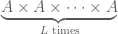

Simple Numerics
A simple approach is to simply make a table:
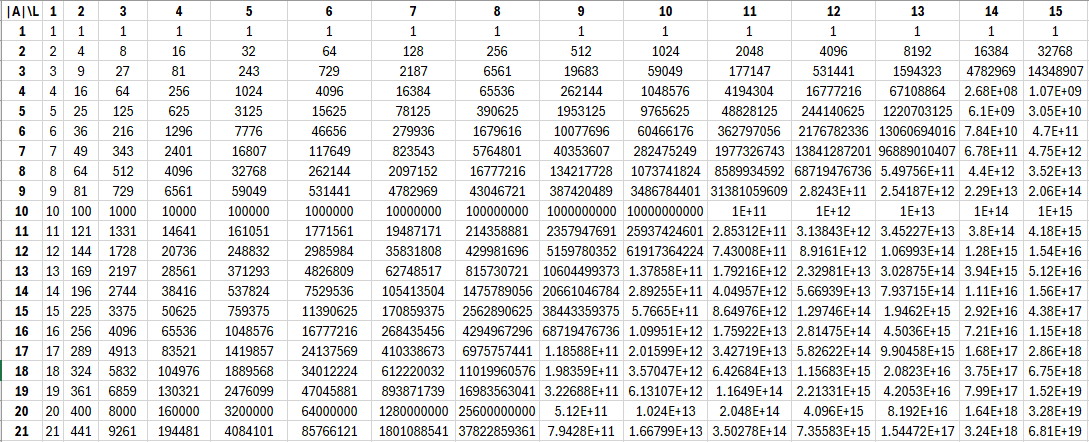
An eyeballing of this will tell you that most of time it appears that increasing the length is preferable to increasing the alphabet size. But then again, alphabet size jumps tend to be larger, e.g. 26 to 52, 52 to 62, etc.
Suppose you have a length 


Some analysis
Consider a password from a set of 
- increase the alphabet size:
, or
- increase the password length
.
If we look what these do to the number of passwords:
vs
,
we are comparing 


For example, from the table above, at 


But for a fixed 
So, if you have a length 61 password from an alphabet of size 20, you are better off increasing the alphabet size.
I guess what is relevant here are the following questions: at 
- If
, and
.
- If
, you could increase the length of the password rather than jumping to
.
- If
, you could increase the length of the password rather than jumping to
.
Going to special characters only makes sense in our framework if there is also a password length condition of 10 or more.
Partial Differentiation
This wasn’t even what I wanted to do here, which was to approximate this question using partial differentiation. In all these questions we are asking about what happens to 


Even I can differentiate with respect to
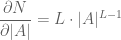
We might use some logs to differentiate with respect to




These partial derivatives estimate that if 


so, approximately, we are left comparing 


 . Let
. Let  count the number of fixed points of a permutation
  . Where
 ![X\sim \mathrm{Poi}[1]](https://s0.wp.com/latex.php?latex=X%5Csim+%5Cmathrm%7BPoi%7D%5B1%5D&bg=ffffff&fg=545454&s=0&c=20201002) , we have that for a random permutation
, we have that for a random permutation  chosen with respect to the uniform distribution, the
  converges in distribution to
  in the sense that:
![\displaystyle \lim_{N\to \infty}\mathbb{P}[\mathrm{fix}_N(\xi_N)=m]=\mathbb{P}[X=m]](https://s0.wp.com/latex.php?latex=%5Cdisplaystyle+%5Clim_%7BN%5Cto+%5Cinfty%7D%5Cmathbb%7BP%7D%5B%5Cmathrm%7Bfix%7D_N%28%5Cxi_N%29%3Dm%5D%3D%5Cmathbb%7BP%7D%5BX%3Dm%5D&bg=ffffff&fg=545454&s=0&c=20201002) .
. .
. ![1+\mathrm{Poi}[1]](https://s0.wp.com/latex.php?latex=1%2B%5Cmathrm%7BPoi%7D%5B1%5D&bg=ffffff&fg=545454&s=0&c=20201002) in the sense that, where
in the sense that, where ![\displaystyle \lim_{N\to \infty}\mathbb{P}[\mathrm{fix}_N(\xi_N)=m]=\mathbb{P}[X=m-1]](https://s0.wp.com/latex.php?latex=%5Cdisplaystyle+%5Clim_%7BN%5Cto+%5Cinfty%7D%5Cmathbb%7BP%7D%5B%5Cmathrm%7Bfix%7D_N%28%5Cxi_N%29%3Dm%5D%3D%5Cmathbb%7BP%7D%5BX%3Dm-1%5D&bg=ffffff&fg=545454&s=0&c=20201002) .
. is integration against the uniform distribution, and
  is integration against the uniform distribution on permutations with one a fixed point, that, for
  :
: ,
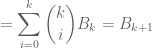
, -st Bell number. Now consider the moments of
  :
:![\displaystyle \sum_{t=0}^\infty t^k\mathbb{P}[1+X=t]=\sum_{t=0}^\infty t^k\mathbb{P}[X=t-1]](https://s0.wp.com/latex.php?latex=%5Cdisplaystyle+%5Csum_%7Bt%3D0%7D%5E%5Cinfty+t%5Ek%5Cmathbb%7BP%7D%5B1%2BX%3Dt%5D%3D%5Csum_%7Bt%3D0%7D%5E%5Cinfty+t%5Ek%5Cmathbb%7BP%7D%5BX%3Dt-1%5D&bg=ffffff&fg=545454&s=0&c=20201002)


 ,
, ,
, is the fundamental magic representation. The moments of
  :
:
 , the probability of finding more than four fixed points is zero.
 and choose our permutation from
  .
. , we take the isotropy
  via the quotient
  .
. . Note this maps
  . Now, using the fact that
  , the
, the  is
is  ). It follows, using similar stuff to the above, that the distribution of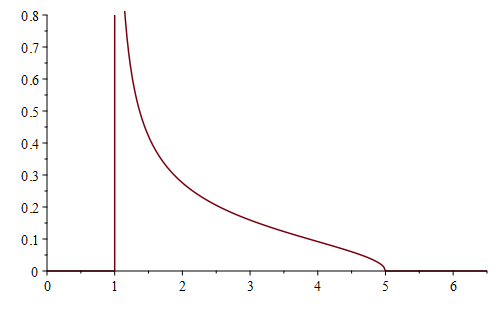
 that asks of a quantum permutation, does it fix one, we get, conditioned on this, the state:
 .
. .
. is
is 
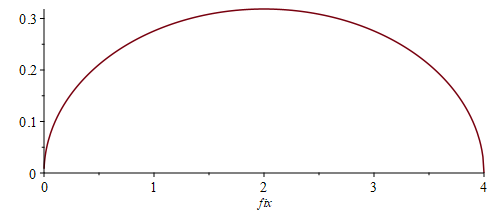
 , we had another unexpected symmetry
  .
.

 J.P. McCarthy: Math Page
Recent Comments