Week 6

We finished off Chapter 2 on Monday and then had some tutorial time.

Wednesday, after an Undetermined Coefficients MCQ, we started looking at “The Engineer’s Transform” — the Laplace Transform. We looked at the first shift theorem, and how the Laplace Transform interacts with differentiation. We started looking at partial fractions.

Only those of us who finished Assignment 1 early got much tutorial time with Chapter 2. I will hope that we will get more tutorial time on Chapter 2 at a later date, but until then, I have developed the following for you to practise your differentiation which you need for Chapter 2 here:

It might not be the worst idea in the world to devote some time to this over Easter.

Assignment 1 – Results and Remarks

Have been emailed to you.

Read the rest of this entry »

VBA Assessment 1 – Week 6

DME2C have their VBA Assessment 1 Friday 09:00-11:00 and this will run 09:05-10:55

More information in last week’s summary.

Written Assessment 1 – Week 7

20 % Written Assessment, based on Weeks 1-5.

Here is a copy of last year’s assessment. This should give you an idea of the length and format but not what questions are coming up

There are far more things I could examine.

Roughly, everything up to but not including Runge Kutta Methods (p.68).

Note the venue and time: Melbourn Hall, Tuesday 10 March, 09:30-10:30

Week 6

After finishing talking about Runge-Kutta Methods, we looked at boundary value problems (in particular the Shooting Method).

In VBA we had VBA Assessment 1.

MCQ League

Unless you are excelling, you are identified by the last five digits of your student number.

Please ask questions in the lab about questions you have gotten wrong. Students in red appear to not have a good handle on the material and should consider putting in extra time outside class in doing exercises (in the manuals).

Read the rest of this entry »

Test 1 – Results

Have been emailed to you,

Week 6

We finished Chapter 2 by looking at Determinants and Cramer’s Rule. Ye did an example in class, video here: Cramer’s Rule Example

The new material was recorded here.

We had about 90 minutes of tutorial time looking at Chapter 2.

Read the rest of this entry »

VBA Assessment 1 – Week 6

VBA Assessment 1 will take place next week, in Week 6 (3 & 6 March), in your usual lab time.

Tuesday 10:00-12:00 will run 10:05-11:55

Tuesday 15:00-17:00 will run 15:05-16:55

Friday 09:00-11:00 will run 09:05-10:55

More information in last week’s summary.

Written Assessment 1 – Week 7

20 % Written Assessment, based on Weeks 1-5.

Here is a copy of last year’s assessment. This should give you an idea of the length and format but not what questions are coming up

There are far more things I could examine.

Roughly, everything up to but not including Runge Kutta Methods (p.68).

Note the venue and time: Melbourn Hall, Tuesday 10 March, 09:30-10:30

Week 5

We continued looking at second order differential equations and how to attack them numerically.

In the afternoon we began a quick study of Runge-Kutta Methods.

In VBA we worked on Lab 4 and MCQV. Those of us who did not finish the lab are advised to finish it outside class time, and are free to email me on their work if they are unsure if they are correct or not.

MCQ League

Unless you are excelling, you are identified by the last five digits of your student number.

Please ask questions in the lab about questions you have gotten wrong. Students in red appear to not have a good handle on the material and should consider putting in extra time outside class in doing exercises (in the manuals).

Read the rest of this entry »

Week 5

We almost finished Chapter 2 on Wednesday. We must do a little more in Week 6.

I was absent Wednesday AM but instead we have an extra class, tomorrow, Thursday 09:00 in B185.

We thus have two hours of tutorial time tomorrow Thursday. You will be allowed work on Assignment 1. If you are ready for Assignment 1 you need to start looking at the Chapter 2 exercises.

Assignment 1

Assignment 1 now has a hand-in time and date of 18:00 Thursday 27 February (Week 5). Submit in class tomorrow or to A283.

  • Work submitted after the deadline will be assigned a mark of ZERO. Hand up whatever you have on time.

Your Excel file must be submitted via CANVAS.

More information in the last two weekly summaries.

Read the rest of this entry »

Test 1 – Results

I will have these to you by the end of the week.

Week 5

After our test, we continued to look at Matrix Inverses — “dividing” for Matrices. This allowed us to solve matrix equations. We will look at linear systems, and spoke again about determinants.

We had no tutorial time.

Read the rest of this entry »

VBA Assessment 1 – Week 6

VBA Assessment 1 will take place in Week 6 (3 & 6 March) in your usual lab time. The following formulae will appear on the assessment.

relevant

The following is the proposed layout of the assessment:

Q. 1: Numerical Solution of Initial Value Problem [80%]

Examples of initial value problems that might be arise include:

  • Damping

\displaystyle \frac{dv}{dt}=-\frac{\lambda}{m}v(t);           v(0)=u

  • The motion of a free-falling body subject to quadratic drag:

\displaystyle \frac{dv}{dt}=g-\frac{c}{m}v(t)^2;           v(0)=u

  • Newton Cooling

\displaystyle \frac{d\theta}{dt}=-k\cdot (\theta(t)-\theta_R);           \theta(0)=\theta_0

  • The charge on a capacitor

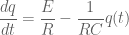
\displaystyle \frac{dq}{dt}=\frac{E}{R}-\frac{1}{RC}q(t);           q(0)=0

Students have a choice of how to answer this problem:

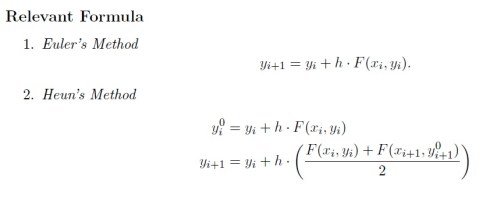
  • The full, 80 Marks are going for a VBA Heun’s Method implementation (like Lab 3).
  • An Euler Method implementation (like Lab 2), gets a maximum of 60 Marks.

You will be asked to write a program that takes as input all the problem parameters, perhaps some initial conditions, a step-size, and a final time, and implements Heun’s Method (or possibly Euler’s Method).

If you can write programs for each of the four initial value problems above you will be in absolutely great shape for this assessment.

Q. 2: Using your Program [20%]

You will then be asked to use your program to answer a number of questions about your model. For example, see the questions to the Newton Cooling Problem on p.126.

Week 4

We can avoid implicit differentiation by using Huen’s Method, which is an adjustment of Euler’s Method in that it uses lines.

We also introduced second order differential equations and saw how to attack them numerically. In particular we looked at a real pendulum.

In VBA we worked on Lab 3 and MCQIII. Those of us who did not finish the lab are advised to finish it outside class time, and are free to email me on their work if they are unsure if they are correct or not.

MCQ League

Unless you are excelling, you are identified by the last five digits of your student number.

Please ask questions in the lab about questions you have gotten wrong. Students in red appear to not have a good handle on the material and should consider putting in extra time outside class in doing exercises (in the manuals).

Read the rest of this entry »

I am emailing a link of this to everyone on the class list every week. If you are not receiving these emails or want to have them sent to another email address feel free to email me at jpmccarthymaths@gmail.com and I will add you to the mailing list.

Assignment 1

Assignment 1 has a hand-in time and date of 11:00 Thursday 27 February (Week 5).

See the Week 2 Summary for more.

One final warning: do not give your work to others to copy. If there is a lack of originality of presentation I will be dividing marks between those who copy each other and the person who did the original work will be penalised along with those who copy them.

Note in particular:

  • Work submitted after the deadline will be assigned a mark of ZERO. Hand up whatever you have on time.
  • Only Partial Pivoting has to be done using Excel.
  • Note that if you are doing Gaussian Elimination by hand you must use exact fractions and square roots rather a decimal approximation.
  • I advise that you do the questions out roughly first because small mistakes are inevitable.

THIS IS A LEARNING ACTIVITY NOT JUST A GRADED ACTIVITY. THE CHAPTER ONE EXAM QUESTION IS WORTH 24.5% OF YOUR FINAL GRADE WHILE THIS ASSIGNMENT IS WORTH JUST 15%. THINK ABOUT WHAT THIS MEANS.

Regarding Problem F, Assignment 1, on P.66 of the manual. The intention with Problem F really is for you to engage in some problem solving skills to come up with a clever way of implementing the Jacobi Method in Excel.
It should still be doable by hand but if it takes a large number of iterations to converge (to two significant figures), Excel is far more suitable.
It is possible that it could take a small number of iterations to converge to two significant figures (say two or three iterations) — which is no problem by hand — but potentially it could take more (at least six). I don’t really want people spending loads of time doing iterations by hand, so I will give 3/4 marks for Q. 2 if you do six iterations by hand. If you want to keep going – by hand – until convergence (to two significant figures) you can of course get the 4/4 marks – but you need to ask yourself is it worth your time to keep going for the sake of one mark (out of 60… out of 15% —- that is 0.25% of your final grade).
If it converges with fewer than six iterations then happy days for you, you can get 4/4.
If it doesn’t, you might be better off trying to come up with a way of doing the question in Excel if you really want all the marks.
You can still answer part Q. 3 if you do six iterations and do not yet have convergence.

Week 4

I was late on Monday… so we had a tutorial instead of a lecture.

We had another tutorial Wednesday AM.

We worked on Chapter 2 Wednesday PM and Thursday.

09:00 Wednesday 26 February

We will not have class 09:00 on Wednesday. Instead we will have class at 09:00 on Thursday, provisionally in B185. Watch this space.

Week 5

We will hopefully finish off our work on the method of undetermined coefficients between Monday and Wednesday PM. We will have two hours of tutorial on Thursday morning before the Assignment 1 deadline of 11:00.

Study

Please feel free to ask me questions about the exercises via email or even better on this webpage.

Student Resources

Please see the Student Resources tab on the top of this page for information on the Academic Learning Centre, etc..

Test 1

Test 1, worth 15%, takes place from 19:00 to 20:05 sharp, Tuesday 25 February in the usual lecture venue. There is a sample on P.53 of the notes to give you an idea of the length and layout only.

More information in last week’s summary.

If you want questions answered you have two options:

  • ask me questions via email, perhaps with a photo to show your work
  • ask me questions via the comment function on this website

Week 4

We had a Concept MCQ about vectors, and then we started looking at Chapter 2: Matrices. We did some examples of matrix arithmetic and look at Matrix Inverses — “dividing” for Matrices.

Here find a note that answers the question: why do we multiply matrices like we do?

We had no tutorial time.

Read the rest of this entry »

Week 3

We then did some further study on the Euler Method. The global error with the Euler Method is \mathcal{O}(h) and we need to reduce this by coming up with a better method or adjusting the Euler Method.

We looked at the Three Term Taylor Method as a better method. To employ the Three Term Taylor Method we need implicit differentiation, which means more pen-and-paper work.

We also looked at calculating a Maclaurin Series

In VBA we finished off the Euler Method Lab 2. Ideally everyone should have done up to p.125 (note in questions 2 and 3 that u should be 0.2.

Some students did or started Exercise 1 and/or Exercise 2 on p. 126.

MCQ League

Unless you are excelling, you are identified by the last five digits of your student number.

Please ask questions in the lab about questions you have gotten wrong. Students in red appear to not have a good handle on the material and should consider putting in extra time outside class in doing exercises (in the manuals).

Read the rest of this entry »