VBA Assessment 1 – Results

I would hope to have these with ye by the end of Week 8.

Written Assessment 1 – Results

I would hope to have these with ye by the end of Week 8

Week 7

In the first lecture you sat your first written assignment.

In the second lecture we looked more at boundary value problems (in particular the Shooting Method and Goal Seek). We started talking about Finite Differences.

In VBA we looked at Runge-Kutta methods.

Read the rest of this entry »

*These starred week numbers are one behind CIT’s week numbers. This is because of the snow.

Linear Algebra: 20% Test

Will now take place Wednesday 21 March, in Week 7* [21 March].

The test will take place from 19:00-20:30 but most students should be able to complete the test in about an hour. It has about 35 Marks worth of questions: five in all (with one very short, and three shortened versions of longer questions).

Anything done in the first five weeks is examinable (see “Independent Learning” below) and it is recommended that you understand what is going on with the summaries of p. 57-59.

The nine questions from p. 60 on are a good revision but not every possible question is listed there. In next week’s Maple you will get a chance to revise these questions.

Week 5* [7 March]

We saw how linear systems can be written as matrix equations, and (sometimes) solved using matrix inverses. Then we spoke about determinants, and their use in figuring out if homogeneous linear systems have non-zero solutions. Finally we looked at Cramer’s Rule.


Week 6* [14 March]

We will start the class with one more example of Cramer’s Rule, and then start pushing into statistics.

In Maple, we will do Lab 3, which is really revision for the Linear Algebra Test.

Week 7* [21 March]

The test is going to begin at 19:00 sharp and run until 20:30. Class will resume at 20:35 sharp. This seems a very short break but the test is designed so that it shouldn’t take much longer than an hour to complete, so almost everyone should have a solid enough break.

At 20:35 we will continue working on statistics.

Week 8* [28 March/4 April]

This may or may not be a Maple night (it depend on how far we get in the previous week).

It appears that at most one student will miss the class, which isn’t too bad. So now we now go back to the poll to pick between the two nights.

Read the rest of this entry »

Week 6

We started looking at “The Engineer’s Transform” — the Laplace Transform. We looked at the first shift theorem, and how the Laplace Transform interacts with differentiation. We started looking at partial fractions.

Week 7

We will continue looking at partial fractions and the inverse Laplace Transform.

Assignment 2

Assignment 2 will have a hand-in date of 17:00 23 April: the Monday of Week 11. Assignment 2 is in the manual, P. 149. Once we get someway into the examples on p.105, you should be able to make a start.


Read the rest of this entry »

Written Assessment 1

Written Assessment 1 takes place Tuesday 13 March at 09:00 in the usual lecture venue.

Here is a copy of last year’s assessment. This should give you an idea of the length and format but not what questions are coming up. There are far more things I could examine.

Roughly, everything up to p. 57 is examinable. More specifically:

Maclaurin/Taylor Series

Examples 1 & 2 on p. 17; Q. 1-2 on p.19

ODEs in Engineering

p.22, Example, Q. 1-4

Euler Method

p.29, Examples 1-4; p.38, Q. 1-6, 8-9; p.48, Q. 1, 5(a)

Three Term Taylor Method

p.35, Example; p. 36, Examples 1-2; p.38, Q. 6-7, 10-14; p.48, Q. 3

Heun’s Method

p.43, Examples 1-2; p.48, Q. 2, 4, 5(b)

Second Order Differential Equations

p.52, Example; p.54, Example; p. 56, Q. 1-14 (some repetition here).

VBA Assessment 1

VBA Assessment 1 will take place in Week 6, (6 & 9 March) in your usual lab time. You will not be allowed any resources other than the library of code (p.124) and formulae (p.123 parts 1 and 2) at the end of the assessment (both are provided on the assessment paper). More information in last week’s weekly summary.


Read the rest of this entry »

“Straight-Line-Graph-Through-The-Origin”

The words of Mr Michael Twomey, physics teacher, in Coláiste an Spioraid Naoimh, I can still hear them.

There were two main reasons to produce this straight-line-graph-through-the-origin:

  • to measure some quantity (e.g. acceleration due to gravity, speed of sound, etc.)
  • to demonstrate some law of nature (e.g. Newton’s Second Law, Ohm’s Law, etc.)

We were correct to draw this straight-line-graph-through-the origin for measurement, but not always, perhaps, in my opinion, for the demonstration of laws of nature.

The purpose of this piece is to explore this in detail.

Direct Proportion

Two variables P and Q are in direct proportion when there is some (real number) constant k such that P=k\cdot Q.

Read the rest of this entry »

Assignment 1

Due to the weather, Assignment 1 now has a hand-in time and date of 17:30 Monday 5 March (Week 6).

Assignment 2

Assignment 2 will have a hand-in date of 17:00 23 April: the Monday of Week 11. Assignment 2 is in the manual.

Week 5

We finished our study of the method of undetermined coefficients.

Week 6

We will start looking at “The Engineer’s Transform” — the Laplace Transform.

Read the rest of this entry »

VBA Assessment 1

VBA Assessment 1 will take place in Week 6, (6 & 9 March) in your usual lab time. You will not be allowed any resources other than the library of code (p.124) and formulae (p.123 parts 1 and 2) at the end of the assessment (both are provided on the assessment paper). More information in last week’s weekly summary.

Written Assessment 1

Written Assessment 1 takes place Tuesday 13 March at 09:00 in the usual lecture venue.

Here is a copy of last year’s assessment. This should give you an idea of the length and format but not what questions are coming up. There are far more things I could examine.

Roughly, everything up to p. 57 is examinable. More specifically:

Maclaurin/Taylor Series

Examples 1 & 2 on p. 17; Q. 1-2 on p.19

ODEs in Engineering

p.22, Example, Q. 1-4

Euler Method

p.29, Examples 1-4; p.38, Q. 1-6, 8-9; p.48, Q. 1, 5(a)

Three Term Taylor Method

p.35, Example; p. 36, Examples 1-2; p.38, Q. 6-7, 10-14; p.48, Q. 3

Heun’s Method

p.43, Examples 1-2; p.48, Q. 2, 4, 5(b)

Second Order Differential Equations

p.52, Example; p.54, Example; p. 56, Q. 1-14 (some repetition here).

Read the rest of this entry »

I am emailing a link of this to everyone on the class list every week. If you are not receiving these emails or want to have them sent to another email address feel free to email me at jpmccarthymaths@gmail.com and I will add you to the mailing list.

Week 4

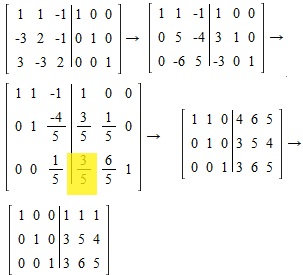
We worked with matrix inverses, seeing how the Gauss-Jordan algorithm can be used to calculate the inverse of a 3\times 3 matrix. We solved a matrix equation.

Here find a corrected Example 2 from p. 39. In class, I made a slip in the third frame. The row operations are the same.

Autumn2011GJE

The final answer is therefore

\displaystyle A^{-1}=\left(\begin{array}{ccc} 1 & 1 & 1 \\ 3 & 5 & 4 \\ 3 & 6 & 5\end{array}\right).

We also had our second Maple lab.

Week 5

We will see how linear systems can be written as matrix equations, and solved using matrix inverses. Then we will talk about determinants, and perhaps push towards the end of Chapter 1.

Linear Algebra: 20% Test

Will take place Wednesday 14 March, in Week 7.

Maple Catch Up


If you have missed the first lab you have two options: either download Maple onto your own machine (instructions may be found here) or come into CIT at another time to use Maple.

Go through the missed lab on your own, doing all the exercises in Maple. Save the worksheet and email it to me.


Read the rest of this entry »

Assignment 1

Assignment 1 has a hand-in time and date of 14:30 Friday 2 March (Week 5) and has been given out.

Careful in your “collaboration” — don’t take an explanation, etc. from another
student unless it makes sense to you: otherwise you are not going to get the benefit out of completing this assignment.

Week 4

We continued our work on Chapter 2 — the method of undetermined coefficients for solving linear odes — by looking at the case of external forces. We had two tutorials.

Week 5

We will hopefully finish off our work on the method of undetermined coefficients: we will start the second tutorial (Thursday) only when we finish Section 2.4 (what if we know the initial conditions).

Read the rest of this entry »

I am emailing a link of this to everyone on the class list every week. If you are not receiving these emails or want to have them sent to another email address feel free to email me at jpmccarthymaths@gmail.com and I will add you to the mailing list.

Assessment

Considering our progress, I have decided to swap the positions of the first and second assessments. This time last year I had Section 1.2.3 completed but have (necessarily) slowed down this year. Last year Section 1.2.3 was tested both in the first (written) assessment and in the second (VBA) assessment.

It is more important that Section 1.2.3 is tested in the written component therefore the decision to switch the assessments.

Due to this change, the information in Sections 3.6 and 3.7 is now out of date.

The following is the proposed assessment schedule:

  1. Week 6, 20% First VBA Assessment, More Info Below
  2. Week 7, 20 % In-Class Written Test, More Info in Week 5
  3. Week 11, 20% Second VBA Assessment, More Info in Week 9
  4. Week 12, 40% Written Assessment(s), More Info in Week 10

VBA Assessment 1

VBA Assessment 1 will take place in Week 6, (6 & 9 March) in your usual lab time. You will not be allowed any resources other than the library of code (p.124) and formulae (p.123 parts 1 and 2) at the end of the assessment. The following is the proposed layout of the assessment:

Q. 1: Numerical Solution of Initial Value Problem [80%]

Examples of initial value problems that might be arise include:

  • Damping

\displaystyle \frac{dv}{dt}=-\frac{\lambda}{m}v(t);           v(0)=u

  • The motion of a free-falling body subject to quadratic drag:

\displaystyle \frac{dv}{dt}=g-\frac{c}{m}v(t)^2;           v(0)=u

  • Newton Cooling

\displaystyle \frac{d\theta}{dt}=-k\cdot (\theta(t)-\theta_R);           \theta(0)=\theta_0

  • The charge on a capacitor

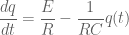
\displaystyle \frac{dq}{dt}=\frac{E}{R}-\frac{1}{RC}q(t);           q(0)=0

Students have a choice of how to answer this problem:

  • The full, 80 Marks are going for a VBA Heun’s Method implementation (like Lab 3).
  • An Euler Method implementation (like Lab 2), gets a maximum of 60 Marks.

You will be asked to write a program that takes as input all the problem parameters, perhaps some initial conditions, a step-size, and a final time, and implements Heun’s Method (or Euler’s Method): similar to Exercise 1 on p. 114 and also Exercise 1 on p.109 (except perhaps implementing Heun’s Method).

If you can write programs for each of the four initial value problems above you will be in absolutely great shape for this assessment.

Q. 2: Using your Program [20%]

You will then be asked to use your program to answer a number of questions about your model. For example, assuming Heun’s Method is used, consider the initial value problem (3.7) on p. 105.

  1. Given, v_0=0.2, m=3, \lambda=1.5, h=0.01, approximate v(0.3).
  2. Given, v_0=0.4, m=30, \lambda=1.5, h=0.1, investigate the behaviour of v(t) for large t.
  3. Given v_0=0.2, m=0.1, \lambda=1.5, h=0.5, T=10, run the Heun program. Comment on the behaviour of v(t). Run the same program except with h=0.05. Comment on the behaviour of v(t).
  4. Given, v_0=0, m=3, \lambda=1.5, h=0.1, T=2, run the Heun program. Comment on the behaviour of v(t).

Week 4

We jumped forward and looked at Heun’s Method in the 09:00 class. We went back then and looked at the Three Term Taylor Method in the afternoon. We stated in the afternoon that Heun’s Method gives the same answer as the Three Term Taylor, and without the need for implicit differentiation.

In VBA we worked on Lab 3. Those of us who did not finish the lab are advised to finish it outside class time, and are free to email me on their work if they are unsure if they are correct or not.

Read the rest of this entry »