I am emailing a link of this to everyone on the class list every week. If you are not receiving these emails or want to have them sent to another email address feel free to email me at jpmccarthymaths@gmail.com and I will add you to the mailing list.

Test 1

I will have your test with me in tutorials both this week and next.

Week 6

We had one remaining Cramer’s Rule example (video here). We started Chapter 3 with a quick review of differentiation (video here) followed by an introduction to operators (video here), and then looked at Parametric Differentiation.

Week 7

We will finish looking at parametric differentiation and then look at related rates.

Read the rest of this entry »

I am emailing a link of this to everyone on the class list every week. If you are not receiving these emails or want to have them sent to another email address feel free to email me at jpmccarthymaths@gmail.com and I will add you to the mailing list.

Week 6

The storm cost us one lecture. Please watch this cantilever example and this summary of beams to catch up. Wednesday, we looked at Euler’s Method in the morning and had an extra tutorial in the evening.

Week 7

In Week 7 we will look at the Three Term Taylor Method and begin Chapter 3 on Probability and Statistics.


Assessment 2

Assessment 2 will be handed out on Friday but doesn’t have to be completed until the Monday of Week 11, giving you more than five full weeks to complete it.

Study

Please feel free to ask me questions about the exercises via email or even better on this webpage — especially those of us who struggled in the test.

Student Resources

Please see the Student Resources tab on the top of this page for information on the Academic Learning Centre, etc.

I am emailing a link of this to everyone on the class list every week. If you are not receiving these emails or want to have them sent to another email address feel free to email me at jpmccarthymaths@gmail.com and I will add you to the mailing list.

Week 6

The storm interrupted us, costing us two lectures. You must watch the following videos to catch up: Inclusion-Exclusion Principle and the properties of relations. We have/had our test this Friday. A sample has been handed out.

Week 7

In Week 7 w will start the chapter on Functions.

Assessment 1

Test 1 will be held at 09:00, Friday 20 October in Week 6. Everything up to but not including relations is examinable. I have emailed ye a sample, a hard copy of which I gave out in tutorials.

Study

We are probably all going to have to put in some extra study before the test. Please try and find some extra time to try exercises, particularly with any new or harder material such as logs, cartesian products, and power sets. Please feel free to ask me questions about the exercises via email or even better on this webpage.

Student Resources

Anyone who is missing notes is to email me.

Please see the Student Resources tab on the top of this page for information on the Academic Learning Centre, etc. There are some excellent notes on Blackboard for MATH6055.


I am emailing a link of this to everyone on the class list every week. If you are not receiving these emails or want to have them sent to another email address feel free to email me at jpmccarthymaths@gmail.com and I will add you to the mailing list.

Week 5

In Week 5 we looked more at sets and explored Cartesian Products We introduced relations. Then on Friday we looked harder at elementssubsets, power sets and the empty set.

Week 6

In Week 6 we will look at the Inclusion-Exclusion Principle and the properties of relations. We should start the chapter on Functions and then have our Test 1 on Friday.

Assessment 1

Test 1 will be held at 09:00, Friday 20 October in Week 6. Everything up to but not including relations is examinable. I have emailed ye a sample, a hard copy of which I will provide you with next week.

Study

We are probably all going to have to put in some extra study before the test. Please try and find some extra time to try exercises, particularly with any new or harder material such as logs, cartesian products, and power sets. We all have only one hour of tutorials before the test and finding two  hours to do exercises will make a big difference. Please feel free to ask me questions about the exercises via email or even better on this webpage.

Student Resources

Anyone who is missing notes is to email me.

Please see the Student Resources tab on the top of this page for information on the Academic Learning Centre, etc. There are some excellent notes on Blackboard for MATH6055.


This post follows on from this post where the following principle was presented:

Fundamental Principle of Solving ‘Easy’ Equations

Identify what is difficult or troublesome about the equation and get rid of it. As long as you do the same thing to both numbers (the “Lhs” and the “Rhs”), the equation will be replaced by a simpler equation with the same solution.

There are a number of subtleties here: basically sometimes you get extra ‘solutions’ (that are not solutions at all), and sometimes you can lose solutions.

Let us write the squaring function, e.g. 6\mapsto 36, x\mapsto x^2 by f(x)=x^2 and the square-rooting function by x\mapsto \sqrt{x}. It appears that (x^2,\sqrt{x}) are an inverse pair but not quite exactly. While

\displaystyle 81\overset{\sqrt{x}}{\mapsto} 9\overset{x^2}{\mapsto}81 and

\displaystyle 7\overset{x^2}{\mapsto}49\overset{\sqrt{x}}{\mapsto}7,

check out O.K. note that

-4\overset{x^2}{\mapsto}+16\overset{\sqrt{x}}{\mapsto}=+4\neq -4,

does not bring us back to where we started.

This problem can be fixed by restricting the allowable inputs to x^2 to positive numbers only but for the moment it is better to just treat this as a subtlety, namely while (\sqrt{x})^2=x, \sqrt{x^2}=\pm x… in fact I recommend that we remember that with an x^2 there will generally be two solutions.

The other thing we look out for as much as possible is that we cannot divide by zero.

There are other issues around such as the fact that \sqrt{x}>0, so that the equation \sqrt{x}=-2 has no solutions (no, x=4 is not a solution! Check.). This equation has no solutions.

Often, in context, these subtleties are not problematic. For example, equations with no solutions rarely arise and quantities might be positive so that if we have \pm\sqrt{a}, only +\sqrt{a} need be considered (for example, a might be a length).

Read the rest of this entry »

I am emailing a link of this to everyone on the class list every week. If you are not receiving these emails or want to have them sent to another email address feel free to email me at jpmccarthymaths@gmail.com and I will add you to the mailing list.

Test 1 Results & Comments

Have been emailed to you along with the marking scheme.

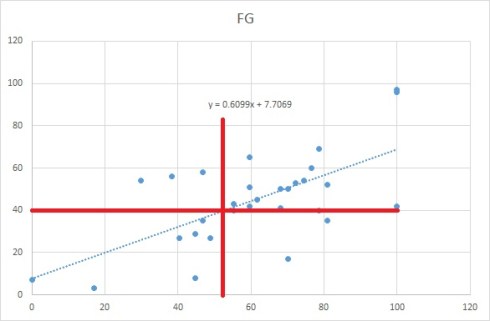
I want to make the following remarks. Below we have a plot of Final Grade vs Test 1 Mark for last year’s class.

graph5

Everyone under the horizontal line failed MATH6040. Note the students in the bottom right. They got ~70% and ~80% in the Vectors test and still failed. There were various students with ~55-100% in Vectors who barely passed. On average, the final grade was about 0.6 times the Test 1 Result + 8. This means that on average students with below 53%  on Test 1 failed MATH6040. That is people to the left of the vertical line.

Therefore, note vectors is the easiest chapter in MATH6040 so don’t get too carried away with your mark. Conversely, if you have done poorly you need to take immediate action: by attending all your tutorials and possibly the Academic Learning Centre. The three students in the top left would have taken this advice. The seven students in the bottom left would not have.

The second thing to note about the results is the impact of attendance on grades. On average:

  • those with satisfactory attendance got 74% — a distinction
  • those with one attendance warnings got 63% — a merit 1
  • those with two attendance warnings got 37% — a FAIL

The third thing to note is that perceived ability is not as important as attendance. Of those who attended the quick test, the correlation coefficient between Quick Test mark and Test 1 mark was only 0.27 while the correlation coefficient between Attendance Warnings and Test 1 mark was -0.59.

Roughly, this suggests that attendance is twice as important as ability.

Week 5

We looked at Determinants and their use in Cramer’s Rule.

Week 6

We will start Chapter 3 with a quick review of differentiation followed by looking at Parametric Differentiation.

Read the rest of this entry »

I am emailing a link of this to everyone on the class list every week. If you are not receiving these emails or want to have them sent to another email address feel free to email me at jpmccarthymaths@gmail.com and I will add you to the mailing list.

Week 5

In Week 5 we finished looking at simply supported beams. We then looked at fixed end beams and cantilevered beams.

Week 6

In Week 6 we will summarise what we learnt about beam and look at numerical approximations to solutions of differential equations that we cannot solve exactly.

Assessment 1

Assessment 1 has been emailed to all of you. The hand in date is, tomorrow,  17:30 Thursday 12 October 2017. I will be in A283 from 10:00-12:00 and 13:00-17:30. Work handed in late shall be assigned a mark of zero.

Assessment 2

Assessment 2 will be handed out on Friday but doesn’t have to be completed until the Monday of Week 11, giving you more than five full weeks to complete it.

Study

Please feel free to ask me questions about the exercises via email or even better on this webpage — especially those of us who struggled in the test.

Student Resources

Please see the Student Resources tab on the top of this page for information on the Academic Learning Centre, etc.

The First Problem

A car has to travel a distance s on a straight road. The car has maximum acceleration a and maximum deceleration b. It starts and ends at rest.

Show that if there is no speed limit, the time is given by

\displaystyle \sqrt{2s\cdot \frac{(a+b)}{ab}}.

Solution: We are going to use two pieces of information:

  • the area under the velocity-time graph is the distance travelled,
  • the slope of the velocity-time graph is the acceleration.

Read the rest of this entry »

I am emailing a link of this to everyone on the class list every week. If you are not receiving these emails or want to have them sent to another email address feel free to email me at jpmccarthymaths@gmail.com and I will add you to the mailing list.

Week 4

In Week 4 we finished looking at logarithms and started the second chapter on Sets and Relations. I tried and failed to tell you about the barber paradox.

Week 5

In Week 5 we will look more at sets and set identities, and explore Cartesian Products and perhaps introduce relations.

Assessment 1

Test 1 will be held at 09:00, Friday 20 October in Week 6. Note this is different to your assessment schedule provided by the head of department, Tim Horgan. Expect a sample this time next week. Only material from Weeks 1-5 will be examined.

Study

We are probably all going to have to put in some extra study before the test. Please try and find some extra time to try exercises, particularly with any new or harder material such as logs. We all have two hours of tutorials before the test and finding two extra hours to do exercises will make a big difference. Please feel free to ask me questions about the exercises via email or even better on this webpage.

Student Resources

Anyone who is missing notes is to email me.

Please see the Student Resources tab on the top of this page for information on the Academic Learning Centre, etc. There are some excellent notes on Blackboard for MATH6055.


I am emailing a link of this to everyone on the class list every week. If you are not receiving these emails or want to have them sent to another email address feel free to email me at jpmccarthymaths@gmail.com and I will add you to the mailing list.

Test 1

The 15% Test 1 will take place at 16:00 on 9 October, Week 5, in B263. There is a sample test in the notes.

Week 4

We did some examples of matrix arithmetic and looked at Matrix Inverses — “dividing” for Matrices. This allowed us to solve matrix equations. Here find a note that answers the question: why do we multiply matrices like we do?

Week 5

We will look at linear systems, and determinants.

Read the rest of this entry »