Introduction
To successfully analyse and solve the equations of Leaving Cert Applied Maths projectiles, one must be very comfortable with trigonometry.
Projectile trigonometry all takes place in ![[0^\circ,90^\circ]](https://s0.wp.com/latex.php?latex=%5B0%5E%5Ccirc%2C90%5E%5Ccirc%5D&bg=ffffff&fg=545454&s=0&c=20201002) so we should be able to work exclusively in right-angled-triangles (RATs), however I might revert to the unit circle for proofs (without using the unit circle, the definitions for zero and
so we should be able to work exclusively in right-angled-triangles (RATs), however I might revert to the unit circle for proofs (without using the unit circle, the definitions for zero and  are found by using continuity).
Recalling that two triangles are similar if they have the same angles, the fundamental principle governing trigonometry might be put something like this:
Similar triangles differ only by a scale factor.
We show this below, but what this means is that the ratio of corresponding sides of similar triangles are the same, and if one of the angles is a right-angle, it means that if you have an angle, say  , and calculate the ratio of, say, the length of the opposite to the length of the hypotenuse, that your answer doesn’t depend on how large your triangle is and so it makes sense to talk about this ratio for rather than just a specific triangle:
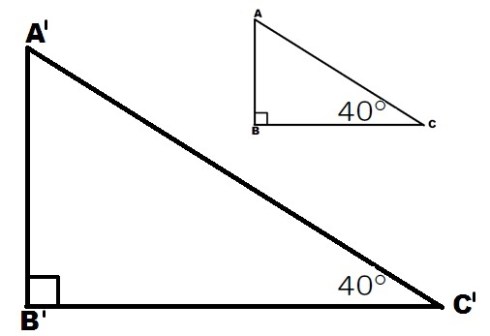
These are two similar triangles. The opposite/hypotenuse ratio is the same in both cases.
Suppose the dashed triangle is a  -scaled version of the smaller triangle. Then
  and
and  . Thus the opposite to hypotenuse ratio for the larger triangle is
 ,
,
which is the same as the corresponding ratio for the smaller triangle.
This allows us to define some special ratios, the so-called trigonometric ratios. If you are studying Leaving Cert Applied Maths you know what these are. You should also be aware of the inverse trigonometric functions. Also you should be able to, given the hypotenuse and angle, find comfortably the other two sides. We should also know that sine is maximised at , where it is equal to one.
In projectiles we use another trigonometric ratio:
 .
.
Note  , so that
  is not defined. Why? Answer here.
The Pythagoras Identity
For any angle  ,
,
 .
.
Read the rest of this entry »

 ??
?? .
.

 for example, and by extension all these positive integer powers. Finally there is the equation or formula type =, the most famous of which is probably
 (speed of light)
  .
. matrices but it should be clear, particularly by looking at this
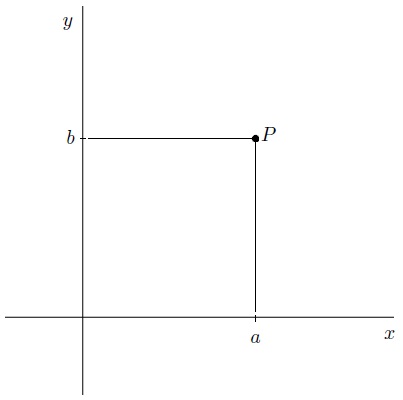
  . By fixing an origin, orientation (
 -directions), and scale, each point
  can be associated with an ordered pair
  , where
  is the distance along the
  is the distance along the
  by
by .
.
 and
and  :
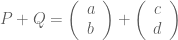
:
 , and
, and .
. , what is the relationship between the area and the side-length?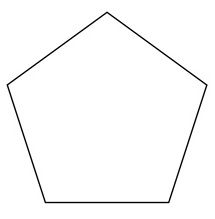
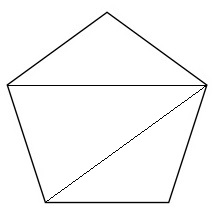
 in each of the three triangles, there
  in those angles around the edges, and, as there are five of them, they are each
  .
.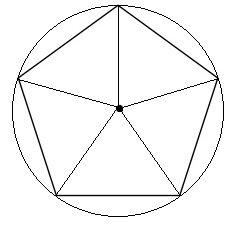
 , and furthermore, by symmetry, the rays bisect the larger angles
  and so each of these triangles are
  .
.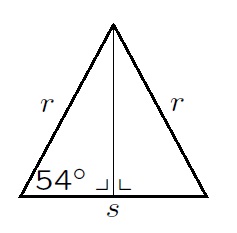
 . Note that, where
  is the perpendicular height:
 .
. . It is

 ,
,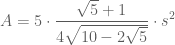
 ,
, . It might be possible to simply
  further.
 J.P. McCarthy: Math Page
Recent Comments