I am emailing a link of this to everyone on the class list every week. If you are not receiving these emails or want to have them sent to another email address feel free to email me at jpmccarthymaths@gmail.com and I will add you to the mailing list.

Week 2

We finished talking about linear least squares curve fitting. We spoke briefly about the Pearson correlation coefficient, and we began talking about fitting curves/models that aren’t of the form

Y=a\,\theta_1(X)+b\,\theta_2(X)

Week 3

In Week 3 we will continue talking about these non-linear models.
Read the rest of this entry »

Quadratics are ubiquitous in mathematics. For the purposes of this piece a quadratic is a real-valued function q:\mathbb{R}\rightarrow \mathbb{R} of the form

q(x)=ax^2+bx+c,

where a,\,b,\,c\in \mathbb{R} such that a\neq 0. There is a little bit more to be said — particularly about the differences between a quadratic and a quadratic function but for those this piece is addressed to (third level: non-maths; all second level), the distinction is unimportant.

Geometry

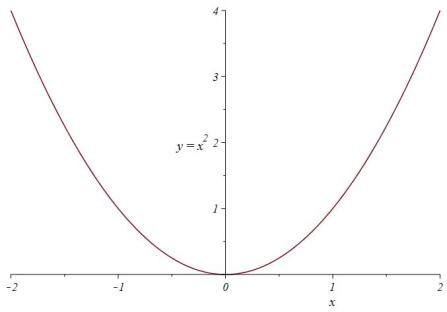
The basic object we study is the square function, s:\mathbb{R}\rightarrow \mathbb{R}, x\mapsto x^2:

graph1

All quadratics look similar to x^2. If a>0 then the quadratic has this \bigcup geometry. Otherwise it looks like y=-x^2 and has \bigcap geometry

The geometry dictates that quadratics can have either zero, one or two real roots. A root of a function is an input x such that f(x)=0. As the graph of a function is of the form y=f(x), roots are such that y=f(x)=0\Rightarrow y=0, that is where the graph cuts the x-axis. With the geometry of quadratics they can cut the x-axis no times, once (like s(x)=x^2), or twice.

Read the rest of this entry »

I am emailing a link of this to everyone on the class list every week. If you are not receiving these emails or want to have them sent to another email address feel free to email me at jpmccarthymaths@gmail.com and I will add you to the mailing list.

Week 1

We studied number and began to take a look at basic algebra.

Week 2

In Week 2 we will look further into algebra and look at equations.

Tutorials

Tutorials start properly in Week 2.

  • COMP1C-X: Tuesday at 15:00 in B241L
  • COMP1C-Y: Wednesday at 12:00 in B225

Read the rest of this entry »

I am emailing a link of this to everyone on the class list every week. If you are not receiving these emails or want to have them sent to another email address feel free to email me at jpmccarthymaths@gmail.com and I will add you to the mailing list.

Manuals

The manuals are available in the Copy Centre. Please purchase ASAP.

Tutorials

Tutorials, which are absolutely vital, start next week.

Week 1

In week one we spoke in general terms about curve fitting. We introduced Lagrange Interpolation and started talking about Least Squares curve fitting.

Week 2

In Week 2 we will continue talking about Least Squares Curve Fitting.
Read the rest of this entry »

I am emailing a link of this to everyone on the class list every week. If you are not receiving these emails or want to have them sent to another email address feel free to email me at jpmccarthymaths@gmail.com and I will add you to the mailing list.

Manuals

The manuals are  available in the Copy Centre and must be purchased as soon as possible.

Tutorials

Tutorial for BioEng2A: Thursdays at 12:00 in B180

Tutorial for BioEng2B: Mondays at 17:00 in B189

Tutorial for SET2: Mondays at 9:00 in E15


Week 1

We began our study of Chapter 2, Vector Algebra. We looked at how to both visualise vectors and describe them algebraically. We learned how to find the magnitude  and direction of a vector, add them and scalar multiply them. We spoke about displacement vectors and introduced the vector product known as the dot product.

Week 2

We will continue working with the vectors and hopefully learn how to add them and scalar multiply them, about displacement vectors,  the vector product known as the dot product and perhaps then introduce the cross product.

Test 1

The test will probably be the Monday of Week 5. Official notice will be given in Week 3. There is a sample test in the notes.

Study

Please feel free to ask me questions about the exercises via email or even better on this webpage.

Student Resources

Please see the Student Resources tab on the top of this page for information on the Academic Learning Centre, etc.

There are a number of ways of explaining why you cannot divide by zero. Here are my two favourites.

Any Set of Numbers Collapses to a Single Number

How old are you? Zero years old.

How tall are you? Zero metres old.

How many teeth do you have? Zero.

How many Superbowls has Tom Brady won? Zero

Yep, if you allow division by zero you only end up with one number to measure everything with.

Read the rest of this entry »

Slides of a talk given at the Topological Quantum Groups and Harmonic Analysis workshop at Seoul National University, May 2017.

Abstract A central tool in the study of ergodic random walks on finite groups is the Upper Bound Lemma of Diaconis & Shahshahani. The Upper Bound Lemma uses the representation theory of the group to generate upper bounds for the distance to random and thus can be used to determine convergence rates for ergodic walks. These ideas are generalised to the case of finite quantum groups.

After a long time I have finally completed my PhD studies when I handed in my hardbound thesis (a copy of which you can see here).

It was a very long road but thankfully now the pressure is lifted and I can enjoy my study of quantum groups and random walks thereon for many years to come.

Assignment 2

Assignment 2 has a hand-in date of this 24 April and a hand-in time of 17:30. Work handed in late will be assigned a mark of zero so hand in what you have on time. You can hand in your work in class or drop it to A283.

Befitting of the second semester of the award year of a major qualification, this is a difficult assignment. Some of the questions will stretch you more than the work you have done in tutorials. If you are having difficulties completing this assignment over Easter feel free to email me looking for help.

If you can handle what this assignment throws at you not only will you be in a good position for your final exam you will also be in a good position DSE3.

Also, you are in the award year of a major qualification: the Easter break isn’t a break.

Student Feedback

If you would like to submit anonymous feedback on this module/lecturer, you may take the do so here. This link will be open until May 11.

Week 10

We looked at systems of differential equations.

Weeks 11 & 12

We will look at double and triple integrals.

Week 13

We will go through last year’s exam on the board and then I will answer your questions if there are any. If there are none I will help one-to-one.

Read the rest of this entry »

Test 2

Wednesday 26 April at 09:00 in the usual lecture venue. Based on Chapter 3, sample at back of Chapter 3.

Easter Revision

More than half the class has had poor attendance over the past fortnight. Frankly poor attendance at this time of the year is disastrous. Ye have a lot of work to do to get up to speed over Easter.

Those of us who have been attending also need to do some work to be properly prepared for the Week 10 Test. There are five sets of exercises in Chapter 3. Serious students should have at least done all the questions ‘up to the line’ and further revision is done by doing questions under the line.

Any student is welcome to email me questions during the Easter break.

Ye all have a tutorial the Monday before the Test where I recommend that ye look at the sample but without a body of work done you are going to be in danger for Test 2.

Catch-up

You will each of a catch up class. BioEng2B the Thursday of Week 12 (at 14:00 in B245) and BioEng2A the Monday of Week 13 (at 11:00 in B245).

We will be covering something that will be on an exam paper so attendance is vital.

Week 10

We started Chapter 4 by looking at integration by parts. We also looked at completing the square.

Week 11

In our two lectures we will look at some more completing the square and work.

Read the rest of this entry »