I am emailing a link of this to everyone on the class list every week. If you are not receiving these emails or want to have them sent to another email address feel free to email me at jpmccarthymaths@gmail.com and I will add you to the mailing list.

Course Notes

Last week they looked like this.

Week 3

In Week 3 we looked at Error Analysis and two-variable Taylor Series. We also began our study of differential equations.

Week 4

In Week 4 we will continue our study of ordinary first order differential equations and develop numerical techniques (the Euler and Three Term Taylor Methods) for approximating solutions to ODEs that we can’t solve exactly.

Test 1

Test 1 will be on the Thursday of Week 6. Expect a sample in Week 5.

Tutorials

Ted should has a division of the class such that one group this week is Thursday 15:00 while the other is 16:00. Both groups in B228.

Read the rest of this entry »

I am emailing a link of this to everyone on the class list every week. If you are not receiving these emails or want to have them sent to another email address feel free to email me at jpmccarthymaths@gmail.com and I will add you to the mailing list.

Assessment 1 Results

Assessment 1 Results will go on your Blackboard the afternoon of Friday 11 October. Question five (about the reduction in area) has been declared null and void so everybody is being awarded that mark.

Course Notes

The notes contain all the lecture material, all the exercises and exercise sheets as well as all of last year’s assessments and you will need them from Monday on. They cost €15 and are on sale in the copying centre.  Also find a useful reference here.

Week 3

In Week 3 we looked at Length, Area and Trigonometry.

Week 4

In Week 4 we will finish trigonometry and start discussing approximation and perhaps statistics.

Assessment 2

Assessment 2 is on in Week 5. Keep an eye on your CIT Blackboard for the latest and definitive assessment information.

Read the rest of this entry »

I am emailing a link of this to everyone on the class list every week. If you are not receiving these emails or want to have them sent to another email address feel free to email me at jpmccarthymaths@gmail.com and I will add you to the mailing list.

Course Notes

The course notes are now on sale in the copying centre (beside the student centre). I would advise you to buy them ASAP. You will need to put money in your card to buy them (you can do this at the shop beside the canteen) and they cost E12. I would buy them Monday – although I will do photocopies for Monday & Tuesday. For Thursday you must have a copy of the notes as there will be no more photocopies. The notes contain all the lecture material, all the exercises, all of last years tests & exam as well as a small set of mathematical tables.

Week 2

In Week 2 we looked at differentiating some common functions. In particular we looked at the Product Rule.

Tutorials

Regarding the tutorial time split:

BioEng:
 – If you are finished early on Tuesday your tutorial is Friday at 09:00 in PF45.
 – If you are ‘finished’ at 16:30 on Tuesday your tutorial is Thursday at 17:00 in PF45
Building Services:
 – You can come to the Friday 09:00 tutorial as well as/instead of the Tuesday 17:00 if you wish to do so.

Academic Learning Centre

I would urge anyone having any problems with material that isn’t being addressed in the tutorials to use the Academic Learning Centre. As you can see the timetable is quite generous. You will get best results if you come to the helpers there with specific questions. You could also win a tablet device if you enter a competition that they are running.

Maple & Wolfram Alpha

If you are subscribed to CIT MathsOnline you will have free access to the mathematical software package Maple:

Self-enrolment for Maths Online

1.           Log into Blackboard Learn

2.           Click on the Courses tab button at the top of the screen. Go to Course Search and type Maths Online in the box.

3.           Once you’ve found the course, click on the action link button next to the course and click on Enrol. This should take you to the Self Enrolment page.

4.           Your Access Code is mathsonline (lower case, no spaces).

5.           After you’ve finished click Submit. You should now see a message that says your enrolment was successful.

Once you’ve enrolled, you can download Maple by selecting the Mathematical Software tab in the left hand column and following the instructions under the Maple item.

I myself am not a Maple expert but ‘grew up’ with another mathematical software package MathematicaMathematica powers the “computational knowledge engine” WolframAlpha. Go on ask it a question!

Week 3

In Week 3 we will learn how to differentiate quotients (fancy word for fractions) \displaystyle \frac{f(x)}{g(x)} and compositions f(g(x)).

Continuous Assessment

As can be seen here in the Module Descriptor, there will be two 15% tests: one in Week 5 and one in Week 10. I hope to give you two week’s notice of each of these and also provide sample tests.

Study

Please feel free to ask me questions about the exercises via email or even better on this webpage — especially those of us who struggled in the test.

Math.Stack Exchange

If you find yourself stuck and for some reason feel unable to ask me the question you could do worse than go to the excellent site math.stackexchange.com. If you are nice and polite, and show due deference to these principles you will find that your questions are answered promptly. For example this question regarding a more rigorous proof of the product rule (our argument was handwaving).

Calculators

Please note the following taken from the CIT code of conduct for CIT examination candidates:

Where a pocket calculator is used it must be silent, self-powered and non-programmable. 

It may not be passed from one candidate to another. Instructions for its use may not be 
brought into the Examination Hall. 
The term ‘programmable’ includes any calculator that is capable of storing a sequence of 
keystrokes that can be retrieved after the calculator is turned off or powers itself off. Note that the 
capacity to recall, edit and replay previously executed calculations does not render a calculator 
programmable, provided that this replay memory is automatically cleared when the calculator is 
powered off. Also, the facility to store numbers in one or more memory locations does not render 
a calculator programmable. 
Calculators with any of the following mathematical features are prohibited: 
• Graph plotting 
• Equation solving 
• Symbolic algebraic manipulation 
• Numerical integration 
• Numerical differentiation 
• Matrix calculations 
Calculators with any of the following features are prohibited 
• Data Banks 
• Dictionaries 
• Language translators 
• Text retrieval 
• Capability of remote communication

I am emailing a link of this to everyone on the class list every week. If you are not receiving these emails or want to have them sent to another email address feel free to email me at jpmccarthymaths@gmail.com and I will add you to the mailing list.

Course Notes

At the moment they look like this.

Week 2

In Week 2 we reviewed partial differentiation.

Tutorials

Tutorials start properly this week. Ted should have a division of the class such that one group this week is Thursday 15:00 while the other is 16:00. Both groups in B228.

Academic Learning Centre

I would urge anyone having any problems with material that isn’t being addressed in the tutorials to use the Academic Learning Centre. As you can see the timetable is quite generous. You will get best results if you come to the helpers there with specific questions. You could also win a tablet device if you enter a competition that they are running.

Maple & Wolfram Alpha

If you are subscribed to CIT MathsOnline you will have free access to the mathematical software package Maple:

Self-enrolment for Maths Online

1.           Log into Blackboard Learn

2.           Click on the Courses tab button at the top of the screen. Go to Course Search and type Maths Online in the box.

3.           Once you’ve found the course, click on the action link button next to the course and click on Enrol. This should take you to the Self Enrolment page.

4.           Your Access Code is mathsonline (lower case, no spaces).

5.           After you’ve finished click Submit. You should now see a message that says your enrolment was successful.

Once you’ve enrolled, you can download Maple by selecting the Mathematical Software tab in the left hand column and following the instructions under the Maple item.

I myself am not a Maple expert but ‘grew up’ with another mathematical software package MathematicaMathematica powers the “computational knowledge engine” WolframAlpha. Go on ask it a question!

Week 3

In Week 4 we will have a look at Error Analysis and two-variable Taylor Series.

Test 1

Test 1 will be on the Thursday of Week 6. Expect a sample in Week 5.

Study

Please feel free to ask me questions about the exercises via email or even better on this webpage — especially those of us who struggled in the test.

Math.Stack Exchange

If you find yourself stuck and for some reason feel unable to ask me the question you could do worse than go to the excellent site math.stackexchange.com. If you are nice and polite, and show due deference to these principles you will find that your questions are answered promptly. For example this question attempting to explain why \displaystyle \frac{\partial^2z}{\partial x\partial y}=\frac{\partial^2 x}{\partial y\partial x}.

Calculators

Please note the following taken from the CIT code of conduct for CIT examination candidates:

Where a pocket calculator is used it must be silent, self-powered and non-programmable. 

It may not be passed from one candidate to another. Instructions for its use may not be 
brought into the Examination Hall. 
The term ‘programmable’ includes any calculator that is capable of storing a sequence of 
keystrokes that can be retrieved after the calculator is turned off or powers itself off. Note that the 
capacity to recall, edit and replay previously executed calculations does not render a calculator 
programmable, provided that this replay memory is automatically cleared when the calculator is 
powered off. Also, the facility to store numbers in one or more memory locations does not render 
a calculator programmable. 
Calculators with any of the following mathematical features are prohibited: 
• Graph plotting 
• Equation solving 
• Symbolic algebraic manipulation 
• Numerical integration 
• Numerical differentiation 
• Matrix calculations 
Calculators with any of the following features are prohibited 
• Data Banks 
• Dictionaries 
• Language translators 
• Text retrieval 
• Capability of remote communication

I am emailing a link of this to everyone on the class list every week. If you are not receiving these emails or want to have them sent to another email address feel free to email me at jpmccarthymaths@gmail.com and I will add you to the mailing list.

Course Notes

The course notes are now on sale in the copying centre (beside the student centre). I would advise you to buy them ASAP. You will need to put money in your card to buy them (you can do this at the shop beside the canteen) and they cost E15. I would buy them before Tuesday’s lecture – although I will do photocopies for next week. After Wednesday you must have a copy of the notes as there will be no more photocopies. The notes contain all the lecture material, all the exercises and exercise sheets as well as all of last year’s assessments.

Week 2

In Week 2 we will look at Ratio & Proportion, Percentages and Tax. Also find a useful reference here.

Tutorials

Tutorials are now in full swing:

  • Group A: Monday 14:00 in B269 and Thursday 10:00 in E7
  • Group B: Monday 12:00 in F1. 3 and Tuesday 15:00 in B116

Academic Learning Centre

I would urge anyone having any problems with material that isn’t being addressed in the tutorials to use the Academic Learning Centre. As you can see the timetable is quite generous. You will get best results if you come to the helpers there with specific questions. You could also win a tablet device if you enter a competition that they are running.

Maple & Wolfram Alpha

If you are subscribed to CIT MathsOnline you will have free access to the mathematical software package Maple:

Self-enrolment for Maths Online

1.           Log into Blackboard Learn

2.           Click on the Courses tab button at the top of the screen. Go to Course Search and type Maths Online in the box.

3.           Once you’ve found the course, click on the action link button next to the course and click on Enrol. This should take you to the Self Enrolment page.

4.           Your Access Code is mathsonline (lower case, no spaces).

5.           After you’ve finished click Submit. You should now see a message that says your enrolment was successful.

Once you’ve enrolled, you can download Maple by selecting the Mathematical Software tab in the left hand column and following the instructions under the Maple item.

I myself am not a Maple expert but ‘grew up’ with another mathematical software package MathematicaMathematica powers the “computational knowledge engine” WolframAlpha. Go on ask it a question!

Week 3

In Week 2 we will look at Interest and this will conclude our study for Wednesday evening’s assessment. After this we will look at some geometry and trigonometry.

Assessment 1

Assessment 1 is on in Week 3. Keep an eye on your CIT Blackboard for the latest and definitive assessment information. It will be a multiple choice test with no negative marking.

Study

Please feel free to ask me questions about the exercises via email or even better on this webpage — especially those of us who struggled in the test.

Math.Stack Exchange

If you find yourself stuck and for some reason feel unable to ask me the question you could do worse than go to the excellent site math.stackexchange.com. If you are nice and polite, and show due deference to these principles you will find that your questions are answered promptly. For example this question regarding interest.

Calculators

Although Assessment 1 is to be taken without the use of calculators, subsequent assessments will have no such ban. Please note the following taken from the CIT code of conduct for CIT examination candidates:

Where a pocket calculator is used it must be silent, self-powered and non-programmable. 

It may not be passed from one candidate to another. Instructions for its use may not be 
brought into the Examination Hall. 
The term ‘programmable’ includes any calculator that is capable of storing a sequence of 
keystrokes that can be retrieved after the calculator is turned off or powers itself off. Note that the 
capacity to recall, edit and replay previously executed calculations does not render a calculator 
programmable, provided that this replay memory is automatically cleared when the calculator is 
powered off. Also, the facility to store numbers in one or more memory locations does not render 
a calculator programmable. 
Calculators with any of the following mathematical features are prohibited: 
• Graph plotting 
• Equation solving 
• Symbolic algebraic manipulation 
• Numerical integration 
• Numerical differentiation 
• Matrix calculations 
Calculators with any of the following features are prohibited 
• Data Banks 
• Dictionaries 
• Language translators 
• Text retrieval 
• Capability of remote communication

I am emailing a link of this to everyone on the class list every week. If you are not receiving these emails or want to have them sent to another email address feel free to email me at jpmccarthymaths@gmail.com and I will add you to the mailing list.

Week 1

In week one we spoke about the questions that the derivative and the definite integral were originally formulated to answer. This led us onto a how to formulate the idea of a limit. We showed that the derivative correctly asked for the slope of a tangent to the line (i.e. the slope of the line).

Tutorials

Tutorials start properly this week:

  • BIS/BEN: Tuesday 17:00 in PF45
  • BIO: Friday 09:00 in PF45

We will discuss these times further on Monday.

Academic Learning Centre

I would urge anyone having any problems with material that isn’t being addressed in the tutorials to use the Academic Learning Centre. As you can see the timetable is quite generous. You will get best results if you come to the helpers there with specific questions. You could also win a tablet device if you enter a competition that they are running.

Week 2

In Week 2 we will look at differentiating some common functions.

Continuous Assessment

As can be seen here in the Module Descriptor, there will be two 15% tests: one in Week 5 and one in Week 10. I hope to give you two week’s notice of each of these and also provide sample tests.

Study

Please feel free to ask me questions about the exercises via email or even better on this webpage — especially those of us who struggled in the test.

Math.Stack Exchange

If you find yourself stuck and for some reason feel unable to ask me the question you could do worse than go to the excellent site math.stackexchange.com. If you are nice and polite, and show due deference to these principles you will find that your questions are answered promptly. For example this question regarding the derivative of y=(x+a)^n.

Calculators

Please note the following taken from the CIT code of conduct for CIT examination candidates:

Where a pocket calculator is used it must be silent, self-powered and non-programmable. 

It may not be passed from one candidate to another. Instructions for its use may not be 
brought into the Examination Hall. 
The term ‘programmable’ includes any calculator that is capable of storing a sequence of 
keystrokes that can be retrieved after the calculator is turned off or powers itself off. Note that the 
capacity to recall, edit and replay previously executed calculations does not render a calculator 
programmable, provided that this replay memory is automatically cleared when the calculator is 
powered off. Also, the facility to store numbers in one or more memory locations does not render 
a calculator programmable. 
Calculators with any of the following mathematical features are prohibited: 
• Graph plotting 
• Equation solving 
• Symbolic algebraic manipulation 
• Numerical integration 
• Numerical differentiation 
• Matrix calculations 
Calculators with any of the following features are prohibited 
• Data Banks 
• Dictionaries 
• Language translators 
• Text retrieval 
• Capability of remote communication

I am emailing a link of this to everyone on the class list every week. If you are not receiving these emails or want to have them sent to another email address feel free to email me at jpmccarthymaths@gmail.com and I will add you to the mailing list.

Week 1

In week one we showed that differential equations can arise in engineering. We discussed how some differential equations do not submit easily to analysis and that sometimes we would have to find approximate solutions. We then proceeds to review of calculus. Finally we answered the question of how calculators work by developing a theory of power series.

Tutorials

Tutorials start properly this week. Ted should have a division of the class such that one group this week is Thursday 16:00 while the other is 17:00.

Academic Learning Centre

I would urge anyone having any problems with material that isn’t being addressed in the tutorials to use the Academic Learning Centre. As you can see the timetable is quite generous. You will get best results if you come to the helpers there with specific questions. You could also win a tablet device if you enter a competition that they are running.

Week 2

In Week 2 we will review partial differentiation and have a look at two-variable Taylor Series.

Test 1

Test 1 will be on the Thursday of Week 6. Expect a sample in Week 5.

Study

Please feel free to ask me questions about the exercises via email or even better on this webpage — especially those of us who struggled in the test.

Math.Stack Exchange

If you find yourself stuck and for some reason feel unable to ask me the question you could do worse than go to the excellent site math.stackexchange.com. If you are nice and polite, and show due deference to these principles you will find that your questions are answered promptly. For example this question addressing the strange conclusion that the Maclaurin Series of e^{i\pi}=-1!

Calculators

Please note the following taken from the CIT code of conduct for CIT examination candidates:

Where a pocket calculator is used it must be silent, self-powered and non-programmable. 

It may not be passed from one candidate to another. Instructions for its use may not be 
brought into the Examination Hall. 
The term ‘programmable’ includes any calculator that is capable of storing a sequence of 
keystrokes that can be retrieved after the calculator is turned off or powers itself off. Note that the 
capacity to recall, edit and replay previously executed calculations does not render a calculator 
programmable, provided that this replay memory is automatically cleared when the calculator is 
powered off. Also, the facility to store numbers in one or more memory locations does not render 
a calculator programmable. 
Calculators with any of the following mathematical features are prohibited: 
• Graph plotting 
• Equation solving 
• Symbolic algebraic manipulation 
• Numerical integration 
• Numerical differentiation 
• Matrix calculations 
Calculators with any of the following features are prohibited 
• Data Banks 
• Dictionaries 
• Language translators 
• Text retrieval 
• Capability of remote communication

I am emailing a link of this to everyone on the class list every week. If you are not receiving these emails or want to have them sent to another email address feel free to email me at jpmccarthymaths@gmail.com and I will add you to the mailing list.

Week 1

In week one we looked at some applications of mathematics. We studied basic arithmetic, in particular we looked at the various number systems, fractions and decimals.

Tutorials

Tutorials start properly this week:

  • Group A: Monday 14:00 in B269 and Thursday 10:00 in E7
  • Group B: Monday 12:00 in F1. 3 and Tuesday 15:00 in B116

Academic Learning Centre

I would urge anyone having any problems with material that isn’t being addressed in the tutorials to use the Academic Learning Centre. As you can see the timetable is quite generous. You will get best results if you come to the helpers there with specific questions. You could also win a tablet device if you enter a competition that they are running.

Week 2

In Week 2 we will look at Ratio & Proportion, Percentages and Tax & Interest. I hope to have the notes printed and ready for your purchase by the end of the week. Until then we will have handouts. Also find a useful reference here.

Assessment 1

Assessment 1 will be on in Week 3. Keep an eye on your CIT Blackboard for the latest and definitive assessment information. It will be a multiple choice test with no negative marking.

Study

Please feel free to ask me questions about the exercises via email or even better on this webpage — especially those of us who struggled in the test.

Math.Stack Exchange

If you find yourself stuck and for some reason feel unable to ask me the question you could do worse than go to the excellent site math.stackexchange.com. If you are nice and polite, and show due deference to these principles you will find that your questions are answered promptly. For example this question regarding infinite decimals.

Calculators

Although Assessment 1 is to be taken without the use of calculators, subsequent assessments will have no such ban. Please note the following taken from the CIT code of conduct for CIT examination candidates:

Where a pocket calculator is used it must be silent, self-powered and non-programmable. 

It may not be passed from one candidate to another. Instructions for its use may not be 
brought into the Examination Hall. 
The term ‘programmable’ includes any calculator that is capable of storing a sequence of 
keystrokes that can be retrieved after the calculator is turned off or powers itself off. Note that the 
capacity to recall, edit and replay previously executed calculations does not render a calculator 
programmable, provided that this replay memory is automatically cleared when the calculator is 
powered off. Also, the facility to store numbers in one or more memory locations does not render 
a calculator programmable. 
Calculators with any of the following mathematical features are prohibited: 
• Graph plotting 
• Equation solving 
• Symbolic algebraic manipulation 
• Numerical integration 
• Numerical differentiation 
• Matrix calculations 
Calculators with any of the following features are prohibited 
• Data Banks 
• Dictionaries 
• Language translators 
• Text retrieval 
• Capability of remote communication

I am emailing a link of this to everyone on the class list every Friday afternoon. If you are not receiving these emails or want to have them sent to another email address feel free to email me at jpmccarthymaths@gmail.ie and I will add you to the mailing list.

Week 12

In Week 12 we looked at how to find the centroid of a plane area and the volume and centre of gravity of a solid of revolution.

Week 13

We will hold review tutorials at the usual lecture times in the usual lecture venues. There will be no review tutorials during the usual tutorial times.

First off, the layout of your exam will be exactly as per Winter 12.

I will field any questions ye might have at this time and if there are no more questions we will do the Autumn 2012 paper.

If we finish this paper I will help ye one-to-one.

Notes

The final set of MATH6040 lecture notes. You might find this E-book useful.

Math.Stack Exchange

If you find yourself stuck and for some reason feel unable to ask me the question you could do worse than go to the excellent site math.stackexchange.com. If you are nice and polite, and show due deference to these principles you will find that your questions are answered promptly. For example this question on the volume of a doughnut.

I am emailing a link of this to everyone on the class list every week. If you are not receiving these emails or want to have them sent to another email address feel free to email me at jpmccarthymaths@gmail.com and I will add you to the mailing list.

Continuous Assessment Results

You are identified by the last four digits of your student number. The first column is your Test 1 result while the second is your Maple Labs participation. The third is your Maple Test Mark out of 5. The fourth is your continuous assessment mark out of 30. The last is the percentage you must have on the final to pass. If you have any issues with this please email me.

Student Number Test Maple Labs Maple Test CA Mark Pass
8272 93 10 5 28.95 15.79
4673 90 10 3 26.5 19.29
1054 78 10 4 25.7 20.43
9455 65 10 5 24.75 21.79
0902 70 10 3 23.5 23.57
2344 61 10 3 22.15 25.50
2352 58 10 2 20.7 27.57
4346 28 10 3 17.2 32.57
3152 40 10 1 17 32.86
2343 25 10 3 16.75 33.21
2351 15 8 3 13.25 38.21
2345 28 6 3 13.2 38.29
4674 48 4 0 11.2 41.14
3150 25 6 0 9.75 43.21
1215 0 6 2 8 45.71
8171 30 0 0 4.5 50.71

Study

Please feel free to ask me questions via email or even better on this webpage — especially those of us who struggled in the test.

Please find a reference for some of the prerequisite material here.

Week 12

We finished our work on Laplace Methods and looked at the general solution of the damped harmonic oscillator. The following is the correct way to categorise over and underdamping:

Damped Harmonic Oscillator Analysis

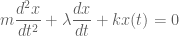
The differential equation

\displaystyle m\frac{d^2x}{dt^2}+\lambda \frac{dx}{dt}+kx(t)=0,

as discussed on page 154 is the equation of a damped harmonic oscillator. There are three behaviours. One way to analyse these is to define the following parameters

\displaystyle \gamma=\frac{\lambda}{2m}, \displaystyle \omega_0=\sqrt{\frac{k}{m}}

and follow the analysis as per the notes. However last night 8 May we outlined an even easier analysis.

First write the differential equation as it will be on your exam paper

\displaystyle \frac{d^2x}{dt^2}+b\cdot \frac{dx}{dt}+c\cdot x(t)=0.

Now find the Laplace Transform of the solution. It will look like

\displaystyle X(s)=\frac{As+B}{s^2+bs+c}.

Now there are three cases depending on whether s^2+bs+c has two distinct real roots, equal real roots, or complex roots. Note in all cases a=1.

Underdamping b^2-4ac<0

In this case the roots are complex: no real roots implying no real factors hence we must complete the square

\displaystyle X(s)=\frac{As+B}{(s+a)^2+k^2}

which is composed of shifted sines and cosines when we transform it back

\displaystyle x(t)=Ce^{-at}\cos kt+De^{-at}\sin kt

Overdamping b^2-4ac>0

In this case the roots are real and distinct so we have two factors and hence a partial fraction expansion like this:

\displaystyle X(s)=\frac{As+B}{s^2+bs+c}=\frac{As+B}{(s+\alpha)(s+\beta)}=\frac{C}{s+\alpha}+\frac{D}{s+\beta},

which is composed of two exponentially decaying terms when we transform back.

\displaystyle x(t)=Ce^{-\alpha t}+De^{-\beta t}

Critical Damping b^2-4ac=0

In this case the root are real and repeated hence we have repeated real factors and hence a partial fraction expansion like this:

\displaystyle X(s)=\frac{As+B}{s^2+bs+c}=\frac{As+B}{(s+\alpha)^2}=\frac{C}{s+\alpha}+\frac{D}{(s+\alpha)^2},

which is composed of an exponentially decaying term and (before transforming) a shifted \displaystyle \frac{1}{s^2} which will need the First Shift Theorem when we transform back:

\displaystyle x(t)=Ce^{-\alpha t}+Dte^{-\alpha t}

In Conclusion

If you are asked to analyse a damped harmonic oscillator of the form

m\frac{d^2x}{dt^2}+\lambda \frac{dx}{dt}+kx(t)=0,

then you have three options:

  1. Calculate b^2-4ac. Over-zero = Over-damping, Under-zero = Under-damping and Equal Zero = Critical-damping
  2. Calculate \gamma and \omega_0 as described on page 154 of the notes and compare. It is actually equivalent to method 1. In the Laplace marking scheme handout a damped harmonic oscillator is analysed using this method.
  3. Solve the differential equation using Laplace Methods and see which behaviour the solution corresponds to.

Week 13

We will hold a review tutorial on Wednesday 8 May in the usual room. First off, the layout of your exam is the same as Winter 2012: do question one worth 50/100 and two out of questions two, three, four; each worth 25/100.

I will field any questions ye might have at this time and if there are no questions we will do the exam paper from Autumn 2012.

Formulae to Learn?

Somebody asked me for a list of formulae that ye might need that are not on the tables. I would put the following on that list:

  • The Midpoint Rule Formula Here

One could include

  • The Differential; if z=f(x,y) then \displaystyle\Delta z\approx dz=\frac{\partial f}{\partial x}\Delta x+\frac{\partial f}{\partial y}\Delta y

There are a number of others such as \displaystyle \int_a^\infty=\lim_{R\rightarrow\infty}\int_a^R for example but these are ideas rather than formulae really. Can you think of any others (the Euler method formula will be given to you)?

Math.Stack Exchange

If you find yourself stuck and for some reason feel unable to ask me the question you could do worse than go to the excellent site math.stackexchange.com. If you are nice and polite, and show due deference to these principles you will find that your questions are answered promptly. For example this question about completing the square.