Taken from Random Walks on Finite Quantum Groups by Franz & Gohm.

Theorem

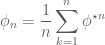
Let \phi be a state on a finite quantum group A. Then the Cesaro mean

\displaystyle \phi_n=\frac{1}{n}\sum_{k=1}^n\phi^{\star n}n\in\mathbb{N}

converges to an idempotent state on A, i.e. to a state \pi such that \pi\star\pi=\pi.

Proof : Let \phi' be an accumulation point of \{\phi_n\}_{n\geq0}, this exists since the states on A form a compact set. We have

\|\phi_n-\phi\star \phi_n\|=\frac{1}{n}\|\phi-\phi^{n+1}\|\leq \frac{2}{n}.

I have no idea where the equality comes from.

Choose sequence \{n_k\}_{k\geq 0} such that \phi_{n_k}\rightarrow \phi', we get \phi\star\phi'=\phi' and similarly \phi'\star \phi=\phi'. By linearity this implies \phi_n\star\phi'=\phi'=\phi'\star \phi_n. If \phi'' is another accumulation point of \{\phi_n\}_{n\geq 0} and \{m_{\ell}\}_{\ell\geq 0} a sequence such that \phi_{m_\ell}\rightarrow\phi'', then we get \phi''\star\phi'=\phi'=\phi'\star\phi'' and thus \phi'=\phi'' by symmetry (??). Therefore the sequence \{\phi_n\}_{n\geq0} has a unique accumulation point, i.e. it converges \bullet

Remark

If \phi is faithful, then the Cesaro limit \pi is the Haar state on A (prove this).

Remark

Due to cyclicity the sequence \{\phi^{\star n}\}_{n\geq 0} does not converge in general. Take, for example, the state \phi=\eta_2 (p.28) on the Kac-Paljutkin quantum group A, then we have

\eta_2^{\star n}=\left\{\begin{array}{ccc}\eta_2&\text{if}& n\text{ is odd}\\ \varepsilon&\text{if}&n\text{ is even}\end{array}\right.,

but

\displaystyle \lim_{n\rightarrow\infty}\frac1{n}\sum_{k=1}^n\eta_2^{\star k}=\frac{\varepsilon+\eta_2}2.

Taken from Random Walks on Finite Quantum Groups by Franz & Gohm

In this section we will show how one can recover a classical Markov chain from a quantum Markov chain. We will apply a folklore theorem that says one gets a classical Markov process, if a quantum Markov process can be restricted to a commutative algebra.

We might like to do more. This result recovers a Markov chain — if the quantum process is in fact a random walk on a finite quantum group can we recover the group, the transition probabilities (yes), the driving probability measure?? 

Conjecture

If we restrict a random walk on a finite quantum group to a commutative subalgebra we can recover a random walk on a finite group.

For random walks on quantum groups we have the following result.

Theorem 6.1

Let A be a finite quantum group \{j_n\}_{n\geq 0} a random walk on a finite dimensional A-comodule algebra B, and B_0 a unital abelian sub-*-algebra of B. The algebra B_0 is isomorphic to the algebra of functions on a finite set, say B_0\cong F(X) where X={1,\dots,d}.

If the transition operator T_\phi of \{j_n\}_{n\geq 0} leaves B_0 invariant, then there exists a classical Markov chain \{\xi_n\}_{n\geq 0} with values in X, whose probabilities can be computed as time-ordered moments of \{j_n\}_{n\geq 0}, i.e.

P(\xi_0=i_0,\dots,\xi_\ell=i_\ell)=\Psi\left(j_0\left(\mathbf{1}_{\{i_0\}}\right)\cdots j_\ell\left(\mathbf{1}_{\{i_\ell\}}\right)\right)

for all \ell\geq 0 and i_0,\dots,i_\ell\in X.

Read the rest of this entry »

Taken from Random Walks on Finite Quantum Groups by Franz & Gohm

In this section we want to represent the algebras on Hilbert spaces and obtain spatial implementations for the random walk. On a finite quantum group A we can introduce an inner product

\langle a,b\rangle=\eta(a^*b),

where a,\,b\in A and \eta and \eta is the Haar state. Because the Haar state is faithful we can think of A as a finite dimensional Hilbert space. Further we denote by \|\cdot\| the norm associated to this inner product. We consider the linear operator

W:A\otimes A\rightarrow A\otimes Ab\otimes a\mapsto \Delta(b)(1_A\otimes a).

It turns out that this operator contains all information about the quantum group and thus it is called its fundamental operator. We discuss some of its properties.

Read the rest of this entry »

Taken from Random Walks on Finite Quantum Groups by Franz & Gohm.

The most important special case of the construction from here is obtained when we choose B=A and \beta=\Delta. Then we have a random walk on a finite group A. Let us first show that this indeed a generalisation of a left-invariant random walk (I must be careful to remember this — I have always worked with right-invariant walks that multiply on the left: these multiply on the right.) Using the coassociativity of \Delta we see that the transition operator T_\phi=(I_A\otimes\phi)\circ\Delta satisfies the formula (\checkmark)

\Delta\circ T_\phi=(I_A\otimes T_\phi)\circ\Delta.

Suppose now that B=A consists of functions on a finite group G and \beta=\Delta is the comultiplication which encodes the group multiplication, i.e.

\displaystyle\Delta\left(\mathbf{1}_{\{g\}}\right)=\sum_{h\in G}\mathbf{1}_{\{gh^{-1}\}}\otimes\mathbf{1}_{\{h\}}=\sum_{h\in G}\mathbf{1}_{\{h^{-1}\}}\otimes\mathbf{1}_{\{hg\}}.

We also have

\displaystyle T_\phi\left(\mathbf{1}_{\{g\}}\right)=\sum_{h\in G}p(h,g)\mathbf{1}_{\{h\}},

where [p(h,g)] is the stochastic matrix.

This calculation makes perfect sense when p(h,g)=\phi\left(\mathbf{1}_{h^{-1}g}\right) and since we’ve said nothing about what \phi should be this makes perfect sense — and with linearity we get all the properties of the stochastic operator we could possibly want. 

Now calculate

\displaystyle (\Delta\circ T_\phi)\mathbf{1}_{\{g\}}=\Delta\left(\sum_{h\in G}p(h,g)\mathbf{1}_{\{h\}}\right)=\sum_{t\in G}\mathbf{1}_{\{t^{-1}\}}\otimes\sum_{h\in G}p(h,g)\mathbf{1}_{\{th\}},

\displaystyle[(I_{F(G)}\otimes T_\phi)\circ\Delta]\mathbf{1}_{\{g\}}=(I_{F(G)}\otimes T_\phi)\sum_{t\in G}\mathbf{1}_{\{t^{-1}\}}\otimes\mathbf{1}_{\{tg\}}

\displaystyle =\sum_{t\in G}\mathbf{1}_{\{t^{-1}\}}\otimes \sum_{s\in G} p(s,tg)\mathbf{1}_{\{s\}}.

Now reindex the second sum here s\rightarrow h and at the same time map s\rightarrow th and we may then conclude that p(h,g)=p(th,tg) for all g,\,h\,t\in G. This is the left invariance of the random walk.

For random walks on a finite quantum groups there are some natural special choices for the initial distribution \psi. On the one hand, one may choose \psi=\varepsilon (the counit) which in the commutative case (i.e. for a group) corresponds to starting at the identity. Then the time evolution of the distributions is given by \varepsilon\star\phi^{\star n}=\star^{\star n}. In other words, we get a convolution semigroup of states.

Inasmuch as I can tell, we have

\psi\star \phi=(\psi\otimes\phi)\circ\Delta.

On the other hand, stationarity of the random walk can be obtained if \psi is chosen such that \psi\star\phi=\star. In particular, we may choose the unique Haar state \eta of the finite quantum group A.

Proposition 4.1

The random walks on a finite quantum group are stationary for all choices of \phi if and only if \psi=\eta.

Proof : This follows from Proposition 3.2 together with the fact that the Haar state is characterised by its right invariance.

Taken from Condition Expectation in Quantum Probabilty by Denes Petz.

In quantum probability there are a number of fundamental questions that ask how faithfully can one quantise classical probability. Suppose that (\Omega,\mathcal{S},P) is a (classical) probability space and \mathcal{G}\subset\mathcal{A} a sub-\sigma-algebra. The conditional expectation of some integrable function f (with respect to some L-space) relative to \mathcal{G} is the orthogonal projection onto the closed subspace L(\mathcal{G}):

\mathbb{E}^{\mathcal{G}}:L(\mathcal{A})\rightarrow L(\mathcal{G})f\mapsto \mathbb{E}(f|\mathcal{G}).

Suppose now that (A,\rho) is a quantum probability space and that B is some C*-subalgebra of A. Can we always define a conditional expectation with respect to B? The answer turns out to be not always, although this paper gives sufficient conditions for the existence of such a projection. Briefly, things work the other way around. Distinguished states give rise to quantum conditional expectations — and these conditional expectations define a subalgebra. We can’t necessarily start with a subalgebra and find the state which gives rise to it — Theorem 2 gives necessary conditions in which this approach does work.

Read the rest of this entry »

Taken from Real Analysis and Probability by R.M. Dudley.

For a sequence of n repeated, independent trials of an experiment, some probability distributions and variables converge as n tends to infinity. In proving such limit theorems, it is useful to be able to construct a probability space on which a sequence of independent random variables is defined in a natural way; specifically, as coordinates for a countable Cartesian product.

The Cartesian product of finitely many \sigma-finite measure spaces gives a \sigma-finite measure space. For example, Cartesian products of Lesbesgue measure on the line give Lesbesgue measure on finite-dimensional Euclidean spaces. But suppose we take a measure space \{0,1\} with two points each having measure 1\mu(\{0\})=1=\mu(\{1\}), and form a countable Cartesian product of copies of this space, so that the measure of any countable product of sets equals the product of their measures. Then we would get an uncountable space in which all singletons have measure 1, giving the measure usually called counting measure. An uncountable set with counting measure is not a \sigma-finite space, although in this example it was a countable product of finite measure spaces. By contrast, the the countable product of probability measures will again be a probability space. Here are some definitions.

For each n=1,2,\dots let (\Omega_n,S_n,P_n) be a probability space. Let \Omega be the Cartesian product \displaystyle \prod_{n\geq 1}\Omega_n, that is, the set of all sequences \{\omega_n\}_{n\geq 1} with \omega_n\in\Omega_n for all n. Let \pi_n be the natural projection of \Omega onto \Omega_n for each n\pi_n\left(\{\omega_m\}_{m\geq 1}\right)=\omega_n for all n. Let S be the smallest \sigma-algebra of subsets of \Omega such that for all m\pi_m is measurable from (\Omega,S) to (\Omega_m,S_m). In other words, S is the smallest \sigma-algebra containing all sets \pi_n^{-1}(A) for all n and all A\in S_n.

Let \mathcal{R} be the collection of all sets \displaystyle \prod_{n\geq 1}A_n\subset\Omega where A_n\in \mathcal{S}_n for all n and A_m=\Omega_m except for at most finitely many values of n. Elements of \mathcal{R} will be called rectangles. Now recall the notion of semiring. \mathcal{R} has this property.

Read the rest of this entry »

Taken from C*-Algebras and Operator Theory by Gerald J. Murphy.

Although the principal aim of this section is to construct direct limits of C*-algebras, we begin with direct limits of groups.

If \{G_n\}_{n=1}^\infty is a sequence of groups, and if for each n we have a homomorphism \varphi_n:G_n\rightarrow G_{n+1}, then we call \{G_n\}_{n\geq1} a direct sequence of groups. Given such a sequence and positive integers n\leq m, we set \varphi_{nn}=I_{G_n} and we define \varphi_{nm}:G_n\rightarrow G_m inductively on m by setting

\varphi_{n,m+1}=\varphi_m\varphi_{nm}.

If n\leq m\leq k, we have \varphi_{nk}=\varphi_{mk}\varphi_{nm}.

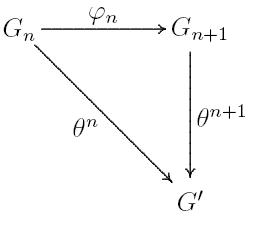
If G' is a group and we have homomorphisms \theta^n:G^n\rightarrow G' such that the diagram

commutes for each n, that is \theta^n=\theta^{n+1}\varphi_n, then \theta^n=\theta^m\varphi_{nm} for all m\geq n.

Read the rest of this entry »

I am emailing a link of this to everyone on the class list every Thursday afternoon. If you are not receiving these emails or want to have them sent to another email address feel free to email me at jippo@campus.ie and I will add you to the mailing list.

The lecture notes are now ready and must be purchased at the SU printing shop in the student centre. They are priced at €10. I thought they’d be cheaper but they contain all the exercises, all the homeworks and a lot of exam papers.

Note that the notes are NOT available in An Scoláire on College Road. I know that some of ye have gone there and are returning to get these notes tomorrow.

They will not be there as I have not emailed him a copy of these notes.
The notes are available in the SU SHOP IN THE STUDENT CENTRE.

In the mean time please find the first two lectures here — up to but not including Section 1.2.

General Information

Lecturer

J.P. McCarthy

Office

Mathematics Research, Western Gateway Building

Meetings by appointment via email only.

Read the rest of this entry »

I am emailing a link of this to everyone on the class list every Wednesday morning. If you are not receiving these emails or want to have them sent to another email address feel free to email me at jippo@campus.ie and I will add you to the mailing list.

Lecture notes must be purchased at the SU printing shop in the student centre. They are priced at €8.


Note that the notes are NOT available in An Scoláire on College Road. Perhaps some of ye have gone there and he has said that he will print them for tomorrow.


Please do not buy them there as they have already been printed by a cheaper supplier.

The notes are available in the SU SHOP IN THE STUDENT CENTRE.


All that remains to be decided is the format/date, etc. of the homework. Hopefully I will have definitive information in the next week or two.

Test Results

First of all results are down the bottom. You are identified by the last five digits of your student number. The scores are itemized as you can see. At the bottom there are some average scores.

If you would like to see your paper or have it discussed please email me.

Students with no score were either absent in which case they score zero — or certified absent in which case their marks carry forward to the summer exam.

Marking Scheme, Continuous Assessment Summary and Remarks

Mostly under construction…

The Marking Scheme.

Read the rest of this entry »