
You are currently browsing the category archive for the ‘Grinds’ category.
Arguably, the three central concepts in the theory of differential calculus are that of a function, that of a tangent and that of a limit. Here we introduce functions and tangents.
Functions
When looking at differential calculus, two good ways to think about functions are via algebraic geometry and interdependent variables. Neither give the proper, abstract, definition of a function, but both give a nice way of thinking about them.
Algebraic Geometry Approach
Let us set up the plane, 

Now, perpendicular to the 
This is the plane,
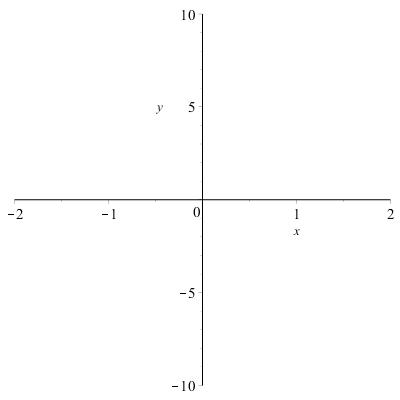
Now points on the plane can be associated with a pair of numbers 

Similarly, I can take a pair of numbers, say (-1,3), and this corresponds to a point on the plane.
This gives a duality:
points on the plane 
Now consider the completely algebraic objects

This post follows on from this post where the logic for the below is discussed. I am not going to define here what easy means!
Here is the strategy/guiding principle:
Fundamental Principle of Solving ‘Easy’ Equations
Identify what is difficult or troublesome about the equation and get rid of it. As long as you do the same thing to both numbers (the “Lhs” and the “Rhs”), the equation will be replaced by a simpler equation with the same solution.
There is a right way to think about equations and there is a wrong way to think about equations. Let us not speak of the wrong way…
The equations I have in mind are those equations written in the form

where the aim is to find all the real numbers
We aren’t always taught the logic behind solving equations. The first thing to say is that many of us are trained to believe that this ‘

written in them… the ‘answer’ of course being eight and the = sign almost suggests that we have to ‘do something’ to 
is correct, the pupil who writes e.g.

has written a statement just as true as 
Introduction
In Ireland at least, we first encounter fractions at age 6-8. At this age, because of our maturity, while we might be capable of some conceptional understanding, by and large we are doing things by rote and, for example, multiplying fractions is just something that we do without ever questioning why fractions multiply together like that. This piece is aimed at second and third level students who want to understand why the ‘calculus’ of fractions is like it is.
Mathematicians can in a rigorous way, write down what a fraction is… this piece is pitched somewhere in between these constructions — perhaps seen in an undergraduate mathematics degree — and the presentation of fractions presented in primary school. It is closer in spirit to a rigorous approach but makes no claims at absolute rigour (indeed it will make no attempt at rigour in places). The facts are real number axioms.
Defining Fractions
We will define fractions in terms of integers and multiplication.
To get the integers we first define the natural numbers.
Definition 1: Natural Numbers
The set of natural numbers is the set of counting numbers
,
together with the operations of addition (+) and multiplication
.
Consider the following question. 


There is a problem with the interpretation and I wouldn’t treat this particular exercise with much importance.
Suppose that
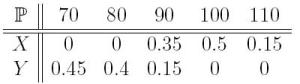

Find the expected average of the profit on a single room. Find the expected average of the profit on 1,000 rooms. Find the probability that the profit on 1,000 rooms is less than 20,000.
Solution : The expected average of a variable is given by:
![\mathbb{E}[X]=\sum_ix_i\mathbb{P}[X=x_i]=\sum_ix_ip_i](https://s0.wp.com/latex.php?latex=%5Cmathbb%7BE%7D%5BX%5D%3D%5Csum_ix_i%5Cmathbb%7BP%7D%5BX%3Dx_i%5D%3D%5Csum_ix_ip_i&bg=ffffff&fg=545454&s=0&c=20201002)
Now expected average is linear:
![\mathbb{E}[X+\lambda Y]=\sum_i(x_i+\lambda y_i)p_i=\sum_{i}x_ip_i+\lambda\sum_i y_i p_i](https://s0.wp.com/latex.php?latex=%5Cmathbb%7BE%7D%5BX%2B%5Clambda+Y%5D%3D%5Csum_i%28x_i%2B%5Clambda+y_i%29p_i%3D%5Csum_%7Bi%7Dx_ip_i%2B%5Clambda%5Csum_i+y_i+p_i&bg=ffffff&fg=545454&s=0&c=20201002)
![=\mathbb{E}[X]+\lambda\mathbb{E}[Y]](https://s0.wp.com/latex.php?latex=%3D%5Cmathbb%7BE%7D%5BX%5D%2B%5Clambda%5Cmathbb%7BE%7D%5BY%5D&bg=ffffff&fg=545454&s=0&c=20201002)
Introduction
This is just a short note to provide an alternative way of proving and using De Moivre’s Theorem. It is inspired by the fact that the geometric multiplication of complex numbers appeared on the Leaving Cert Project Maths paper (even though it isn’t on the syllabus — lol). It assumes familiarity with the basic properties of the complex numbers.
Complex Numbers
Arguably, the complex numbers arose as a way to find the roots of all polynomial functions. A polynomial function is a function that is a sum of powers of 
Definition
Let 


is a polynomial of degree 
In many instances, the first thing we want to know about a polynomial is what are its roots. The roots of a polynomial are the inputs 
Theorem: Cauchy-Schwarz Inequality
Let 


Proof : Consider the following quadratic function 

Note at this point that 


That is 


Now take square roots (remembering 

With the new Project Maths programme being developed as we speak, diligent students might like to know which proofs are examinable under the new syllabus so they know which to look at.
It can be difficult to sift through the syllabi at projectmaths.ie but I have gone through them and here are the proofs required.
This is a short note covering pensions as done in LC HL Project Maths. I do not know how pensions are calculated “in the real world”.
Fixed Number of Payouts
Suppose you want a pension that will pay you €20,000 per year for 25 years after retirement. How much should you have in your pension fund on retirement in order to have this? Suppose further that money can be invested at 3% per annum.
Method 1
Suppose we need the pension fund to contain €X on retirement. Let 


but then take out €20,000:

We then accrue interest on this (capital + interest = 

Now this accrues interest but €20,000 is withdrawn:


![p(25)=X(1+i)^{24}-20,000[(1+i)^{24}+(1+i)^{23}+\cdots+(1+i)+1]](https://s0.wp.com/latex.php?latex=p%2825%29%3DX%281%2Bi%29%5E%7B24%7D-20%2C000%5B%281%2Bi%29%5E%7B24%7D%2B%281%2Bi%29%5E%7B23%7D%2B%5Ccdots%2B%281%2Bi%29%2B1%5D&bg=ffffff&fg=545454&s=0&c=20201002)
Taken from here.
A manufacturing company keeps records of the numbers of defective items it produces per day. A random sample of days was selected. From their records, the company calculated the proportion of defective items produced per day. The frequency distribution of of proportions defective is as follows:
|
Proportion Defective |
Number of Days |
|
0 – 1% |
66 |
|
1 – 2% |
44 |
|
2 – 3% |
32 |
|
3 – 4% |
19 |
|
4 – 5% |
8 |
|
5 – 6% |
5 |
|
6 – 8% |
4 |
|
8% or more |
2 |
(a)
Draw a histogram for the distribution on proportions defective. Comment on its shape.
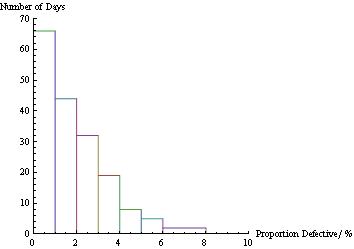
The histogram is skewed to the left towards 0.
(b)
Explain how you determined the heights of the bars for the last two frequency classes in preparing the histogram.
A histogram is constructed such that the area under each bar is equal to the number in the class interval. For the 6 – 8% class interval the base was 2 and the number in the class interval was 4 so we wanted height 
(c)
Provide a numerical measure to describe the proportions defective. Justify your choice of numerical measure.
Using the formula for the mean, 

where the sum is over all class intervals where 


We will however crop the 8 – 100% class to 8 – 10% to prevent a massive bias here. This will improve our calculation because any data above 10% is clearly an outlier (which is bad for the mean — see below).
Thus we get

We use the mean as there are not too many outliers and while the data is skewed, the data is relatively spread out.
(d)
Calculate the first quartile and interpret it’s value. State any assumptions you make. Assess whether these assumptions are valid.
There are 180 days in total so one quarter is 45. Now the lowest 45 are in the class interval 0 – 1% which actually includes 66 elements. Hence we look to take just 
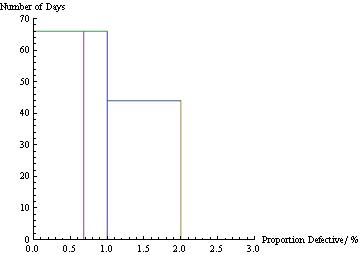
So the first quarter lies between 0 and 0.682%… therefore the first quartile is 0 — 0.682%. The interpretation is that the 25% best days have less than 0.682% defections.
To do this we assume that the distribution is uniform across the class interval 0 – 1%.
While this answer may well be accurate we can’t be too sure — particularly when the model suggest there are days with very little defections. For example, this assumption demands that there is a day when there are 0.015% defections; i.e. 1 in 6,666 — but does the manufacturer ever make this many a day?
(e)
The manufacturing company operates a policy which specifies that if the proportion defective exceeds 4.75% on any given day, an investigation of the manufacturing process must be undertaken. Estimate the percentage of days on which such an investigation would be undertaken.
Looking at the histogram there were 5+4+2=11 days when the proportion defective exceeded 5%. Now the 4.75 – 5% class sub-interval corresponds to 1/4 of the 4 – 5% class interval — that is 2 days. Hence we have 11+2=13/180 days when the proportion defective exceeded 4.75%. 13/180 translates to an estimation of 7.2% of days of proportions defective exceeding 4.75%.
(f)
The manufacturing company reviewed the policy referred to in part (e). They want to change the cut-off for the proportion defective that necessitates the investigation of the manufacturing process (currently 4.75%). Estimate the cut-off that should be used to ensure that the percentage of days on which the investigations would be undertaken is at most 5%.
We want to adjust the 7.2% above to 5%. 5% of 180 days is nine days. So which were the nine worst days? We have six days worse than 6% and then we want to take 3 of the five bad days in 5 -6% class interval to make up the worst nine days. Now we want to take, therefore, the class sub-interval 5.4 – 6%, which is 3/5 of that interval. Hence the new threshold is 5.4% (which estimates an investigation on 5% of days).

 J.P. McCarthy: Math Page
Recent Comments