
You are currently browsing the category archive for the ‘MATH7019’ category.
I recommend continuing to aim for seven hours per week of MATH7019 but you may want to continue working on Chapter 2/Assignment 2 material before viewing the Week 7 lectures. There are no exercises for the Week 7 lectures.
Assignment 2
Assignment 2 is now available. It has a deadline the end of Week 8, Friday 20 November.
Week 7
Your focus at this time should be on Assessment 2: this includes catching up on Chapter 2 lectures and exercises, which were front-loaded into the Week 6 announcement.
Lectures
Not much here: 48 minutes which can be watched in about 70 minutes.
- Random Variables I (27 minutes)
- Random Variables II (20 minutes)
Exercises
Same as Week 6.
You can (carefully) take photos of your work and submit to the Week 7 Exercises.
Submit the images as a single pdf file. To do this, select all the images in a folder, right-click and press print. It will say something like How do you want to print your pictures? Press (Microsoft?) Print to PDF. If possible choose an orientation that has all the images in portrait.
Read the rest of this entry »This is being released early so that those who want to work on the Chapter 2 material and get ahead for Assignment 2, perhaps during Reading Week, may choose to do so. At the time of writing I have not decided when Assignment 2 will become available but all relevant lectures have been recorded here.
There is more than 7 hours learning tasks to get through here: realistically this learning will take place primarily over three weeks:
- (For those getting ahead) Reading Week (26 October to 1 November)
- Week 6
- Week 7 (only a little bit of new material)
Again the target/recommendation is 7 hours per week (subject of course to your own time management around other modules, etc.).
Assignment 2
I had said that I would make Assignment 2, based on Chapter 2, available the morning after Assignment 1 is due. Instead I have made available, via the Week 6 announcement, the rest of the Chapter 2 material.
I will make Assignment 2 available sometime around the end of week 6, Monday of Week 7. It has a deadline the end of Week 8, Friday 20 November.
Week 6
Lectures
There is a lot of video here: two hours and 20 minutes… about three and a half hours of time… but the last video can be kept perhaps for Week 7 (9 – 15 November), and Week 7 is going to have very little video.
- Fixed End Beams II (24 minutes)
- Cantilevers (29 minutes)
- Beams: Summary (10 minutes — I got a bit lazy, this is an old video: in the new manual the material is covered on p.104, 105, and p.109/110.)
- Euler Method: Theory (27 minutes)
- Euler Method: Examples (23 minutes)
- Three Term Taylor Method (26 minutes — this is really Chapter/Assignment 4 material but follows on from the Euler Method)
Exercises
There are a lot of exercises here. You might consider using the Reading Week to get a little ahead of this work.
You must understand that:
Any and all submitted work will receive feedback.
This includes work submitted late (i.e. Week 4 exercises submitted in Week 5), or work emailed to me. It is easiest for me however if work is:
- Submitted on Canvas
- Properly labelled (page number and question)
- Ideally work that you know is correct (i.e. matches answer in the manual) not be submitted for feedback.
If you are completed the earlier Chapter 2 exercises, and/or feel confident watching the above video, you could look at:
- p. 99, Q. 1-9 (mixture of simply supported and fixed ends)
- p.107, Q.1-8 (mixture of simply supported, fixed ends, and cantilevers)
- p.121, Q. 1-4 (maybe just use Euler’s Method at this time).
You can (carefully) take photos of your work and submit to the Week 6 Exercises.
Submit the images as a single pdf file. To do this, select all the images in a folder, right-click and press print. It will say something like How do you want to print your pictures? Press (Microsoft?) Print to PDF. If possible choose an orientation that has all the images in portrait.
Week 7
There will be little new material in Week 7 as you will need time to focus on Chapter 2 with Assignment 2 due in Week 8.
We will begin Chapter 3 on Probability and Statistics. We will look in particular at Mutual Exclusivity and Independence.
Zoom
Unfortunately when I sent the survey about Zoom, I had not yet “submitted” the Canvas feedback on the Week 3 exercises, and so students opinions might not have been fully informed… at the moment one in three respondents to the survey say they “need Zoom time”, but some of them have not yet submitted to Canvas so… If you want to have your say on this please fill in this survey (Links to an external site.)
This difficult topic will be considered by me again, perhaps after the Reading Break.
Academic Learning Centre
Have you heard about CIT Maths Online (Links to an external site.) on Canvas? It’s full of helpful Maths and Stats resources, notes, quizzes and videos to help you throughout the whole year.
During this period of remote learning we will be using the Maths Online module on Canvas to offer Maths and Stats support to you and answer as many student questions as possible.
1-to-1 Maths appointments will be available through Zoom. There are 32 appointments available per week. Please log on to Maths online to see the most up to date resources and to book a 1-to-1 video call. Find out how to add it to your Canvas dashboard here https://studentengagement.cit.ie/alc/resources.maths (Links to an external site.).
Drop-in Maths is on every Tuesday from 12 – 2. Here you can drop in to ask our lecturer a quick Maths question.
If you have any other question about our remote Maths and Stats supports email Joy and Deirdre at academiclearning@cit.ie.
See the CIT Students tab above for further resources.
You are advised to to spend seven hours per week on MATH7019. This should comprise of however long it takes to watch the lectures, and then the rest of time should be spent emailing questions, doing exercises, completing assignments, and catch-up/revision.
30% Assignment 1
With a deadline of 23.59, Friday of Week 5, 23 October for Assignment 1, you must consider time management. Perhaps it might be a good idea to watch lectures, and then spend the rest of your MATH7019 time on Assignment 1.
In the context of this assignment I use the term Originality of Presentation and this video explains what this means.
As the video also explains two files must be submitted:
- a single *.pdf report consisting of your written answers as well as appropriate Excel content. Ideally the Excel work for Problem A near the written work for Problem A, etc.
- an Excel file
Ordinarily I assign late work a mark of zero. As explained in the video my strong recommendation is that you submit what you have done on time. Submitting late is only going to cause backlogs in your other modules.
Read the rest of this entry »Week 4
You are advised to to spend seven hours per week on MATH7019. This should comprise of however long it takes to watch the lectures, and then the rest of time should be spent doing exercises, emailing questions, and submitting work. Also catching up on material we have already covered, and doing exercises. At the time of writing, tutorials consist of you emailing questions and getting feedback on submitted work, but this is subject to change.
Lecture
Schedule about two and half hours to watch these 104 minutes of lectures. I recommend about 50% extra time as you will want to pause/rewind.
- Beams: Variables (28 minutes)
- Beams: Loads I (28 minutes)
- Beams: Loads II; and Review of Quadratics (26 minutes)
- Simply Supported Beams I (22 minutes)
Exercises
You need to schedule about four and half hours to work on this week’s exercises.
Do not hesitate to contact me with questions at any time. My usual modus operandi is to answer all queries in the morning.
- p. 72 (instructions) for p. 73, Q. 1-5
- p. 89, Q. 1
You can (carefully) take photos of your work and submit to the Week 4 Exercises those images on Canvas before midnight Sunday 18 October. The intention would be that after 09:00 Monday 19 October someone (I am going on two weeks paternity leave at some stage) will download all student work and reply with feedback.
If possible, submit the images as a single pdf file. To do this, select all the images in a folder, right-click and press print. It will say something like How do you want to print your pictures? Press (Microsoft?) Print to PDF. If possible choose an orientation that has all the images in portrait.
Week 5
We will then look at more examples of simply supported beams before moving onto fixed-end beams.
Academic Learning Centre
I would urge anyone having any problems with material that isn’t being addressed in the tutorial communication to use the Academic Learning Centre. If you are a little worried about your maths this semester you need to be aware of this resource. You will get best results if you come to the helpers there ith specific questions.
Assessment 1
Assessment 1 has a provisional hand-in of the end of Week 4, start of Week 5. Once the class list is established I can send on the student-number-personalised assessment.
Student Resources
Please see the Student Resources tab on the top of this page for information on the Academic Learning Centre, etc.
Week 3
You are advised to to spend seven hours per week on MATH7019. This should comprise of however long is recommended to watch the lectures, and then the rest of time should be spent doing exercises, emailing questions, and submitting work. At the time of writing, tutorials consist of you emailing questions and getting feedback on submitted work, but this is subject to change.
Chapter 1 Lectures
Schedule about an hour and a quarter to watch these 51 minutes of lectures. I recommend about 50% extra time as you will want to pause/rewind.
- Non-linear Laws and Linearisation (14 minutes)
- Log-Linear Least Squares: Example I (19 minutes)
- Log-Linear Least Squares Example II & Curve Fitting Summary (15 minutes)
Here are Chapter 1 slides if you have not purchased or printed off the manual.
Chapter 1 Exercises
You need to schedule about two and a quarter hours to work on these exercises.
- p.41, linearise.
- p.49, Q.1-7.
Chapter 2 Lectures
Schedule about an hour and a quarter to watch these 54 minutes of lectures. I recommend about 50% extra time as you will want to pause/rewind.
- Beams: Intro and Calculus Review (23 minutes)
- Intro to Differential Equations (4 minutes)
- Impulse and Step Functions (27 minutes)
Chapter 2 Exercises
You need to schedule about two and a quarter hours to work on these exercises.
- p. 59, Q. 1-2.
- p.65, Q.1-3.
Information for Exercises
Do not hesitate to contact me with questions at any time. My usual modus operandi is to answer all queries in the morning but sometimes I may respond sooner. I am not sure exactly what will happen with these questions while I am on paternity leave… hopefully someone will take these questions for you.
You can (carefully) take photos of your work and submit to the Week 3 Exercises those images on Canvas before midnight Sunday 11 October. The intention would be that after 09:00 Monday 12 October someone (I am going on two weeks paternity leave at some stage) will download all student work and reply with feedback.
If possible, submit the images as a single pdf file. To do this, select all the images in a folder, right-click and press print. It will say something like How do you want to print your pictures? Press (Microsoft?) Print to PDF. If possible choose an orientation that has all the images in portrait.
Week 4
We will plough into Chapter 2, looking at simply supported beams.
Academic Learning Centre
I would urge anyone having any problems with material that isn’t being addressed in the tutorial communication to use the Academic Learning Centre. If you are a little worried about your maths this semester you need to be aware of this resource. You will get best results if you come to the helpers there ith specific questions.
Assessment 1
Assessment 1 has a provisional hand-in of the end of Week 4, start of Week 5. Once the class list is established I can send on the student-number-personalised assessment.
Student Resources
Please see the Student Resources tab on the top of this page for information on the Academic Learning Centre, etc.
Week 2
You are advised to to spend seven hours per week on MATH7019. This should comprise of however long is recommended to watch the lectures, and then the rest of time should be spent doing exercises, emailing questions, and submitting work. At the time of writing, tutorials consist of you emailing questions and getting feedback on submitted work, but this is subject to change.
Lecture
Schedule about three hours to watch these 126 minutes of lectures. I recommend about 50% extra time as you will want to pause/rewind.
- Revision: Lines, Differentiation, Optimisation (18 minutes)
- Least Squares: Theory (19 minutes)
- Least Squares: Example I (22 minutes)
- Least Squares: Practise and Cramer’s Rule (19 minutes)
- Least Squares: Example II (21 minutes)
- Least Squares: Example III (23 minutes)
- Correlation (4 minutes)
Here are Chapter 1 slides if you have not purchased or printed off the manual.
Exercises
You need to schedule about four hours to work on this week’s exercises.
Do not hesitate to contact me with questions at any time. My usual modus operandi is to answer all queries in the morning but sometimes I may respond sooner. I am not sure exactly what will happen with these questions while I am on paternity leave… hopefully someone will take these questions for you.
- p.34, Q. 1-4
- p.37, Autumn 2015
Additional (Harder) Exercises:
- p.22, show that
and
are both positive.
- p.26, repeat the page 22 analysis for
:

Partially differentiate this with respect to 


You can (carefully) take photos of your work and submit to the Week 2 Exercises those images on Canvas before midnight Sunday 4 October. The intention would be that after 09:00 Monday 5 October someone (I am going on two weeks paternity leave at some stage) will download all student work and reply with feedback.
If possible, submit the images as a single pdf file. To do this, select all the images in a folder, right-click and press print. It will say something like How do you want to print your pictures? Press (Microsoft?) Print to PDF. If possible choose an orientation that has all the images in portrait.
Week 3
We will start looking at non-linear models.
Academic Learning Centre
I would urge anyone having any problems with material that isn’t being addressed in the tutorial communication to use the Academic Learning Centre. If you are a little worried about your maths this semester you need to be aware of this resource. You will get best results if you come to the helpers there ith specific questions.
Assessment 1
Assessment 1 has a provisional hand-in of the end of Week 4, start of Week 5. Once the class list is established I can send on the student-number-personalised assessment.
Student Resources
Please see the Student Resources tab on the top of this page for information on the Academic Learning Centre, etc.
Facetime
Some Facetime with me: click here.
Manuals
The lectures are being delivered via pre-recorded lectures. As you will see, the lectures use a manual that contain all the lecture material, via gaps that are filled in during lectures, and exercises. I tend to use a number of colours during lectures, and pencil, so you might want to consider ordering some of these:
In a sliding scale from best to worst, in my opinion, here are your options for using this manual. There are other options but I cannot recommend them. If you do option one you have all your notes in one place and can follow the lectures as if you were in the classroom.
- Email copy.centre@cit.ie and tell them you want to order a bound copy of MATH7019 Manual Winter 2020. The manuals can be collected from Reprographics beside the Student Centre. Note that this is a cash-free area so you will need to put the appropriate amount of funds on your student card. At the time of writing I do not know the cost but it will be of the order of €15. This seems like a lot of money for a manual but with all the materials (including worked examples, summaries, etc) it comes to about 187 pages and provides a comprehensive resource for this module.
- Print off the manual at home or somewhere else. Click here here to find a copy.
- I am going to scan and email the completely slides. You can keep these somewhere for your notes. You could print these or keep digital copies. Here is Chapter 1.
Week 1
You are advised to to spend seven hours per week on MATH7019. This should comprise of however long is recommended to watch the lectures, and then the rest of time should be spent doing exercises, emailing questions, and submitting work. At the time of writing, tutorials consist of you emailing questions and getting feedback on submitted work, but this is subject to change.
There is probably less than two and half hours here for Week 1: this might be nice to ease yourself back into things, but if you are hungry for more material feel free to jump into Week 2 (see Canvas announcements).
Read the rest of this entry »Mathematics Exam Advice
- The first piece of advice is to read questions carefully. Don’t glance at a question and go off writing: take a moment to understand what you have been asked to do.
- Don’t use tippex; instead draw a simple line(s) through work that you think is incorrect.
- For equations, check your solution by substituting your solution into the original equation. If your answer is wrong and you know it is wrong: write that on your script.
If you do have time at the end of the exam, go through each of your answers and ask yourself:
- have I answered the question that was asked?
- does my answer make sense? If no, say so, and then try and fix your solution.
- check your answer (e.g. for a fitted curve or beam function, input values and see do they make sense; substitute your solution into equations; check your answer against a rough estimate; or what a picture is telling you; etc). If your answer is wrong, say so, and then try and fix your solution.
Student Feedback
You are invited to give your feedback on my teaching and this module here.
Tutorial Split
I am not sure what is going on with Leonard’s classes but I will be present this Friday, tomorrow 6 December for tutorials in A243L (11:00) and A213B (12:00).
Week 12
On Monday we finished off Chapter 4 by looking at Error Analysis. Better exercises than the book here (including corrections to the sheet handed out in class). We then had over two and a half hours of tutorial time for lectures, and another tutorial on Friday.
Student Feedback
You are invited to give your feedback on my teaching and this module here.
Tutorial Split
I am not sure what is going on with Leonard’s classes but I will be present this Friday and next Friday for tutorials in A243L (11:00) and A213B (12:00).
Assessment 2 — Results
These have been sent to you. Comments to follow.
Week 11
We had a tutorial dedicated to differentiation on Monday.
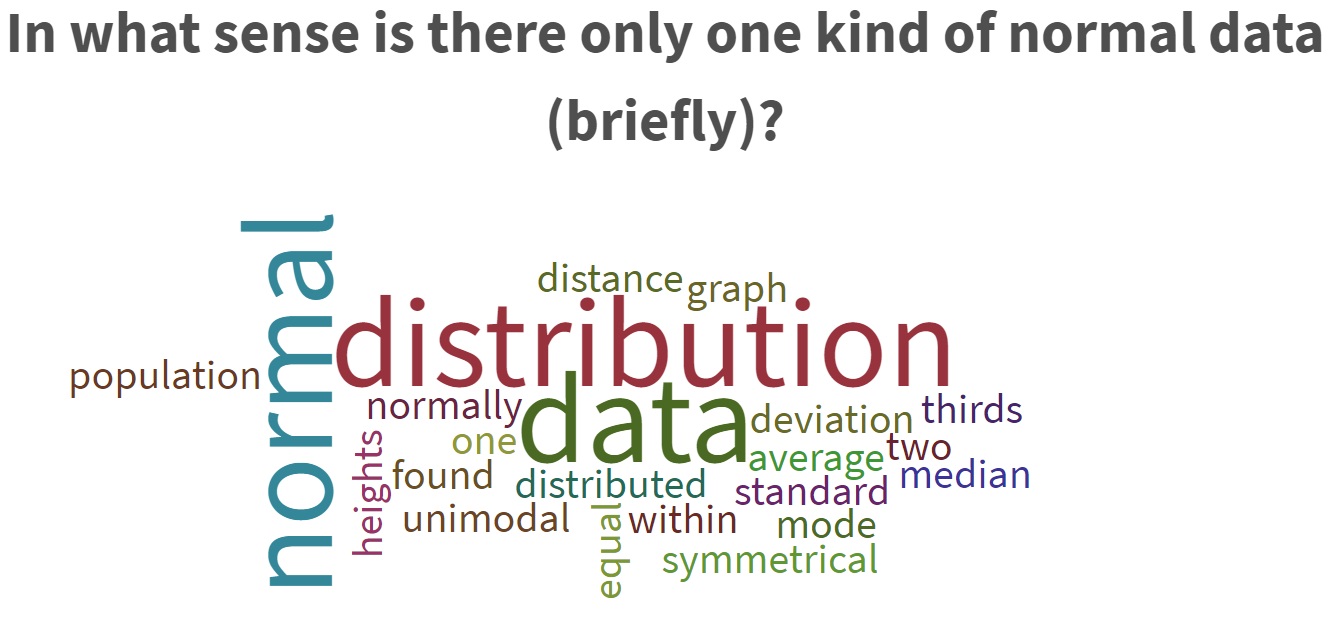
We tried to look at a Probability and Statistics Word Cloud on Wednesday. It was a disaster as my computer froze… anyway:
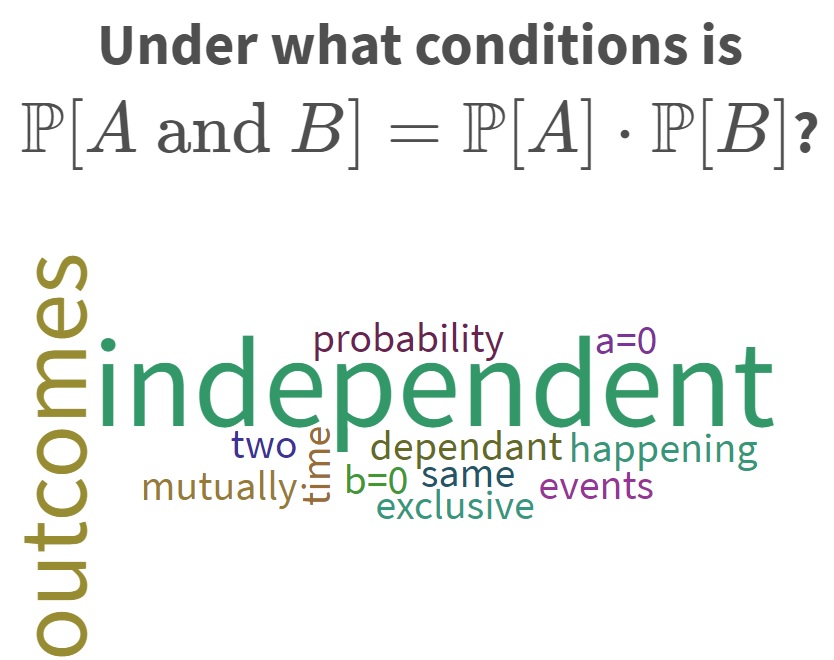
My answer: when 

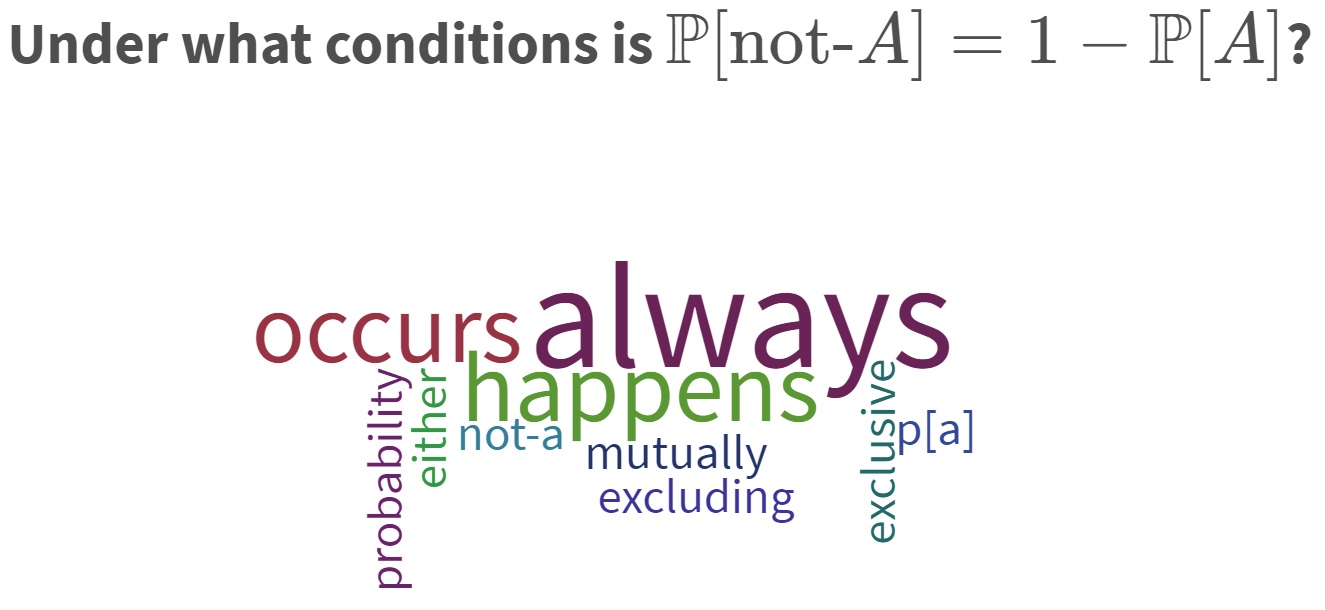
My answer: Always

My answer: bell-shaped curve.
A difficult one. My answer: Every probability/area under a bell curve can be calculated by transforming the area to a 
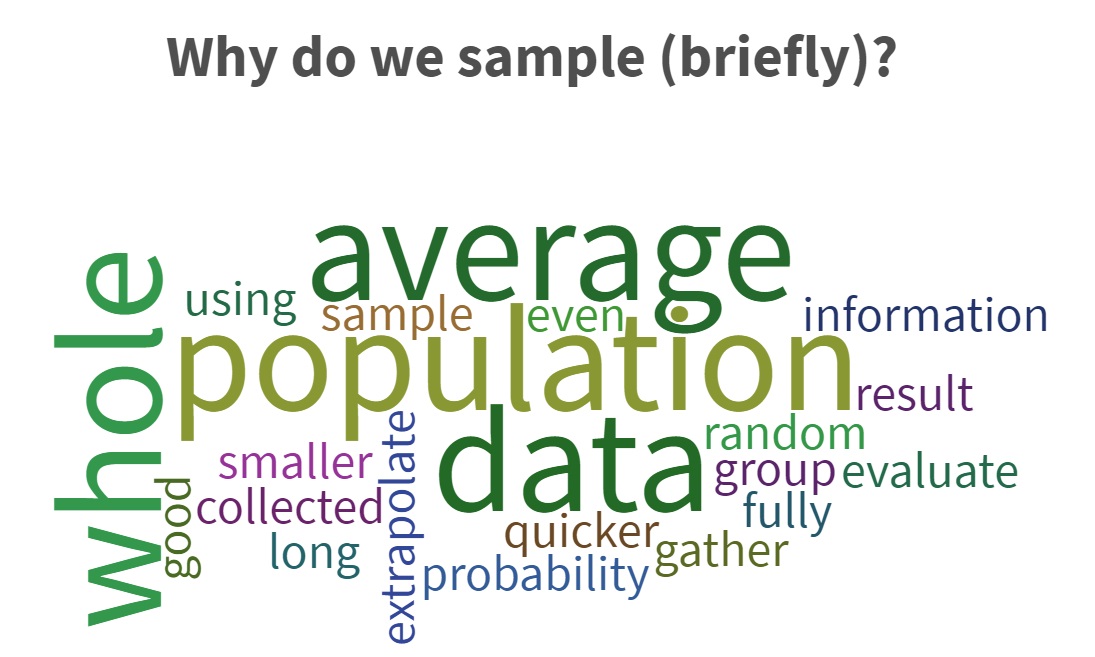
My answer: To infer things about the population, e.g. the population mean.
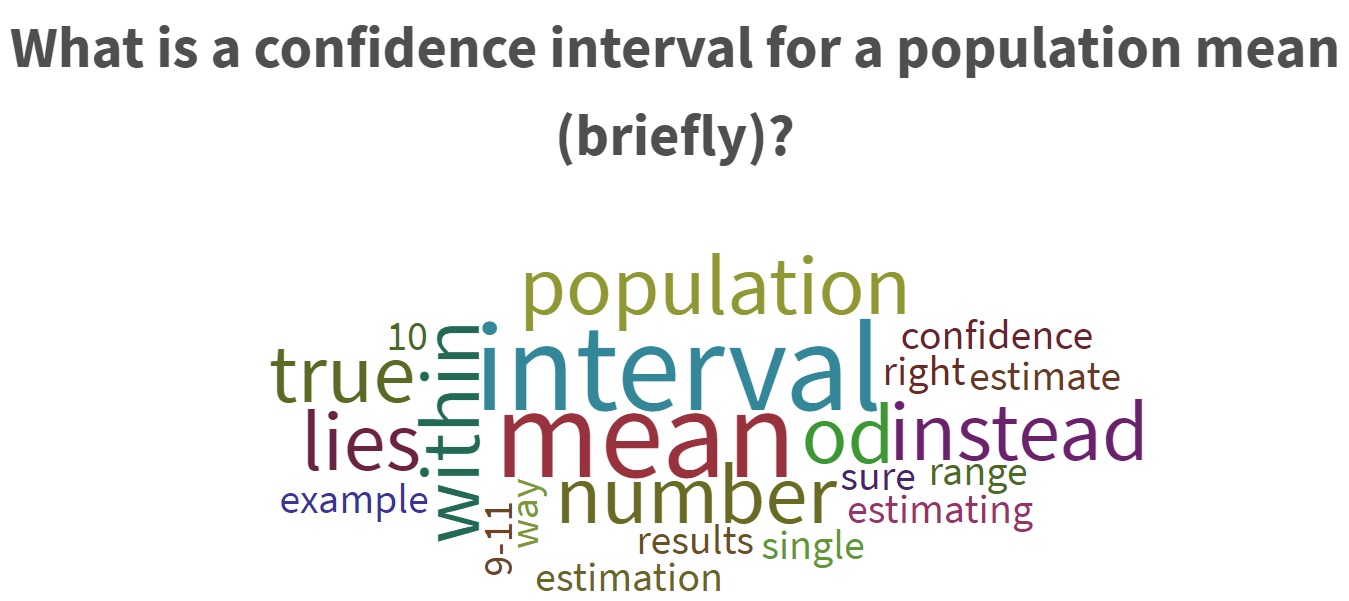
My answer: An interval that we believe the population mean is in (with a certain confidence).
On Wednesday and Thursday we had a look at more general Taylor Series: not just near 
Tutorial Split
See my email of 12 November regarding the Friday tutorial split for the rest of the semester.
Tomorrow we go back to the normal room of A213B for the 12:00 tutorial.
Assessment 2 — Corrections
Hopefully I can get these to ye within the week. I have some ‘man flu’ at the moment but hopefully that goes away.
Week 10
We had an extra tutorial on Monday. Most people concentrated on the Sample Question 3s on Probability and Statistics.
We finished off Chapter 3 — and spoke about the Bad and Good and Bad News — before we began Chapter 4 with a Revision of Differentiation and had a look at Maclaurin Series.
Oh: one thing — I never told ye what a p-value was (Sample Paper I Q. 3 (c) B ii.). It is the same as the level of significance, the probability of making a Type I Error… the answer is 5%.
Week 11
We will have a tutorial dedicated to differentiation on Monday.
We might look at a Probability and Statistics Concept MCQ on Wednesday.
On Wednesday and Thursday we will have a quick look at more general Taylor Series: not just near

 J.P. McCarthy: Math Page
Recent Comments