You are currently browsing the category archive for the ‘Random Walks on Finite Quantum Groups’ category.

Taken from Random Walks on Finite Quantum Groups by Franz & Gohm

In this section we will show how one can recover a classical Markov chain from a quantum Markov chain. We will apply a folklore theorem that says one gets a classical Markov process, if a quantum Markov process can be restricted to a commutative algebra.

We might like to do more. This result recovers a Markov chain — if the quantum process is in fact a random walk on a finite quantum group can we recover the group, the transition probabilities (yes), the driving probability measure?? 

Conjecture

If we restrict a random walk on a finite quantum group to a commutative subalgebra we can recover a random walk on a finite group.

For random walks on quantum groups we have the following result.

Theorem 6.1

Let A be a finite quantum group \{j_n\}_{n\geq 0} a random walk on a finite dimensional A-comodule algebra B, and B_0 a unital abelian sub-*-algebra of B. The algebra B_0 is isomorphic to the algebra of functions on a finite set, say B_0\cong F(X) where X={1,\dots,d}.

If the transition operator T_\phi of \{j_n\}_{n\geq 0} leaves B_0 invariant, then there exists a classical Markov chain \{\xi_n\}_{n\geq 0} with values in X, whose probabilities can be computed as time-ordered moments of \{j_n\}_{n\geq 0}, i.e.

P(\xi_0=i_0,\dots,\xi_\ell=i_\ell)=\Psi\left(j_0\left(\mathbf{1}_{\{i_0\}}\right)\cdots j_\ell\left(\mathbf{1}_{\{i_\ell\}}\right)\right)

for all \ell\geq 0 and i_0,\dots,i_\ell\in X.

Read the rest of this entry »

Taken from Random Walks on Finite Quantum Groups by Franz & Gohm

In this section we want to represent the algebras on Hilbert spaces and obtain spatial implementations for the random walk. On a finite quantum group A we can introduce an inner product

\langle a,b\rangle=\eta(a^*b),

where a,\,b\in A and \eta and \eta is the Haar state. Because the Haar state is faithful we can think of A as a finite dimensional Hilbert space. Further we denote by \|\cdot\| the norm associated to this inner product. We consider the linear operator

W:A\otimes A\rightarrow A\otimes Ab\otimes a\mapsto \Delta(b)(1_A\otimes a).

It turns out that this operator contains all information about the quantum group and thus it is called its fundamental operator. We discuss some of its properties.

Read the rest of this entry »

Taken from Random Walks on Finite Quantum Groups by Franz & Gohm.

The most important special case of the construction from here is obtained when we choose B=A and \beta=\Delta. Then we have a random walk on a finite group A. Let us first show that this indeed a generalisation of a left-invariant random walk (I must be careful to remember this — I have always worked with right-invariant walks that multiply on the left: these multiply on the right.) Using the coassociativity of \Delta we see that the transition operator T_\phi=(I_A\otimes\phi)\circ\Delta satisfies the formula (\checkmark)

\Delta\circ T_\phi=(I_A\otimes T_\phi)\circ\Delta.

Suppose now that B=A consists of functions on a finite group G and \beta=\Delta is the comultiplication which encodes the group multiplication, i.e.

\displaystyle\Delta\left(\mathbf{1}_{\{g\}}\right)=\sum_{h\in G}\mathbf{1}_{\{gh^{-1}\}}\otimes\mathbf{1}_{\{h\}}=\sum_{h\in G}\mathbf{1}_{\{h^{-1}\}}\otimes\mathbf{1}_{\{hg\}}.

We also have

\displaystyle T_\phi\left(\mathbf{1}_{\{g\}}\right)=\sum_{h\in G}p(h,g)\mathbf{1}_{\{h\}},

where [p(h,g)] is the stochastic matrix.

This calculation makes perfect sense when p(h,g)=\phi\left(\mathbf{1}_{h^{-1}g}\right) and since we’ve said nothing about what \phi should be this makes perfect sense — and with linearity we get all the properties of the stochastic operator we could possibly want. 

Now calculate

\displaystyle (\Delta\circ T_\phi)\mathbf{1}_{\{g\}}=\Delta\left(\sum_{h\in G}p(h,g)\mathbf{1}_{\{h\}}\right)=\sum_{t\in G}\mathbf{1}_{\{t^{-1}\}}\otimes\sum_{h\in G}p(h,g)\mathbf{1}_{\{th\}},

\displaystyle[(I_{F(G)}\otimes T_\phi)\circ\Delta]\mathbf{1}_{\{g\}}=(I_{F(G)}\otimes T_\phi)\sum_{t\in G}\mathbf{1}_{\{t^{-1}\}}\otimes\mathbf{1}_{\{tg\}}

\displaystyle =\sum_{t\in G}\mathbf{1}_{\{t^{-1}\}}\otimes \sum_{s\in G} p(s,tg)\mathbf{1}_{\{s\}}.

Now reindex the second sum here s\rightarrow h and at the same time map s\rightarrow th and we may then conclude that p(h,g)=p(th,tg) for all g,\,h\,t\in G. This is the left invariance of the random walk.

For random walks on a finite quantum groups there are some natural special choices for the initial distribution \psi. On the one hand, one may choose \psi=\varepsilon (the counit) which in the commutative case (i.e. for a group) corresponds to starting at the identity. Then the time evolution of the distributions is given by \varepsilon\star\phi^{\star n}=\star^{\star n}. In other words, we get a convolution semigroup of states.

Inasmuch as I can tell, we have

\psi\star \phi=(\psi\otimes\phi)\circ\Delta.

On the other hand, stationarity of the random walk can be obtained if \psi is chosen such that \psi\star\phi=\star. In particular, we may choose the unique Haar state \eta of the finite quantum group A.

Proposition 4.1

The random walks on a finite quantum group are stationary for all choices of \phi if and only if \psi=\eta.

Proof : This follows from Proposition 3.2 together with the fact that the Haar state is characterised by its right invariance.

Quantisation

I had been of the understanding that a quantisation looks as follows. There is some process or property P(X) of a space X which we want to examine. Depending on the type of space X, from a suitable algebra of complex functions on XF(X), we can recover and examine many of the properties of P(X) by instead looking at F(X): we essentially have the identification X\leftrightarrow F(X). When the process/ property P(X) is about a space then it is said to be classical or commutative because for any x\in X and f,\,g\in F(X) we have that fg=gf because fg(x)=f(x)g(x)=gf(x) as the f(x),\,g(x) lie in the commutative algebra \mathbb{C}.

Now from X we know about F(X) and vice versa. Now a suitably chosen F(X) is just a commutative C*-algebra so what about a non-commutative C*-algebra F — can we examine it’s “underlying space” in the same way?

So essentially, this means that I thought you quantised objects, such as Markov chains, by replacing a commutative C*-algebra F(X) with a not-necessarily commutative one. (This roughly follows my interpretation as per this)

Read the rest of this entry »

Taken from Franz & Gohm.

Let return to the map b:M\times G\rightarrow M considered in the beginning of the previous section. If G is a group, then b:M\times G\rightarrow M is called a left action of G on M, if it satisfies the following axioms expressing associativity and unit (\checkmark0),

b(b(x,g),h)=b(x,hg), and b(x,e)=x

for all x\in Mg,h\in G; and where e\in G is the identity. As before we have the unital *-homomorphisms \alpha_g:F(M)\rightarrow F(M). Actually, in order to get a representation of G on F(M), i.e. \alpha_g\alpha_h=\alpha_{gh} for all g,\,h\in G we modify  the definition and use \alpha_g(f)(x):=f(b(x,g^{-1})). (Otherwise we get an anti-representation. But this is a minor point at this stage). In the associated coaction \beta:F(M)\rightarrow F(M)\otimes F(G) the axioms above are turned into the coassociativity and counit properties. These make perfect sense not only for groups but also for quantum groups and we state them at once in this more general setting. We are rewarded with a particular interesting class of quantum Markov chains associated to quantum groups which we call random walks and are the subject of this lecture.

Read the rest of this entry »

Taken from Random Walks on Finite Quantum Groups by Franz & Gohm.

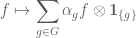
To motivate the definition of quantum Markov chains let us start with a reformulation of the classical Markov chain. Let M,\,G be finite sets. Any map b:M\times G\rightarrow M may be called an action of G on M. Let F(M) and F(G) be the *-algebra of complex functions on M and G. For all g\in G, we have unital *-homomorphisms (\checkmark) \alpha_g:F(M)\rightarrow F(M) given by (\alpha_g f)(x):=f(b(x,g)). They can be put together into a single unital *-homomorphism

\displaystyle\beta:F(M)\rightarrow F(M)\otimes F(G)\displaystyle f\mapsto \sum_{g\in G}\alpha_g f\otimes\mathbf{1}_{\{g\}},

where \mathbf{1}_{\{g\}} is the indicator function. We get a natural non-commutative generalisation just by allowing the algebras to become non-commutative (by replacing the C*-algebras F(M) and F(G) by more general (!), not necessarily commutative C*-algebras).

Let B and A be unital C*-algebras and \beta:B\rightarrow B\otimes A a unital *-homomorphism. Here B\otimes A is the spatial tensor product. Then we can build up the following iterative scheme for n\geq 0:

j_0:B\rightarrow Bb\mapsto b

j_1:B\rightarrow B\otimes Ab\mapsto\beta(b)=b_{(0)}\otimes a_{(0)}.

(Sweedler’s notation b_{(0)}\otimes b_{(1)} stands for \sum_i b_{0i}\otimes b_{1i} and is very convenient for writing formulas).

\displaystyle j_n:B\rightarrow B\otimes\bigotimes_{1}^nAj_n=(j_{n-1}\otimes I_A)\circ\beta,

\displaystyle b\mapsto j_{n-1}(b_{(0)})\otimes b_{(1)}\in \left(B\otimes\bigotimes_1^{n-1}A\right)\otimes A.

Read the rest of this entry »