Remarks in italics are by me for extra explanation. These comments would not be necessary for full marks in an exam situation. Exercises taken from https://jpmccarthymaths.wordpress.com/2011/02/01/math6037-general-information/

Question 1

(a)

Now:

\frac{d}{dx}x^2=2x and \frac{d}{dx}5x=5,

hence:

\int_0^1 (2x+5)\,dx=\left[x^2+5x\right]_0^1 =(1^2+5(1))-(0^2+5(0))=6

(b)

There is no obvious anti-derivative and there is no obvious manipulation hence we are looking for the function-dervative pattern to make a substitution (or else use the LIATE rule). Notice that the top is the derivative of the bottom. Hence we will let u be the function; i.e. the bottom:

Let u=x^2+5x+1:

\frac{du}{dx}=2x+5

\Rightarrow dx=\frac{du}{2x+5}

Now put everything back into the integrand, suppressing the limits:
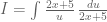
I=\int \frac{2x+5}{u}\,\frac{du}{2x+5}

=\int \frac{du}{u}=\ln u =[\ln (x^2+5x+1)]_0^1

=\ln(1^2+5(1)+1)-\ln(0^2+5(0)+1)

Now, what do we have to raise e to, to get 1? i.e. e^?=1; well e^0=1. Hence \ln 1=0:

I=\ln 7.

Read the rest of this entry »

Express every solution of the given system as the sum of a specific solution plus a solution of the associated homogeneous system:

2x_1+x_2-x_3-x_4=-1

3x_1+x_2+x_3-2x_4=-2

-x_1-x_2+2x_3+x_4=2

-2x_1-x_2+2x_4=3

Solution: This question essentially asks you to use Theorem 3.4. Theorem 3.4 states that to solve the linear system of equations;

A\mathbf{X}=\mathbf{b}      (*)

it is sufficient to find some/ any (among all the solutions – if one exists) solution \mathbf{X}_1, find the solution to the homogeneous system, \mathbf{X}_0:

A\mathbf{X}=\mathbf{0},

and that the general solution to (*) will be \mathbf{X}_1+\mathbf{X_0}.

Realistically you wouldn’t use this method to solve this problem (Q.4 (ii)) – we are more seeing how this theorem works as ye will be using it later in solving linear differential equations.

Read the rest of this entry »

Suppose we want to maximise (or minimise) the linear function C(x,y)=\lambda x+\mu y on a set S. Suppose S is defined as the solution of  the system of three linear inequalities:

a_1x+b_1y\leq c_1

a_2x+b_2y\leq c_2

a_3x+b_3y\leq c_3

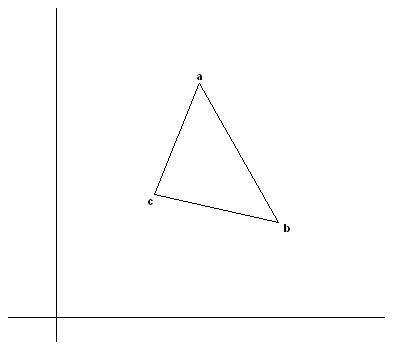
In general, the solution set of these inequalities will be a triangular sea of x and y:

The points \mathbf{a}, \mathbf{b}, \mathbf{c} are the extreme points on S. We want to prove that C(x,y) is maximised at \mathbf{a}, \mathbf{b} \text{ or } \mathbf{c}.

Read the rest of this entry »

I am emailing a link of this to everyone on the class list every week. If you are not receiving these emails or want to have them sent to another email address feel free to email me at jippo@campus.ie and I will add you to the mailing list.

This Week

After introductions, we gave a motivation for studying differential equations and probability & statistics. We then did a very quick review of calculus and first order separable differential equations.

Typeset Notes

This is what we have thus far.

Tutorials

Tutorials Tuesday 6 – 8 pm will not start until week 4. After that we will have tutorials in weeks 4, 5, 6, 8, 10, 12.

Supplementary Notes

A note on integration.

I am emailing a link of this to everyone on the class list every week. If you are not receiving these emails or want to have them sent to another email address feel free to email me at jippo@campus.ie and I will add you to the mailing list.

This Week

After introduction, we gave a motivation for studying linear systems and probability & statistics. We then looked at linear systems and how to solve them using elimination algorithms.

Typeset Notes

This is what we have thus far.

Maple Resource

A Maple tutorial we might look at in Week 3.

Module Description:

MATH6037

More detailed General Information on this module (* not all one hundred percent accurate at time of publication) may be found after the table of contents in this set of incomplete notes:

MATH6037 Lecture Notes

(last updated 04 May. )

Module Description:

MATH6014

More detailed General Information on this module (* not all one hundred percent accurate at time of publication) may be found after the table of contents in this set of incomplete notes:

MATH6014 Lecture Notes

(last updated 04 May)

February 16

Additional exercises have been added to the section on Basic Algebra (go to the link to the notes above).

Additional exercises are also to be found in the suggested reading.

Past exam papers also comprise additional exercises.

I will strive to include more exercises in future — and will have more algebra exercises in time. I will furnish ye with equation exercises on Friday.

An exam paper from 2007/08:

Technological Mathematics 1

I have continued to work through Murphy http://books.google.com/books?id=emNvQgAACAAJ&dq=gerald+murphy+c*+algebras+and+operator+theory&h

I managed to get through two sections last week: Compact Hilbert Space Operators and The Spectral Theorem. I also have 9 of 12 chapter 2 exercises completed. I have been writing my study up here and this is proving fruitful on three counts:

  1. I can put questions in red for my supervisor to see
  2. I am not happy putting up something on this page that I haven’t justified to myself. This means I have to fill in some extra steps (in blue)
  3. I should have a nice set of notes to peruse should I need them

Unfortunately this week will be mostly concerned with preparing lectures for two modules that I will be lecturing in CIT:

MATH6014

MATH6037

Let X be a compact Hausdorff space and H a Hilbert Space. A spectral measure E relative to (X,H) is a map from the \sigma-algebra of all Borel sets of X to the set of projections in B(H) such that

  1. E(\emptyset)=0E(X)=1;
  2. E(S_1\cap S_2)=E(S_1)E(S_2) for all Borel sets S_1,\,S_2 of X;
  3. for all x,y\in H, the function E_{x,y}:S\mapsto \langle E(S)x,y\rangle, is a regular Borel complex measure on X.

A Borel measure \mu is a measure defined on Borel sets. If every Borel set in X is both outer and inner regular, then \mu is called regular. A measurable A\subset X is inner and outer regular if

\mu(A)=\sup\left\{\mu(F):\text{ closed }F\subset A\right\}, and

\mu(A)=\inf\left\{\mu(G):A\subset G\text{ open }\right\}

Denote by M(X) the Banach space of all regular Borel complex measures on X, and by B_\infty(X) the C*-algebra of all bounded Borel-measurable complex-valued functions on X (I assume with respect to the Borel \sigma-algebra on \mathbb{C}).

Read the rest of this entry »

This starts on P.58 rather than p.53. I underline my own extra explanations, calculations, etc. The notation varies on occasion from Murphy to notation which I prefer.

H is always a Hilbert space. H^1 is the set of unit vectors.

If P is a finite-rank projection on H, then the C*-algebra A=PB(H)P is finite dimensional. To see this, write P=\sum_{j=1}^ne_j\otimes e_j, where e_1,\dots,e_n\in H. If T\in B(H), then

PTP=\sum_{j,k=1}^n(e_j\otimes e_j)T(e_k\otimes e_k)=\sum_{j,k=1}^n\langle Te_k,e_j\rangle (e_j\otimes e_k)

Hence, A\subset <e_j\otimes e_k>, (j,k=1,\dots,n) (*), and therefore is finite dimensional.

Read the rest of this entry »