Student Feedback

You are invited to give your feedback on this module here.

Assessment 2

Results have been emailed to you. You have a chance to see your work this Friday in tutorial. Some comments here.

Week 11

We looked at more general Taylor Series: not just near a=0 and also for functions of several variables.

Week 12

We will finish off Chapter 4 by looking at Error Analysis.

Week 13

We will go through last year’s exam on the board and then I will answer your questions if there are any. If there are none I will help one-to-one. Usual class times and locations.

We will also have tutorials on Friday 8 December in the usual times and venues.

Study

Please feel free to ask me questions about the exercises via email or even better on this webpage.

Student Resources

Please see the Student Resources tab on the top of this page for information on the Academic Learning Centre, etc.

The Fibonacci Sequence is given by the recursive definition:

\displaystyle F(n)=\begin{cases}1 & \text{ if }n=1\text{ or }n=2\\ F(n-1)+F(n-2) & \text{ otherwise } \end{cases}

Exercises

  • Prove that if F(n)=x^n satisfies the recurrence relation

F(n+2)=F(n+1)+F(n),

that x=\frac{1\pm \sqrt{5}}{2}.

  • If the Fibonacci Sequence is given by:

\displaystyle F(n)=\frac{\phi^n-\psi^n}{\sqrt{5}},

where \phi=\frac{1+\sqrt{5}}{2} and \psi=\frac{1-\sqrt{5}}{2}, prove that for large n:

F(n+1)\approx \phi\cdot F(n)

  • Use ten terms of the Fibonacci Sequence to write down a sequence of rational approximations to \phi.


  • Using \displaystyle F(n)=\frac{\phi^n-\psi^n}{\sqrt{5}}, where \phi=\frac{1+\sqrt{5}}{2} and \psi=\frac{1-\sqrt{5}}{2}, or otherwise, find F(22).

This follows on from this post.

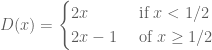
Recall the Doubling Mapping D:[0,1)\rightarrow [0,1) given by:

\displaystyle D(x)=\begin{cases} 2x & \text{ if }x<1/2 \\ 2x-1 & \text{ if }x\geq 1/2 \end{cases}

At the end of the last post we showed that this dynamical system displays sensitivity to initial conditions. Now we show that it displays topological mixing (a chaotic orbit) and density of periodic points.

First we must talk about periodic points.

Periodic Points

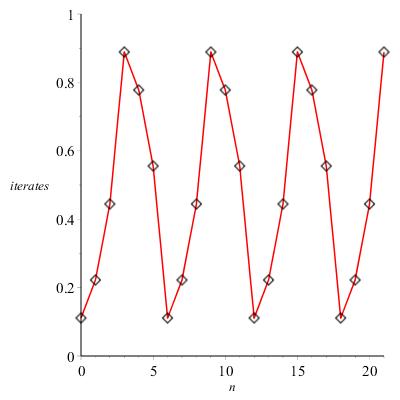
Consider, for example, the initial state \displaystyle x_0=\frac{1}{9}. The orbit of x_0 is given by:

\displaystyle \text{orb}(x_0)=\left\{\frac{1}{9},\frac29,\frac49,\frac89,\frac79,\frac59,\frac19,\frac29,\dots\right\}

Here we see \frac19 repeats itself and so gets ‘stuck’ in a repeating pattern:

graph1

The orbit of x_0=1/9.

The orbit of any fraction, e.g. \displaystyle x_0=\frac{4}{243}, must be periodic, because \displaystyle D\left(\frac{i}{243}\right) is either equal to \displaystyle \frac{2i}{243} of \displaystyle \frac{2i-243}{243} and so the orbit consists only of states of the form:

\displaystyle \frac{i}{243},

and there are only 243 of these and so after 244 iterations, some state must be repeated and so we get locked into a periodic cycle.

If we accept the following:

Proposition

A fraction \frac{p}{q} has a recurring binary expansion:

\displaystyle \frac{p}{q}=0.b_1\dots b_m\overline{a_1a_2\dots a_n}_2,

then this is another way to see that fractions are (eventually) periodic. Take for example,

\displaystyle x_0=0.101,101,101,101,\dots_2=0.\overline{101}_2=\frac{5}{7}.

Read the rest of this entry »

Assessment 2

Has now been submitted. I am going to do my utmost to get these corrected ASAP.

Week 10

We looked at Hypothesis Testing and began Chapter 4 with a Revision of Differentiation. We looked then at Maclaurin Series.

Week 11

We will look at more general Taylor Series: not just near a=0 and also for functions of several variables.

Read the rest of this entry »

Assessment 2

Will be held on the Friday of Week 11 (24 November), at 09:00 in B214 (the usual lecture venue). A sample has been emailed and I also have hard copies with me. I strongly advise you that attending the tutorial alone may not be sufficient preparation for this test so you may have to devote extra time outside classes to study.

Week 10

In Week 10 explored Network Theory, or rather Graph Theory, in more depth. We looked at digraphs, connectedness, valency, walks, and trees.

Week 11

We will finish our study of Graph Theory by looking at Eulerian graphs, Fleury’s Algorithm, Hamiltonian graphs, and Dirac’s Theorem. We will then begin the last chapter on recursion. We have our test on Friday

Week 12

In Week 12 we will finish our study of recursion and perhaps do a little revision.

Week 13

In Week 13, perhaps we will have five tutorials (normal rooms and times) of which you are invited to up to four (your own tutorial slot plus the up to three of the lecture slots).


Study

Some students need to do extra work outside tutorials. Please feel free to ask me questions about the exercises via email or even better on this webpage.

Student Resources

Anyone who is missing notes is to email me.

Please see the Student Resources tab on the top of this page for information on the Academic Learning Centre, etc. There are some excellent notes on Blackboard for MATH6055.


Geometric Series

Let a,r\in\mathbb{R} be constants. Let \{a_n\} be a sequence of real numbers with the following recursive definition:

a_n=\begin{cases}a & \text{ if }n=1\\ r\cdot a_{n-1}&\text{ if }n>1\end{cases}.

Therefore the sequence is given by:

a,ar,ar^2,ar^3,ar^4,\dots

Such a sequence is called a geometric sequence with common ratio r.

When we add up the terms a sequence we have a geometric sum:

S_n=a+ar+ar^2+ar^3+\cdots ar^{n-1}.

Here S_n is the sum of the first n terms.

We can find a formula for S_n using the following ‘trick’:

r\cdot S_n=ar+ar^2+ar^3+\cdots ar^n

\Rightarrow a+r\cdot S_n-ar^n=S_n

\Rightarrow S_n(r-1)=a(r^n-1)

\displaystyle \Rightarrow S_n=\frac{a(r^n-1)}{r-1}.

Exercises

Assuming that |r|<1, find a formula for the geometric series

\displaystyle S_{\infty}=\lim_{n\rightarrow \infty}S_n.

Binary Numbers

Exercises

  • Write the following as fractions:

0.1_2,\,0.11_2,\,0.101_2.

  • Use infinite geometric series to show that:
    • 0.111\dots_2=1
    • 0.0111\dots_2=\frac12
    • 0.101010\dots_2=\frac23

Doubling Mapping

The doubling mapping D:[0,1)\rightarrow [0,1) is given by:

\displaystyle D(x)=\begin{cases}2x & \text{ if }x<1/2 \\ 2x-1 & \text{ of }x\geq 1/2\end{cases}.

Exercises

  • Find the first six iterates of the point x_0=\frac17 under D.
  • Find the first four iterates of the point

x_0=\frac{1}{2}+\frac{1}{2^2}+\frac{0}{2^3}+\frac{1}{2^4}=0.1101_2.

  • Where x has the binary representation

x = 0.a_1a_2a_3a_4a_5a_6a_7a_8\dots ,

write down expressions for D(x) and D^5(x).

  • Hence find points y, z \in [0, 1] such that y and z agree to 5 binary digits but D^N(y) and D^N(z) differ in the first binary digit for some N \in \mathbb{N}.
  • Describe the period-5 points of D.
  • Let w \in [0, 1] have a binary representation beginning w = 0.01001\dots  . Find a period-5 point \gamma of D such that w and \gamma agree to five binary digits.
  • Find a \delta \in [0, 1] such that there are iterates of \delta, D^{n_1}(\delta),D^{n_2}(\delta),D^{n_3}(\delta), with n_1, n_2, n_3 \in \mathbb{N}, that agree with 0.111 , 0.101, and 0.010, to three binary
    digits.

Sensitivity to Initial Conditions

Exercise

Let f(x)=4x\cdot (1-x). Where [0,1] is the set of states, and f:[0,1]\rightarrow [0,1] the iterator function, by looking at the first seven iterates of x_0=0.8 and y_0=0.81, show that this dynamical system displays sensitivity to initial conditions [HINT:4*ANS*(1-ANS)]


Test 2

Thursday 23 November at 09:00 in the usual lecture venue. You will be given a copy of these tables. Based on Chapter 3, samples at the back of Chapter 3 and also here (Q. 4 has a typo — it should be e^{-x}\sin(y)). I strongly advise you that attending tutorials alone will not be sufficient preparation for this test and you will have to devote extra time outside classes to study aka do exercises.

Week 10

We started Chapter 4 by looking at integration by parts. We started looking at completing the square.

Week 11

We will look at completing the square and work.

Read the rest of this entry »

Dynamical Systems

A dynamical system is a set of states S together with an iterator function f:S\rightarrow S which is used to determine the next state of a system in terms of the previous state. For example, if x_0\in S is the initial state, the subsequent states are given by:

x_1=f(x_0),

x_2=f(x_1)=f(f(x_0))=(f\circ f)(x_0)=:f^2(x_0)

x_3=f(x_2)=f(f^2(x_0))=f^3(x_0),

and in general, the next state is got by applying the iterator function:

x_{i}=f(x_{i-1})=f^i(x_0).

The sequence of states

\{x_0,x_1,x_2,\dots\}

is known as the orbit of x_0 and the x_i are known as the iterates.

Such dynamical systems are completely deterministic: if you know the state at any time you know it at all subsequent times. Also, if a state is repeated, for example:

\text{orb}(x_0)=\{x_0,x_1,x_2,x_3,x_4=x_2,x_5\dots,\}

then the orbit is destined to repeated forever because

x_5=f(x_4)=f(x_2)=x_3,

x_6=f(x_5)=f(x_3)=x_4=x_2, etc:

\Rightarrow \text{orb}(x_0)=\{x_0,x_1,x_2,x_3,x_2,x_3,x_2,\dots\}

Example: Savings

Suppose you save in a bank, where monthly you receive 0.1\%=0.001 interest and you throw in 50 per month, starting on the day you open the account.

This can be modeled as a dynamical system.

Let S=\mathbb{R} be the set of euro amounts. The initial amount of savings is x_0=50. After one month you get interest on this: 0.001\times50, you still have your original 50 and you are depositing a further €50, so the state of your savings, after one month, is given by:

x_1=50+0.001\times 50+50=(1+0.001)50+50.

Now, in the second month, there is interest on all this:

interest in second month 0.001\times((1+0.001)50+50)=0.001x_1,

we also have the x_1=(1+0.001)50+50 from the previous month and we are throwing in an extra €50 so now the state of your savings, after two months, is:

x_2=x_1+0.001x_1+50=(1+0.001)x_1+50,

and it shouldn’t be too difficult to see that how you get from x_i\longrightarrow x_{i+1} is by applying the function:

f(x)=(1+0.001)x+50.

Exercise

Use geometric series to find a formula for x_n.

Weather

If quantum effects are neglected, then weather is a deterministic system. This means that if we know the exact state of the weather at a certain instant (we can even think of the state of the universe – variations in the sun affecting the weather, etc), then we can calculate the state of the weather at all subsequent times.

This means that if we know everything about the state of the weather today at 12 noon, then we know what the weather will be at 12 noon tomorrow…

Read the rest of this entry »

The following question gave a little grief:

Two smooth spheres of masses 2m and 3m respectively lie on a smooth horizontal table.

The spheres are projected towards each other with speeds 4u and u respectively.

i. Find the speed of each sphere after the collision in terms of e, the coefficient of restitution

ii. Show that the spheres will move in opposite directions after the collision if e>\frac13.

My contention is that the question erred in not specifying that the answers to part i. were to be in terms of e and u.

Solution: 

i. The following is the situation:

diagram

Let v_1 and v_2 be the velocities of the smaller respectively larger sphere after collision. Note that the initial velocity of the larger sphere is minus u.

Using conservation of momentum,

m_1u_1+m_2u_2=m_1v_1+m_2v_2

\Rightarrow 2m(4u)+3m(-u)=2mv_1+3mv_2

\Rightarrow 5u=2v_1+3v_2.

Using:

\displaystyle e(u_1-u_2)=-(v_1-v_2)\Rightarrow \frac{v_1-v_2}{u_1-u_2}=-e,

Therefore,

\displaystyle \frac{v_1-v_2}{4u-(-u)}=-e

\Rightarrow v_1-v_2=-5ue\Rightarrow v_1=v_2-5ue,

and so

5u=2(v_2-5ue)+3v_2\Rightarrow 5u=2v_2-10ue+3v_2,

\Rightarrow 5v_2=5u+10ue\Rightarrow v_2=u(1+2e).

\Rightarrow v_1=u(1+2e)-5ue=u+2ue-5ue=u(1-3e).


ii. v_2>0. If e>\frac13\Rightarrow 3e>1\Rightarrow 1-3e<0 and so

v_1=u(1-3e)<0;

that is the particles move in opposite directions.


Week 9

In Week 9, will looked at examples of functions, including lines, quadratic functions, polynomial functions, exponential functions, the natural logarithm function, the floor function, and the ceiling function. We began the chapter on Network Theory by looking at the Bridges of Konigsberg Problem.

Week 10

In Week 10 we will explore Network Theory, or rather Graph Theory, in more depth. We will look at digraphs, connectedness, valency, walks, and trees.


Assessment 2

Will be held on the Friday of Week 11 (24 November), at 09:00 in B214 (the usual lecture venue). Expect a sample test shortly.

Study

Some students need to do extra work outside tutorials. Please feel free to ask me questions about the exercises via email or even better on this webpage.

Student Resources

Anyone who is missing notes is to email me.

Please see the Student Resources tab on the top of this page for information on the Academic Learning Centre, etc. There are some excellent notes on Blackboard for MATH6055.