
You are currently browsing the category archive for the ‘Grinds’ category.
The Average
The average or the mean of a finite set of numbers is, well, the average. For example, the average of the (multiset of) numbers 

When we have some real-valued variable (a variable with real number values), for example the heights of the students in a class, that we know all about — i.e. we have the data or statistics of the variable — we can define it’s average or mean.
Definition
Let 



In Leaving Cert Maths we are often asked to differentiate from first principles. This means that we must use the definition of the derivative — which was defined by Newton/ Leibniz — the principles underpinning this definition are these first principles. You can follow the argument at the start of Chapter 8 of these notes:
https://jpmccarthymaths.com/wp-content/uploads/2010/07/lecture-notes.pdf,
to see where this definition comes from, namely:

Inflation Adjustment
Suppose that we want to invest €


Initially we have €

So to get the value of the investment you multiply the previous years value by 

and we can generalise to any number of years.
The final value of an investment of a principal 

p. 30 of the tables – Compound Interest
But what about inflation?
This note is primarily about LC Project Maths but also contains details on the Old Syllabus
The Leaving Cert mocks are coming up very fast but don’t fret. There is a lot of time in between February and June to learn maths – but there will be no more chances to test your skills as an examinee. This short note will focus on five areas which you must address to get the maximum benefit from your mocks.
A short note covering integration for Leaving Cert maths.
(Please note that the proof of the Fundamental Theorem of Calculus inside isn’t quite correct. We need the Mean Value Theorem to prove it but the one in here is just for illustrative purposes.)
For those doing Project Maths at Leaving Cert, an initial stumbling block will be on how to revise. The best way to revise mathematics is by doing exercises and a ready supply of these is traditionally found in past exam papers:
http://examinations.ie/index.php?l=en&mc=en&sc=ep&formAction=agree
However you might be under the impression that these past papers are useless with the new syllabus: not necessarily. For those doing Project Maths in 2011, the syllabus is to be found at:
Strand 5, “Functions”, doesn’t become examinable until 2012. However this topic includes differentiation and integration, which will certainly be examinable as per the old syllabus.
Essentially the past papers may be done partially. Paper 1, Q. 6-8 is definitely fair game. Figuring out which of the other questions on past papers are still relevant involves cross-checking the new syllabus with the old.
Some fairly comprehensive notes for introductory Mathematical Analysis.
(By a Dr. Kin Y. Li from the Hong Kong University of Science & Technology)
Here we present the proof of the following theorem:
Let 


![\left(\frac{f}{g}\right)'(a)=\frac{f'(a)g(a)-f(a)g'(a)}{[g(a)]^2}](https://s0.wp.com/latex.php?latex=%5Cleft%28%5Cfrac%7Bf%7D%7Bg%7D%5Cright%29%27%28a%29%3D%5Cfrac%7Bf%27%28a%29g%28a%29-f%28a%29g%27%28a%29%7D%7B%5Bg%28a%29%5D%5E2%7D&bg=ffffff&fg=545454&s=0&c=20201002)
Quotient Rule
Remark: In the Leibniz notation,
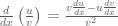
Proof: Let 



![=\frac{g(a)[f(a+h)-f(a)]-f(a)[g(a+h)-g(a)]}{g(a+h)g(a)}](https://s0.wp.com/latex.php?latex=%3D%5Cfrac%7Bg%28a%29%5Bf%28a%2Bh%29-f%28a%29%5D-f%28a%29%5Bg%28a%2Bh%29-g%28a%29%5D%7D%7Bg%28a%2Bh%29g%28a%29%7D&bg=ffffff&fg=545454&s=0&c=20201002)
![\Rightarrow \frac{q(a+h)-q(a)}{h}=\frac{g(a)\left[\frac{f(a+h)-f(a)}{h}\right]-f(a)\left[\frac{g(a+h)-g(a)}{h}\right]}{g(a+h)g(a)}](https://s0.wp.com/latex.php?latex=%5CRightarrow+%5Cfrac%7Bq%28a%2Bh%29-q%28a%29%7D%7Bh%7D%3D%5Cfrac%7Bg%28a%29%5Cleft%5B%5Cfrac%7Bf%28a%2Bh%29-f%28a%29%7D%7Bh%7D%5Cright%5D-f%28a%29%5Cleft%5B%5Cfrac%7Bg%28a%2Bh%29-g%28a%29%7D%7Bh%7D%5Cright%5D%7D%7Bg%28a%2Bh%29g%28a%29%7D&bg=ffffff&fg=545454&s=0&c=20201002)
Letting 
![q'(a)=\left(\frac{f}{g}\right)'(a)=\frac{g(a)f'(a)-f(a)g'(a)}{[g(a)]^2}](https://s0.wp.com/latex.php?latex=q%27%28a%29%3D%5Cleft%28%5Cfrac%7Bf%7D%7Bg%7D%5Cright%29%27%28a%29%3D%5Cfrac%7Bg%28a%29f%27%28a%29-f%28a%29g%27%28a%29%7D%7B%5Bg%28a%29%5D%5E2%7D&bg=ffffff&fg=545454&s=0&c=20201002)

Hopefully. The following note (in progress) might help you understand the power and proper functioning of basic real algebra Short_note_on_algebra
MATH6037 please skip to the end of this entry.
The sum, product and quotient rules show us how to differentiate a great many different functions from the reals to the reals. However some functions, such as 

Proposition 4.1.8 (Chain Rule)
Let 


 J.P. McCarthy: Math Page
Recent Comments