
You are currently browsing the category archive for the ‘MATH6040’ category.
In this short note we will explain why we multiply matrices in this “rows-by-columns” fashion. This note will only look at 
First of all we need some objects. Consider the plane 


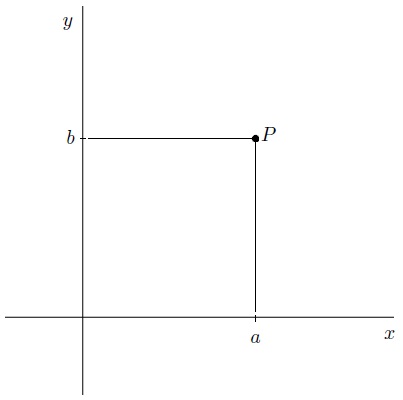
We have two basic operations with points in the plane. We can add them together and we can scalar multiply them according to, if 

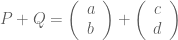


Objects in mathematics that can be added together and scalar-multiplied are said to be vectors. Sets of vectors are known as vector spaces and a feature of vector spaces is that all vectors can be written in a unique way as a sum of basic vectors.
I am emailing a link of this to everyone on the class list every week. If you are not receiving these emails or want to have them sent to another email address feel free to email me at jpmccarthymaths@gmail.com and I will add you to the mailing list.
Week 3
We looked at the applications of vectors to work and moments. We began Chapter 2: Matrices.
Week 4
We will do some examples of matrix arithmetic and look at Matrix Inverses — “dividing” for Matrices.
I am emailing a link of this to everyone on the class list every week. If you are not receiving these emails or want to have them sent to another email address feel free to email me at jpmccarthymaths@gmail.com and I will add you to the mailing list.
Week 2
We continued working with the dot product and then introduced the cross product.
Week 3
We will look at the applications of vectors to work and moments. We might begin Chapter 2: Matrices.
Quadratics are ubiquitous in mathematics. For the purposes of this piece a quadratic is a real-valued function 

where 

Geometry
The basic object we study is the square function, 

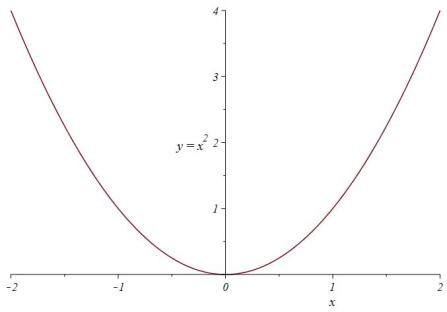
All quadratics look similar to 


The geometry dictates that quadratics can have either zero, one or two real roots. A root of a function is an input 



I am emailing a link of this to everyone on the class list every week. If you are not receiving these emails or want to have them sent to another email address feel free to email me at jpmccarthymaths@gmail.com and I will add you to the mailing list.
Manuals
The manuals are available in the Copy Centre and must be purchased as soon as possible.
Tutorials
Tutorial for BioEng2A: Thursdays at 12:00 in B180
Tutorial for BioEng2B: Mondays at 17:00 in B189
Tutorial for SET2: Mondays at 9:00 in E15
Week 1
We began our study of Chapter 2, Vector Algebra. We looked at how to both visualise vectors and describe them algebraically. We learned how to find the magnitude and direction of a vector, add them and scalar multiply them. We spoke about displacement vectors and introduced the vector product known as the dot product.
Week 2
We will continue working with the vectors and hopefully learn how to add them and scalar multiply them, about displacement vectors, the vector product known as the dot product and perhaps then introduce the cross product.
Test 1
The test will probably be the Monday of Week 5. Official notice will be given in Week 3. There is a sample test in the notes.
Study
Please feel free to ask me questions about the exercises via email or even better on this webpage.
Student Resources
Please see the Student Resources tab on the top of this page for information on the Academic Learning Centre, etc.
There are a number of ways of explaining why you cannot divide by zero. Here are my two favourites.
Any Set of Numbers Collapses to a Single Number
How old are you? Zero years old.
How tall are you? Zero metres old.
How many teeth do you have? Zero.
How many Superbowls has Tom Brady won? Zero
Yep, if you allow division by zero you only end up with one number to measure everything with.
Test 2
Wednesday 26 April at 09:00 in the usual lecture venue. Based on Chapter 3, sample at back of Chapter 3.
Easter Revision
More than half the class has had poor attendance over the past fortnight. Frankly poor attendance at this time of the year is disastrous. Ye have a lot of work to do to get up to speed over Easter.
Those of us who have been attending also need to do some work to be properly prepared for the Week 10 Test. There are five sets of exercises in Chapter 3. Serious students should have at least done all the questions ‘up to the line’ and further revision is done by doing questions under the line.
Any student is welcome to email me questions during the Easter break.
Ye all have a tutorial the Monday before the Test where I recommend that ye look at the sample but without a body of work done you are going to be in danger for Test 2.
Catch-up
You will each of a catch up class. BioEng2B the Thursday of Week 12 (at 14:00 in B245) and BioEng2A the Monday of Week 13 (at 11:00 in B245).
We will be covering something that will be on an exam paper so attendance is vital.
Week 10
We started Chapter 4 by looking at integration by parts. We also looked at completing the square.
Week 11
In our two lectures we will look at some more completing the square and work.
Test 2
Wednesday 26 April at 09:00 in the usual lecture venue. Based on Chapter 3, sample at back of Chapter 3.
Catch-up
You will each of a catch up class. One group the Thursday of Week 12 (at 14:00) and the other the Monday of Week 13 (at 11:00).
We will be covering something that will be on an exam paper so attendance is vital.
Week 9
We finished looking at Partial Differentiation and saw how it can be used in error analysis.
Week 10
We will start Chapter 4 by looking at integration by parts. We will look at completing the square and work.
I am emailing a link of this to everyone on the class list every week. If you are not receiving these emails or want to have them sent to another email address feel free to email me at jpmccarthymaths@gmail.com and I will add you to the mailing list.
Test 2
Wednesday 26 April at 09:00 in the usual lecture venue. Based on Chapter 3, sample at back of Chapter 3.
Catch-up
You will each have a catch up class in Week 11 (after the Easter break). Details to follow in time. We will be covering something that will be on an exam paper so attendance is vital.
Week 8
We looked at Implicit Differentiation and Partial Differentiation.
Week 9
We will finish looking at Partial Differentiation and see how it can be used in error analysis.
I am emailing a link of this to everyone on the class list every week. If you are not receiving these emails or want to have them sent to another email address feel free to email me at jpmccarthymaths@gmail.com and I will add you to the mailing list.
Test 1 – Results
Apologies for the delay. I will have these by the Monday of Week 8, 20 March.
Week 7
We looked at Parametric Differentiation and Related Rates
Week 8
We will look at Implicit Differentiation and Partial Differentiation.

 J.P. McCarthy: Math Page
Recent Comments