
You are currently browsing the category archive for the ‘MATH7016’ category.
Keep in mind at all times:
“Any and all work, submitted at any time, will receive feedback.”
“Do not hesitate to contact me with questions at any time. My usual modus operandi is to answer all queries in the morning but sometimes I may respond sooner.”
Week 12/13
11:00 Tuesday 28 April, Week 12: Assessment Based on Lab 7
Students can submit work — VBA or Theory, catch-up or revision — based on Week 9 Lab 7 VBA/Theory Catch-up/Revision II assignment by today, Saturday 25 April.
If you have any further questions, I am answering emails seven days a week. Email before midnight Monday 27 April to be guaranteed a response Tuesday 28 April. I cannot guarantee that I answer emails sent on Tuesday morning (although of course I will try).
Catch Up/Revision of Lab 8 Material
If you have not yet done so, you will undertake the learning described in Week 10.
If you feel like doing even more theory work on top of this, you will be asked to consider looking at the theory exercises described in Week 10.
If you have already conducted this learning, and submitted a Lab 8 either back before 6 April, or after, I will invite you, if necessary, to take on board the feedback I gave to that submission, and resubmit a corrected version for further feedback.
Students will be able submit work — VBA or Theory, catch-up or revision — based on Week 10 to a Lab 8 VBA/Theory Catch-up/Revision assignment on Canvas (due dates 3 May and 9 May).
Week 14
11:00 Tuesday 12 May, Week 14: Assessment Based on Lab 8
This assessment will ask you to do the following:
Consider:
(1)
For one (i.e.
or
or
) or all (i.e. general
), use equations (2) and (3) to write (1) in the form:
i.e. find the temperature at node
at time
in terms of the temperatures at the previous time
. You may take
.


Keep in mind at all times:
“Any and all work, submitted at any time, will receive feedback.”
“Do not hesitate to contact me with questions at any time. My usual modus operandi is to answer all queries in the morning but sometimes I may respond sooner.”
Week 11
20% VBA Assessment Based on Lab 6
Thank you to everyone for completing the assignment.
Catch Up/Revision
You are advised to catch-up on the learning described in Week 9.
If you have already conducted this learning, and submitted a Lab 7 either back before 30 March, or after, I will invite you, if necessary, to take on board the feedback I gave to that submission, and resubmit a corrected version for further feedback. If you feel like doing even more theory work on top of this, you will be asked to consider looking at the theory exercises described in Week 9.
Students can submit work — VBA or Theory, catch-up or revision — based on Week 9 to the Lab 7 VBA/Theory Catch-up/Revision I assignment on Canvas (by Sunday 19 April), or Lab 7 VBA/Theory Catch-up/Revision II assignment by Saturday 25 April.
Week 12/13
PROVISIONAL: Tuesday 28 April, Week 12: Assessment Based on Lab 7
Catch Up/Revision
If you have not yet done so, you will undertake the learning described in Week 10.
If you feel like doing even more theory work on top of this, you will be asked to consider looking at the theory exercises described in Week 10.
If you have already conducted this learning, and submitted a Lab 8 either back before 6 April, or after, I will invite you, if necessary, to take on board the feedback I gave to that submission, and resubmit a corrected version for further feedback.
Students will be able submit work — VBA or Theory, catch-up or revision — based on Week 10 to a Lab 8 VBA/Theory Catch-up/Revision assignment on Canvas.
I may have two due dates. Perhaps Sunday 3 May and Saturday 9 May.
PROVISIONAL: Tuesday 12 May, Week 14: Assessment Based on Lab 8
This assessment will ask you to do the following:
Consider:
For one (i.e.
i.e. find the temperature at node
In your Canvas announcements you will see that I have laid out a provisional plan for the remaining assessment.
We have now covered all the material, and my focus at this time is to support your learning through the remaining assessment.
The first assessment will take place 11:00 Tuesday 14 April 2020 and is based on Lab 6. The other assessment are provisionally set for 28 April (based on Lab 7), and 12 May (based on Lab 8). The following plan is designed around these.
Keep in mind at all times:
“Any and all work, submitted at any time, will receive feedback.”
“Do not hesitate to contact me with questions at any time. My usual modus operandi is to answer all queries in the morning but sometimes I may respond sooner.”
Easter Week 2 to Sunday 19 April
20% VBA Assessment Based on Lab 6
This test is worth 20% and will become available at 11:00 Tuesday 14 April, at which point you may download the student-number-individualised question paper.
More information under the VBA Test 2 (based on Lab 6) Practical Information announcement on Canvas.
If you have any further questions, I am answering emails seven days a week. Email before midnight Monday 13 April to be guaranteed a response early Tuesday 14 April. I cannot guarantee that I answer emails sent on Tuesday (although of course I will try).
Catch Up/Revision
If prepared for (or have completed) VBA Test 2 (based on Lab 6), if you have not yet done so, you are advised to catch-up on the learning described in Week 9.
If you have already conducted this learning, and submitted a Lab 7 either back before 30 March, or after, I will invite you, if necessary, to take on board the feedback I gave to that submission, and resubmit a corrected version for further feedback. If you feel like doing even more theory work on top of this, you will be asked to consider looking at the theory exercises described in Week 9.
Students can submit work — VBA or Theory, catch-up or revision — based on Week 9 to the Lab 7 VBA/Theory Catch-up/Revision I assignment on Canvas.
The remaining plans are provisional.
Week 11
Similar to Easter Week 2.
Week 12/13
PROVISIONAL: Tuesday 28 April, Week 12: Assessment Based on Lab 7
Catch Up/Revision
If you have not yet done so, you will undertake the learning described in Week 10.
If you feel like doing even more theory work on top of this, you will be asked to consider looking at the theory exercises described in Week 10.
If you have already conducted this learning, and submitted a Lab 8 either back before 6 April, or after, I will invite you, if necessary, to take on board the feedback I gave to that submission, and resubmit a corrected version for further feedback.
Students will be able submit work — VBA or Theory, catch-up or revision — based on Week 10 to a Lab 8 VBA/Theory Catch-up/Revision assignment on Canvas.
I may have two due dates. Perhaps Sunday 3 May and Saturday 9 May.
PROVISIONAL: Tuesday 12 May, Week 14: Assessment Based on Lab 8
In your Canvas announcements you will see that I have laid out a provisional plan for the remaining assessment.
We have now covered all the material, and my focus at this time is to support your learning through the remaining assessment.
If you have completed the learning tasks, and submitted Labs 6, 7, and 8, you should be in a good position to complete the remaining assessment.
However if this is not the case for you, it is not too late to get on top of all the material.
The first assessment will take place 11:00 Tuesday 14 April 2020 and is based on Lab 6. The other assessment are provisionally set for 28 April (based on Lab 7), and 12 May (based on Lab 8). The following plan is designed around these.
Especially if you have put in the hours over the last three weeks (inclusive), the demand on your time in terms of MATH7016 is now greatly diminished, but this plan also allows those who have not yet had a chance to engage in remote learning to begin.
Keep in mind at all times:
“Any and all work, submitted at any time, will receive feedback.”
“Do not hesitate to contact me with questions at any time. My usual modus operandi is to answer all queries in the morning but sometimes I may respond sooner.”
Final MCQ
If you have watched the Week 10 lectures, you should be able to do the final MCQ, MCQ VIII.
Submit your answers here before 09.00 Wednesday 8 April.
Easter Week 1 to Sunday 12 April
Catch Up
If you have not yet done so, undertake the learning described under Week 8 here. You may submit your Lab 6 to the UNGRADED Lab 6 Revision assignment on Canvas.
This ‘assignment’ has a due date of Easter Saturday. I have chosen this date so that you receive your feedback two days before the assessment.
Revision
If you have already conducted this learning, and submitted a Lab 6 either back before 23 March, or after, I would invite you, if necessary, to take on board the feedback I gave to that submission, and resubmit a corrected version for further feedback.
Theory
If you feel like doing even more theory work on top of this, consider looking at the following exercises:
- p.59, Q. 1-3
- p.90, Q. 1-3
These can be submitted to UNGRADED Lab 6 Theory Exercises by Easter Saturday and will receive feedback Easter Sunday. If possible, submit the images as a single pdf file. To do this, select all the images in a folder, right-click and press print. It will say something like How do you want to print your pictures? Press (Microsoft?) Print to PDF. If possible choose an orientation that has all the images in portrait.
Tuesday 14 April, Easter Week 2: Assessment Based on Lab 6
This test is worth 20% and will become available at 11:00 Tuesday 14 April, at which point you may download the student-number-individualised question paper.
You will be asked to write a program. The assessment runs from 11:00 to 12:30. The assessment is designed to be completed in 45 minutes, and there is a very generous 15 minutes allocated to submitting your work to Canvas. There is an additional 30 minutes grace period due to the remote nature of this assessment. Therefore you have until 12:30 to submit your work on Canvas. You can use the 90 minutes however you want but no submissions will be accepted after 12:30.
The remaining plans are provisional.
Wednesday 15 April Easter Week 2 and Week 11/12 to Monday 27 April
Catch Up
If you have not yet done so, you will undertake the learning described in Week 9. You will be able to submit your Lab 7 to an UNGRADED Lab 7 Revision assignment on Canvas.
I may have two due dates. Perhaps Sunday 19 April and Saturday 25 April.
Revision
If you have already conducted this learning, and submitted a Lab 7 either back before 30 March, or after, I will invite you, if necessary, to take on board the feedback I gave to that submission, and resubmit a corrected version for further feedback.
Theory
If you feel like doing even more theory work on top of this, you will be asked to consider looking at the theory exercises described in Week 9.
PROVISIONAL: Tuesday 28 April, Week 12: Assessment Based on Lab 7
Wednesday 29 April Week 12 and Week 13/14 to Monday 11 May
Catch Up
If you have not yet done so, you will undertake the learning described in Week 10. You will be able to submit your Lab 8 to an UNGRADED Lab 8 Revision assignment on Canvas.
I may have two due dates. Perhaps Sunday 3 May and Saturday 9 May.
Revision
If you have already conducted this learning, and submitted a Lab 8 either back before 6 April, or after, I will invite you, if necessary, to take on board the feedback I gave to that submission, and resubmit a corrected version for further feedback.
Theory
If you feel like doing even more theory work on top of this, you will be asked to consider looking at the theory exercises described in Week 10.
PROVISIONAL: Tuesday 12 May, Week 14: Assessment Based on Lab 8
Please find a provisional plan for Weeks 10-13. I do not yet have any certainty around assessment. At this time it is my intention to deliver week-on-week up to 19 April, and then have review after this. Of course all plans are provisional in the current environment.
I want you to know from the perspective of MATH7016 that I am in daily communication with my Head of Department about a plan for your assessment. This has to be done properly, and indeed my HoD is helping me improve my plan.
Once the plan for the MATH7016 assessment is settled from my end, this will have to be integrated with all your other assessment.
This is why I have not been able to be definitive about remaining assessment. Trust however that as soon as concrete plans are in place these will be communicated to ye. There is no point in me speculating about assessment when all the ducks are not yet in a row.
My advice for the moment, for MATH7016 at least, is to focus at this time on learning rather than assessment.
This means my recommendation is, as far as MATH7016 is concerned, is to spend 7 hours a week on your learning.
Trust that whatever plan is devised for your MATH7016 assessment, it will put your needs first.
Week 10 to Sunday 5 April
If you have completed the tasks outlined in the Week 9 summary, you can now begin on the below.
Any and all work, submitted at any time, will receive feedback.
Lectures
There are about 82 minutes of lectures. You should schedule 2 hours and 10 minutes to watch them and take the notes in your manual. You need this extra time above 82 minutes because you will want to pause me.
- Derivation of Heat Equation (26 minutes)
- Finite Differences for the Heat Equation (29 minutes)
- Heat Equation Finite Differences Example I (11 minutes)
- Heat Equation Finite Differences Example II (16 minutes, continued from above, the dog interrupted)
Do not hesitate to contact me with questions at any time. My usual modus operandi is to answer all queries in the morning but sometimes I may respond sooner.
Lab 8
AFTER watching the lectures above, you should be able to do Lab 8 on p. 112.
Between now and Monday 6 April, you will be able to submit your work to Canvas, from which I will give you individual feedback. After 09:00 Tuesday 7 April I will download all student work and reply with feedback.
MCQ
After watching the lectures above, you should be able to do the final MCQ, MCQ VIII.
Submit your answers here before 09.00 Wednesday 8 April.
You can still do MCQ7 if you have not yet done so. Submit your answers here before 10:00 Wednesday 1 April.
Theory Exercises
You should be spending about 7 hours per week on MATH7016. If you have any time left over you should look at Theory exercises in the notes.
- p.111, Q. 1-2,
- p.113, Q. 4
If you still have not spent 7 hours I recommend looking back at:
- p.90, Q. 1-3
You can (carefully) take photos of your work (with questions labelled neatly) and submit to the Week 10 Theory Exercises those images on Canvas before midnight Sunday 5 April. After 09:00 Monday 6 April I will download all student work and reply with feedback.
If possible, submit the images as a single pdf file. To do this, select all the images in a folder, right-click and press print. It will say something like How do you want to print your pictures? Press (Microsoft?) Print to PDF. If possible choose an orientation that has all the images in portrait.
If you still haven’t spent 7 hours on MATH7016 maybe look at some other theory exercises in the manual. Any and all work will receive feedback.
Please find a provisional plan for Weeks 9-13. I do not yet have any certainty around assessment. At this time it is my intention to deliver week-on-week up to 19 April, and then have review after this. Of course all plans are provisional in the current environment.
Week 9 to Sunday 29 March
If you have completed the tasks outlined in the Week 7 summary, you can now begin on the below.
Lectures
There are about 80 minutes of lectures. You should schedule 2 hours and 15 minutes to watch them and take the notes in your manual. You need this extra time above 80 minutes because you will want to pause me.
- Laplace’s Difference Equation (26 minutes)
- Mean Value Property (12 minutes)
- Laplace’s Difference Equation Examples (29 minutes)
- Laplace’s Equation Irregular Boundary (9 minutes)
- Calculating Heat Flux Density (7 minutes)
Do not hesitate to contact me with questions at any time. My usual modus operandi is to answer all queries in the morning but sometimes I may respond sooner.
Lab 7
AFTER watching the first three lectures above, you should be able to do Lab 7 on p. 146.
Between now and Monday 30 March, you will be able to submit your work to Canvas, from which I will give you individual feedback. After 09:00 Tuesday 31 March I will download all student work and reply with feedback.
MCQ
After watching the first three lectures above, you should be able to do MCQ VII.
Submit your answers here before 09.00 Wednesday 1 April.
You can still do MCQ VI if you have not yet done so. Submit your answers here before 10:00 Wednesday 25 March.
Theory Exercises
You should be spending about 7 hours per week on MATH7016. If you have any time left over you should look at Theory exercises in the notes.
- p.104, Q. 1-2
- p.105, Q. 1
You can (carefully) take photos of your work (with questions labelled neatly) and submit to the Week 9 Theory Exercises those images on Canvas before midnight Sunday 29 March. After 09:00 Monday 30 March I will download all student work and reply with feedback.
If possible, submit the images as a single pdf file. To do this, select all the images in a folder, right-click and press print. It will say something like How do you want to print your pictures? Press (Microsoft?) Print to PDF. If possible choose an orientation that has all the images in portrait.
If you still haven’t spent 7 hours on MATH7016 maybe look at some other theory exercises in the manual. Any and all work will receive feedback.
DME2C Lab 5: Runge-Kutta
DME2C are invited to do Lab 5: Runge-Kutta remotely.
I have set up an (ungraded) assignment on Canvas that you (DME2C student) can submit your Lab 5 work. After Tuesday 09:00 I will download all the submissions and give feedback on each.
Recall our overall framework for our programmes in MATH7016:
- Define variables
- Give initial values
- Loop that
- Prints current variables (of interest)
- Calculates next variables
For Runge-Kutta, as usual there will be an x and y variables, but also a number of 
The loop must calculate the various

where 

All of Lab 5 is to be done in VBA. Problem 4 is missing the formula:

the relevant formula is on p. 74. Also the sign of the derivative is wrong (and I have the rocket fuel being ejected too quickly… use

DME2C: Concept MCQ 5
I want to keep the (ungraded) MCQ league going — I have pledged €35 of my own cash for first (€20), second (€10), and third (€5), and it would be great to keep it going until the ‘end of the season’. The same three names have been leading the league for a few weeks so maybe they might falter now.
Well anyway, DME2C can enter MCQ5 by emailing me their selection (ABCDDB or whatever) before Tuesday 09:00.
Week 8
Luckily enough from my point of view, because of St Patrick’s Day, I have already recorded lectures for next week.
First watch Goal Seek for Boundary Value Problems (less than 20 minutes).
Then you will be in a position to do Lab 6: Boundary Value Problems.
Between Tuesday 17 March and Monday 23 March, you will be able to submit your work to Canvas, from which I will give you individual feedback.
After this watch the rest of the first playlist, watch Intro to PDEs (less than 20 minutes), and then watch the Derivation of the Laplace Equation (40 minutes).
I will also send on an MCQ6 to keep the league going.
Week 7
In the Tuesday 09:00 class we had Written Assessment 1.
The lab was based on Runge Kutta methods.
In the 12:00 lecture we did a (written) Shooting Method example.
In VBA we will also have MCQ V.
VBA Assessment 1 – Week 6
DME2C have their VBA Assessment 1 Friday 09:00-11:00 and this will run 09:05-10:55
More information in last week’s summary.
Written Assessment 1 – Week 7
20 % Written Assessment, based on Weeks 1-5.
Here is a copy of last year’s assessment. This should give you an idea of the length and format but not what questions are coming up
There are far more things I could examine.
Roughly, everything up to but not including Runge Kutta Methods (p.68).
Note the venue and time: Melbourn Hall, Tuesday 10 March, 09:30-10:30
Week 6
After finishing talking about Runge-Kutta Methods, we looked at boundary value problems (in particular the Shooting Method).
In VBA we had VBA Assessment 1.
MCQ League
Unless you are excelling, you are identified by the last five digits of your student number.
Please ask questions in the lab about questions you have gotten wrong. Students in red appear to not have a good handle on the material and should consider putting in extra time outside class in doing exercises (in the manuals).
VBA Assessment 1 – Week 6
VBA Assessment 1 will take place next week, in Week 6 (3 & 6 March), in your usual lab time.
Tuesday 10:00-12:00 will run 10:05-11:55
Tuesday 15:00-17:00 will run 15:05-16:55
Friday 09:00-11:00 will run 09:05-10:55
More information in last week’s summary.
Written Assessment 1 – Week 7
20 % Written Assessment, based on Weeks 1-5.
Here is a copy of last year’s assessment. This should give you an idea of the length and format but not what questions are coming up
There are far more things I could examine.
Roughly, everything up to but not including Runge Kutta Methods (p.68).
Note the venue and time: Melbourn Hall, Tuesday 10 March, 09:30-10:30
Week 5
We continued looking at second order differential equations and how to attack them numerically.
In the afternoon we began a quick study of Runge-Kutta Methods.
In VBA we worked on Lab 4 and MCQV. Those of us who did not finish the lab are advised to finish it outside class time, and are free to email me on their work if they are unsure if they are correct or not.
MCQ League
Unless you are excelling, you are identified by the last five digits of your student number.
Please ask questions in the lab about questions you have gotten wrong. Students in red appear to not have a good handle on the material and should consider putting in extra time outside class in doing exercises (in the manuals).
VBA Assessment 1 – Week 6
VBA Assessment 1 will take place in Week 6 (3 & 6 March) in your usual lab time. The following formulae will appear on the assessment.
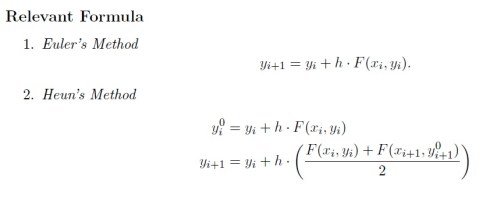
The following is the proposed layout of the assessment:
Q. 1: Numerical Solution of Initial Value Problem [80%]
Examples of initial value problems that might be arise include:
- Damping


- The motion of a free-falling body subject to quadratic drag:

- Newton Cooling


- The charge on a capacitor
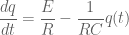

Students have a choice of how to answer this problem:
- The full, 80 Marks are going for a VBA Heun’s Method implementation (like Lab 3).
- An Euler Method implementation (like Lab 2), gets a maximum of 60 Marks.
You will be asked to write a program that takes as input all the problem parameters, perhaps some initial conditions, a step-size, and a final time, and implements Heun’s Method (or possibly Euler’s Method).
If you can write programs for each of the four initial value problems above you will be in absolutely great shape for this assessment.
Q. 2: Using your Program [20%]
You will then be asked to use your program to answer a number of questions about your model. For example, see the questions to the Newton Cooling Problem on p.126.
Week 4
We can avoid implicit differentiation by using Huen’s Method, which is an adjustment of Euler’s Method in that it uses lines.
We also introduced second order differential equations and saw how to attack them numerically. In particular we looked at a real pendulum.
In VBA we worked on Lab 3 and MCQIII. Those of us who did not finish the lab are advised to finish it outside class time, and are free to email me on their work if they are unsure if they are correct or not.
MCQ League
Unless you are excelling, you are identified by the last five digits of your student number.
Please ask questions in the lab about questions you have gotten wrong. Students in red appear to not have a good handle on the material and should consider putting in extra time outside class in doing exercises (in the manuals).

 J.P. McCarthy: Math Page
Recent Comments