
You are currently browsing the category archive for the ‘MATH7016’ category.
Week 3
We then did some further study on the Euler Method. The global error with the Euler Method is 
We looked at the Three Term Taylor Method as a better method. To employ the Three Term Taylor Method we need implicit differentiation, which means more pen-and-paper work.
We also looked at calculating a Maclaurin Series
In VBA we finished off the Euler Method Lab 2. Ideally everyone should have done up to p.125 (note in questions 2 and 3 that 

Some students did or started Exercise 1 and/or Exercise 2 on p. 126.
MCQ League
Unless you are excelling, you are identified by the last five digits of your student number.
Please ask questions in the lab about questions you have gotten wrong. Students in red appear to not have a good handle on the material and should consider putting in extra time outside class in doing exercises (in the manuals).
Week 2
In pre-recorded videos, we developed the Euler Method for approximating the solution of differential equations. As we will need Taylor Series to analyse the error in this approximation — and improve Euler’s Method — we started looking at that. We kind of rushed it, but we used it to analyse the Euler Method.
If you have not yet watched the video lectures please do so before Tuesday.
In VBA we started programming the Euler Method to solve the problem of a damper. We did MCQ 1. If you were missing you should do the two Excel (not VBA — you can do that next week) exercises on p.121-123.
MCQ League
Unless you are excelling, you are identified by the last five digits of your student number.
Please ask questions in the lab about questions you have gotten wrong. Students in red appear to not have a good handle on the material and should consider putting in extra time outside class in doing exercises (in the manuals).
The standings after Week 2:

Week 1
In Week 1, by briefly looking at a number of examples (many of which we have seen before), we had a review of some central ideas from approximation theory such as approximation, measurement error, accuracy & precision, iteration, convergence, meshing, error, etc.
We started looking at where ordinary differential equations come into Engineering.
In VBA we had a quick review lab, focussing on plotting data, command buttons, message boxes, input boxes, If-statements and do-loops.
If you have not completed Lab 1 (p.116), I recommend that you do at least up to the first Do-Loop exercise.
MCQ League
To add a bit of interest to the Ungraded Concept MCQs, I will keep a league table. There are cash prizes (€20, €10, €5) for first, second, and third at the end of the league.
Unless you are excelling, you are identified by the last five digits of your student number.
Please ask questions in the lab about questions you have gotten wrong.
The standings after Week 1:
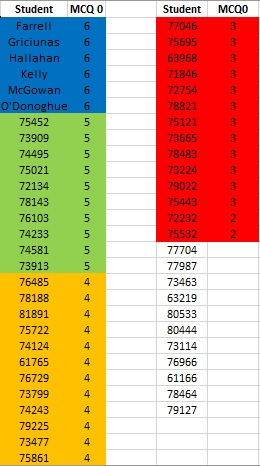
VBA Assessment 1 & Written Assessment 1 – Results
VBA Assessment 1 Results have been emailed and I hope to have your Written Assessment 1 Results to ye Wednesday or Thursday.
Week 10
We looked at finite differences for the Heat Equation. This completes the examinable written material.
In VBA we implemented same.
Week 11 — 2nd 20% VBA Assessment
I will be in B242 from 08:30 – 09:00 to help with any questions, ideally the p. 146 tutorial equations. This is extra time that I am making myself available but it is just an option for you.
This tutorial time will continue in B242 until 09:55.
In the 12:00 class we will have a revision session, geared towards the 40% Written Assessment 2.
To understand how your student numbers generate constants (see below) see this VBA Test 2 from 2017 (do not read this as a sample – it included e.g. the Heat Equation which you will not be examined on and the Laplace’s Equation might be slightly simpler than what ye will have).
Your VBA 2 Assessment will consist of three questions:
- shooting method
- finite differences; steady state temperature uninsulated rod (more P. 90)
- Laplace’s Equation
Formulae will be provided in the VBA 2 Assessment.
See last weeks’ Summary for more detail on the VBA 2 assessment.
Week 12 — 40% Written Test — After Easter
There will be no 12:00 class but I will be in B242 from 08:00 until about 08:40 for any last minute questions.
The 40% Written Assessment will be broken up into two parts.
- Theory Element Tuesday 30 April, Melbourne Rows E-G, 09:00 (30 minutes worth but given an hour).
It will be geared more towards theoretical questions. Please see P. 108-110. More questions p.84, Q. 3.
- Calculation Element in your Week 12 VBA time and lab, (45 minutes worth but given an hour and 45 minutes)
The second part of the Test will take place in your VBA slot. I have to tell you in advance what questions are coming up so let us say
- Second Order Problem Using Heun’s Method
- Heat Flux Density at a Point (p.101)
- Heat Equation
Each group will get questions with only minor variations from the sample questions p. 111 (more Q. 1 on P.55).
Formulae will be provided in the Written Assessment 2.
Study
Study should consist of
- doing exercises from the notes
- completing VBA exercises
Student Resources
Please see the Student Resources tab on the top of this page for information on the Academic Learning Centre, etc.
Final Concept MCQ League Table
Unfortunately with my illness this kind of ran of steam so this is the final standings.

Please ask questions in the lab about questions you have gotten wrong.
VBA Assessment 1 & Written Assessment 1 – Results
I have been very ill over the last two weeks but have gotten some meds from the doctor and hope to get these back to you ASAP.
Weeks 8 & 9
I missed the 09:00 class on the Tuesday of Week 8 with illness.
In the afternoon, we did two examples: of the Shooting Method and of Finite Differences (for the temperature along a rod). Please see Shooting_and_FiniteDifferences_Examples.
In Week 9, we started looking at partial differential equations by looking at Laplace’s Equation.
In VBA, in Week 8 we had MCQ VI and we did the Boundary Value Problems lab.
In VBA, in Week 9 we did the Laplace Equation Lab (which also had some 1-d boundary value stuff). I will email on a VBA file of the 1-D finite differences problem.
This completes the examinable VBA material. The Heat Equation that we cover in Week 10 will not be examinable.
Week 10
We will look at finite differences for the Heat Equation. This completes the examinable written material.
In VBA we will implement same.
VBA Assessment 1 – Results
Last year I didn’t have these until Week 8.
Written Assessment 1 – Results
Last year I didn’t have these until Week 9.
Week 7
We looked at finite differences.
In VBA we have VBA Assessment 1.
Week 8
We will do a (written) Shooting Method example and start looking at partial differential equations by looking at Laplace’s Equation.
In VBA we have MCQ VI and will do the Boundary Value Problems lab.
VBA Assessment 1
VBA Assessment 1 is taking place this week, Week 6.
Tuesday 14:20-16:00 will run 14:20-16:10
Friday 09:05-10:45 will run 09:05-10:55
More information in the Week 4 weekly summary.
In the Week 5 VBA we worked on Lab 3. Those of us who did not finish the lab are advised to finish it outside class time, and are free to email me on their work if they are unsure if they are correct or not.
Written Assessment 1
Written Assessment 1 takes place Tuesday 12 March at 09:00 in the usual lecture venue.
Here is a copy of last year’s assessment. This should give you an idea of the length and format but not what questions are coming up – and replaces Section 1.6.1 of the manual.
However there are far more things I could examine.
Roughly, everything up to but not including Runge Kutta Methods (p.64). Some examples of questions I could ask include:
ODEs in Engineering
p.13, Examples 1-4; p.15, Q.1-4
General Theory
Example, p. 15; p.34 Example
Maclaurin/Taylor Series
Examples 1 & 2 on p. 24; Q. 1 on p.27
Euler Method
p.29, Examples 1-4; p. 38, Q.1-5, 8-9
Three Term Taylor Method
p. 35, Examples 1-2; p.39, Q.7, 10-14
Heun’s Method
p.38, Q. 6; p. 42, Examples 1-2l p. 47, Q.4-5
Second Order Differential Equations
p.50, Example. p.51, Example. p.55, Q. 1-3, 5-14
VBA Assessment 1
VBA Assessment 1 will take place in Week 6, (5 & 8 March) in your usual lab time.
Tuesday 10:05-11:45 will run 10:05 to 11:55
Tuesday 14:20-16:00 will run 14:20-16:10
Friday 09:05-10:45 will run 09:05-10:55
More information in last week’s weekly summary.
In the Week 5 VBA we worked on Lab 3. Those of us who did not finish the lab are advised to finish it outside class time, and are free to email me on their work if they are unsure if they are correct or not.
Written Assessment 1
Written Assessment 1 takes place Tuesday 12 March at 09:00 in the usual lecture venue.
Here is a copy of last year’s assessment. This should give you an idea of the length and format but not what questions are coming up – and replaces Section 1.6.1 of the manual.
However there are far more things I could examine.
Roughly, everything up to but not including Runge Kutta Methods (p.64). Some examples of questions I could ask include:
ODEs in Engineering
p.13, Examples 1-4; p.15, Q.1-4
General Theory
Example, p. 15; p.34 Example
Maclaurin/Taylor Series
Examples 1 & 2 on p. 24; Q. 1 on p.27
Euler Method
p.29, Examples 1-4; p. 38, Q.1-5, 8-9
Three Term Taylor Method
p. 35, Examples 1-2; p.39, Q.7, 10-14
Heun’s Method
p.38, Q. 6; p. 42, Examples 1-2l p. 47, Q.4-5
Second Order Differential Equations
p.50, Example. p.51, Example. p.55, Q. 1-3, 5-14
VBA Assessment 1
VBA Assessment 1 will take place in Week 6 (5 & 8 March) in your usual lab time. You will not be allowed any resources – but the library of code (p.148) and these formulae will appear on the assessment:
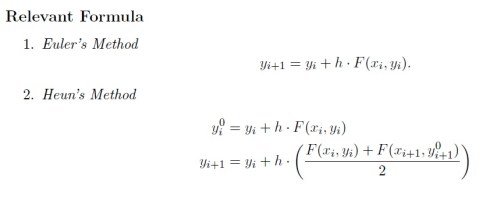
The following is the proposed layout of the assessment:
Q. 1: Numerical Solution of Initial Value Problem [80%]
Examples of initial value problems that might be arise include:
- Damping


- The motion of a free-falling body subject to quadratic drag:

- Newton Cooling


- The charge on a capacitor
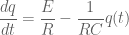

Students have a choice of how to answer this problem:
- The full, 80 Marks are going for a VBA Heun’s Method implementation (like Lab 3).
- An Euler Method implementation (like Lab 2), gets a maximum of 60 Marks.
You will be asked to write a program that takes as input all the problem parameters, perhaps some initial conditions, a step-size, and a final time, and implements Heun’s Method (or possibly Euler’s Method): similar to Exercise 1 on p. 122 (except possibly implementing Heun’s Method) and also Exercise 1 on p.128 (except without the “conditional” derivative).
If you can write programs for each of the four initial value problems above you will be in absolutely great shape for this assessment.
Q. 2: Using your Program [20%]
You will then be asked to use your program to answer a number of questions about your model. For example, assuming Heun’s Method is used, consider the initial value problem (3.7) on p. 119.
- Given,
,
,
,
, approximate
.
- Given,
,
,
, investigate the behaviour of
for large
.
- Given
,
,
, run the Heun program. Comment on the behaviour of
. Comment on the behaviour of
- Given,
,
, run the Heun program. Comment on the behaviour of
Week 4
We finished off a Three Term Taylor Method example and spoke again about Heun’s Method.
We also introduced second order differential equations and saw how to attack them numerically. In particular we looked at a real pendulum.
In VBA we worked on Lab 3. Those of us who did not finish the lab are advised to finish it outside class time, and are free to email me on their work if they are unsure if they are correct or not.
Week 5
In the morning class we will finish looking at second order differential equations.
In the afternoon we will begin a quick study of Runge-Kutta Methods.
In VBA we have MCQ III and look at Lab 4, on Second Order Differential Equations.
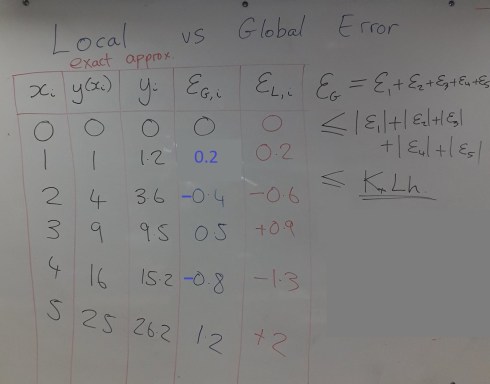
Local vs Global Error
Assessment
The following is a proposed assessment schedule:
- Week 6, 20% First VBA Assessment, Based (roughly) on Weeks 1-4
- Week 7, 20 % In-Class Written Test, Based (roughly) on Weeks 1-5
- Week 11, 20% Second VBA Assessment, Based (roughly) on Weeks 6-9
- Week 12, 40% Written Assessment(s), Based on Weeks 1-11
Study
Study should consist of
- doing exercises from the notes
- completing VBA exercises
Student Resources
Please see the Student Resources tab on the top of this page for information on the Academic Learning Centre, etc.
Ungraded Concept MCQ League Table
To add a bit of interest to the Ungraded Concept MCQs, I will keep a league table.
Unless you are excelling, you are identified by the last five digits of your student number. AW is the number of attendance warnings received.

Please ask questions in the lab about questions you have gotten wrong.
Week 3
We backtracked a little and found the Maclaurin Series
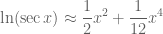
We then did some further study on the Euler Method. The global error with the Euler Method is
We looked at the Three Term Taylor Method as a better method. To employ the Three Term Taylor Method we need implicit differentiation, which means more pen-and-paper work.
We could avoid implicit differentiation by looking at Huen’s Method, which is an adjustment of Euler’s Method in that it uses lines.
In VBA we finished off the Euler Method Lab 2 and looked at P. 122, Exercise 1. The first group also started P. 123, Exercise 2, but the later groups instead used the time for some theory revision.

 J.P. McCarthy: Math Page
Recent Comments