Week 3

You are advised to to spend seven hours per week on MATH7019. This should comprise of however long is recommended to watch the lectures, and then the rest of time should be spent doing exercises, emailing questions, and submitting work. At the time of writing, tutorials consist of you emailing questions and getting feedback on submitted work, but this is subject to change.

Chapter 1 Lectures

Schedule about an hour and a quarter to watch these 51 minutes of lectures. I recommend about 50% extra time as you will want to pause/rewind.

Here are Chapter 1 slides if you have not purchased or printed off the manual.

Chapter 1 Exercises

You need to schedule about two and a quarter hours to work on these exercises.

  • p.41, linearise.
  • p.49, Q.1-7.

Chapter 2 Lectures

Schedule about an hour and a quarter to watch these 54 minutes of lectures. I recommend about 50% extra time as you will want to pause/rewind.

Chapter 2 Exercises

You need to schedule about two and a quarter hours to work on these exercises.

  • p. 59, Q. 1-2.
  • p.65, Q.1-3.

Information for Exercises

Do not hesitate to contact me with questions at any time. My usual modus operandi is to answer all queries in the morning but sometimes I may respond sooner. I am not sure exactly what will happen with these questions while I am on paternity leave… hopefully someone will take these questions for you.

You can (carefully) take photos of your work and submit to the Week 3 Exercises those images on Canvas before midnight Sunday 11 October. The intention would be that after 09:00 Monday 12 October someone (I am going on two weeks paternity leave at some stage) will download all student work and reply with feedback.

If possible, submit the images as a single pdf file. To do this, select all the images in a folder, right-click and press print. It will say something like How do you want to print your pictures? Press (Microsoft?) Print to PDF. If possible choose an orientation that has all the images in portrait.

Week 4

We will plough into Chapter 2, looking at simply supported beams.

Academic Learning Centre

I would urge anyone having any problems with material that isn’t being addressed in the tutorial communication to use the Academic Learning Centre. If you are a little worried about your maths this semester you need to be aware of this resource. You will get best results if you come to the helpers there ith specific questions.

Assessment 1

Assessment 1 has a provisional hand-in of the end of Week 4, start of Week 5. Once the class list is established I can send on the student-number-personalised assessment.

Student Resources

Please see the Student Resources tab on the top of this page for information on the Academic Learning Centre, etc.

Week 2

You are advised to to spend seven hours per week on MATH7019. This should comprise of however long is recommended to watch the lectures, and then the rest of time should be spent doing exercises, emailing questions, and submitting work. At the time of writing, tutorials consist of you emailing questions and getting feedback on submitted work, but this is subject to change.

Lecture

Schedule about three hours to watch these 126 minutes of lectures. I recommend about 50% extra time as you will want to pause/rewind.

Here are Chapter 1 slides if you have not purchased or printed off the manual.

Exercises

You need to schedule about four hours to work on this week’s exercises.

Do not hesitate to contact me with questions at any time. My usual modus operandi is to answer all queries in the morning but sometimes I may respond sooner. I am not sure exactly what will happen with these questions while I am on paternity leave… hopefully someone will take these questions for you.

  • p.34, Q. 1-4
  • p.37, Autumn 2015

Additional (Harder) Exercises:

  • p.22, show that \displaystyle \frac{\partial^2S}{\partial a^2} and \displaystyle \frac{\partial^2S}{\partial b^2} are both positive.
  • p.26, repeat the page 22 analysis for Z=aX+bY+c:

\displaystyle S(a,b,c)=\sum_{i=1}^N(Z_i-aX_i-bY_i-c)^2

Partially differentiate this with respect to a, b, c, solve equal to zero, to find the equations in the middle of p.26.

You can (carefully) take photos of your work and submit to the Week 2 Exercises those images on Canvas before midnight Sunday 4 October. The intention would be that after 09:00 Monday 5 October someone (I am going on two weeks paternity leave at some stage) will download all student work and reply with feedback.

If possible, submit the images as a single pdf file. To do this, select all the images in a folder, right-click and press print. It will say something like How do you want to print your pictures? Press (Microsoft?) Print to PDF. If possible choose an orientation that has all the images in portrait.

Week 3

We will start looking at non-linear models.

Academic Learning Centre

I would urge anyone having any problems with material that isn’t being addressed in the tutorial communication to use the Academic Learning Centre. If you are a little worried about your maths this semester you need to be aware of this resource. You will get best results if you come to the helpers there ith specific questions.

Assessment 1

Assessment 1 has a provisional hand-in of the end of Week 4, start of Week 5. Once the class list is established I can send on the student-number-personalised assessment.

Student Resources

Please see the Student Resources tab on the top of this page for information on the Academic Learning Centre, etc.

Facetime

Some Facetime with me: click here.

Manuals

The lectures are being delivered via pre-recorded lectures. As you will see, the lectures use a manual that contain all the lecture material, via gaps that are filled in during lectures, and exercises. I tend to use a number of colours during lectures, and pencil, so you might want to consider ordering some of these:

image.png

In a sliding scale from best to worst, in my opinion, here are your options for using this manual. There are other options but I cannot recommend them. If you do option one you have all your notes in one place and can follow the lectures as if you were in the classroom.

  1. Email copy.centre@cit.ie and tell them you want to order a bound copy of MATH7019 Manual Winter 2020. The manuals can be collected from Reprographics beside the Student Centre. Note that this is a cash-free area so you will need to put the appropriate amount of funds on your student card. At the time of writing I do not know the cost but it will be of the order of €15. This seems like a lot of money for a manual but with all the materials (including worked examples, summaries, etc) it comes to about 187 pages and provides a comprehensive resource for this module.
  2. Print off the manual at home or somewhere else. Click here here to find a copy.
  3. I am going to scan and email the completely slides. You can keep these somewhere for your notes. You could print these or keep digital copies. Here is Chapter 1.

Week 1

You are advised to to spend seven hours per week on MATH7019. This should comprise of however long is recommended to watch the lectures, and then the rest of time should be spent doing exercises, emailing questions, and submitting work. At the time of writing, tutorials consist of you emailing questions and getting feedback on submitted work, but this is subject to change.

There is probably less than two and half hours here for Week 1: this might be nice to ease yourself back into things, but if you are hungry for more material feel free to jump into Week 2 (see Canvas announcements).

Read the rest of this entry »

Giving a talk 17:00, September 1 2020:

See here for more.

Slides.

I am not sure has the following observation been made:

When the Jacobi Method is used to approximate the solution of Laplace’s Equation, if the initial temperature distribution is given by T^0(\mathbf{x}), then the iterations T^{\ell}(\mathbf{x}) are also approximations to the solution, T(\mathbf{x},t), of the Heat Equation, assuming the initial temperature distribution is T^0(\mathbf{x}).

I first considered such a thought while looking at approximations to the solution of Laplace’s Equation on a thin plate. The way I implemented the approximations was I wrote the iterations onto an Excel worksheet, and also included conditional formatting to represent the areas of hotter and colder, and the following kind of output was produced:

Let me say before I go on that this was an implementation of the Gauss-Seidel Method rather than the Jacobi Method, and furthermore the stopping rule used was the rather crude |T^{\ell+1}_{i,j}-T^{\ell}_{i,j}|<\varepsilon.

However, do not the iterations resemble the flow of heat from the heat source on the bottom through the plate? The aim of this post is to investigate this further. All boundaries will be assumed uninsulated to ease analysis.

Discretisation

Consider a thin rod of length L. If we mesh the rod into n pieces of equal length \Delta x=L/n, we have discretised the rod, into segments of length \Delta x, together with ‘nodes’ 0=x_0<\Delta x=x_1<2\Delta x=x_2<\cdots<n\Delta x=L=x_n.

Suppose are interested in the temperature of the rod at a point x\in[0,L], T(x). We can instead consider a sampling of T, at the points x_i:

\displaystyle T(x_i)=T(i\Delta x)=:T_i.

Similarly we can mesh a plate of dimensions W\times H into an n\times m rectangular grid, with each rectangle of area \Delta x\Delta y, where n\Delta x=W and m\Delta y=H, together with nodes x_{i,j}=(i\Delta x,j\Delta y), and we can study the temperature of the plate at a point \mathbf{x}\in[0,W]\times [0,H] by sampling at the points x_{i,j}:

\displaystyle T(x_{i,j})=T(i\Delta x,j\Delta y)=:T_{i,j}.

We can also mesh a box of dimension W\times D\times H into an n_1\times n_2\times n_2 3D grid, with each rectangular box of volume \Delta x\Delta y\Delta z, where n_1\Delta x=W, n_2\Delta y=D, and n_3\Delta z=H, together with nodes x_{i,j,k}=(i\Delta x,j\Delta y,k\Delta z), and we can study the temperature of the box at the point \mathbf{x}\in [0,W]\times [0,D]\times [0,H] by sampling at the points x_{i,j,k}:

\displaystyle T(x_{i,j,k})=T(i\Delta x,j\Delta y,k\Delta z)=:T_{i,j,k}.

Finite Differences

How the temperature evolves is given by partial differential equations, expressing relationships between T and its rates of change.

Read the rest of this entry »

We are the mathematicians and they are the physicists (all jibes and swipes are to be taken lightly!!)

A

A is for atom and axiom. While we build beautiful universes from our carefully considered axioms, they try and destroy this one by smashing atoms together.

B

B is for the Banach-Tarski Paradox, proof if it was ever needed that the imaginary worlds which we construct are far more interesting then the dullard of a one that they study.

C

C is for Calculus and Cauchy. They gave us calculus about 340 years ago: it only took us about 140 years to make sure it wasn’t all nonsense! Thanks Cauchy!

D

D is for Dimension. First they said there were three, then Einstein said four, and now it ranges from 6 to 11 to 24 depending on the day of the week. No such problems for us: we just use n.

E

E is for Error Terms. We control them, optimise them, upper bound them… they just pretend they’re equal to zero.

F

F is for Fundamental Theorems… they don’t have any.

G

G is for Gravity and Geometry. Ye were great yeah when that apple fell on Newton’s head however it was us asking stupid questions about parallel lines that allowed Einstein to formulate his epic theory of General Relativity.

H

H is for Hole as in the Black Hole they are going to create at CERN.

I

I is for Infinity. In the hand of us a beautiful concept — in the hands of you an ugliness to be swept under the carpet via the euphemism of “renormalisation”…

J

J is for Jerk: the third derivative of displacement. Did you know that the fourth, fifth, and sixth derivatives are known as Snap, Crackle, and Pop? No, I did not know they had a sense of humour either.

K

K is for Knot Theory. A mathematician meets an experimental physicist in a bar and they start talking.

  • Physicist: “What kind of math do you do?”,
  • Mathematician: “Knot theory.”
  • Physicist: “Yeah, Me neither!”

L

L is for Lasers. I genuinely spent half an hour online looking for a joke, or a pun, or something humorous about lasers… Lost Ample Seconds: Exhausting, Regrettable Search.

M

M is for Mathematical Physics: a halfway house for those who lack the imagination for mathematics and the recklessness for physics.

N

N is for the Nobel Prize, of which many mathematicians have won, but never in mathematics of course. Only one physicist has won the Fields Medal.

O

O is for Optics. Optics are great: can’t knock em… 7 years bad luck.

P

P is for Power Series. There are rules about wielding power series; rules that, if broken, give gibberish such as the sum of the natural numbers being -\frac{1}{12}. They don’t care: they just keep on trucking.

Q

Q is for Quark… they named them after a line in Joyce as the theory makes about as much sense as Joyce.

R

R is for Relativity. They are relatively pleasant.

S

S is for Singularities… instead of saying “we’re stuck” they say “singularity”.

T

T is for Tarksi… Tarski had a son called Jon who was a physicist. Tarksi always appears twice.

U

U is for the Uncertainty Principle. I am uncertain as to whether writing this was a good idea.

V

V is for Vacuum… Did you hear about the physicist who wanted to sell his vacuum cleaner? Yeah… it was just gathering dust.

W

W is for the Many-Worlds-Interpretation of Quantum Physics, according to which, Mayo GAA lose All-Ireland Finals in infinitely many different ways.

X

X is unknown.

Y

Y is for Yucky. Definition: messy or disgusting. Example: Their “Calculations”

Z

Z is for Particle Zoo… their theories are getting out of control. They started with atoms and indeed atoms are only the start. Pandora’s Box has nothing on these people.. forget baryons, bosons, mesons, and quarks: the latest theories ask for sneutrinos and squarks; photinos and gluinos, zynos and even winos. A zoo indeed.

PS

We didn’t even mention String Theory!

The End.

This post follows on from this one. The purpose of posts in this category is for me to learn more about the research being done in quantum groups. This post looks at this paper of Schmidt.

Preliminaries

Compact Matrix Quantum Groups

The author gives the definition and gives the definition of a (left, quantum) group action.

Definition 1.2

Let G be a compact matrix quantum group and let C(X) be a \mathrm{C}^*-algebra. An (left) action of G on X is a unital *-homomorphism \alpha: C(X)\rightarrow C(X)\otimes C(G) that satisfies the analogue of g_2(g_1x)=(g_2g_1)x, and the Podlés density condition:

\displaystyle \overline{\text{span}(\alpha(C(X)))(\mathbf{1}_X\otimes C(G))}=C(X)\otimes C(G).

Quantum Automorphism Groups of Finite Graphs

Schmidt in this earlier paper gives a slightly different presentation of \text{QAut }\Gamma. The definition given here I understand:

Definition 1.3

The quantum automorphism group of a finite graph \Gamma=(V,E) with adjacency matrix A is given by the universal \mathrm{C}^*-algebra C(\text{QAut }\Gamma) generated by u\in M_n(C(\text{QAut }\Gamma)) such that the rows and columns of u are partitions of unity and:

uA=Au.

_______________________________________

The difference between this definition and the one given in the subsequent paper is that in the subsequent paper the quantum automorphism group is given as a quotient of C(S_n^+) by the ideal given by \mathcal{I}=\langle Au=uA\rangle… ah but this is more or less the definition of universal \mathrm{C}^*-algebras given by generators E and relations R:

\displaystyle \mathrm{C}^*(E,R)=\mathrm{C}^*( E)/\langle \mathcal{R}\rangle

\displaystyle \Rightarrow \mathrm{C}^*(E,R)/\langle I\rangle=\left(\mathrm{C}^*(E)/R\right)/\langle I\rangle=\mathrm{C}*(E)/(\langle R\rangle\cap\langle I\rangle)=\mathrm{C}^*(E,R\cap I)

where presumably \langle R\rangle \cap \langle I \rangle=\langle R\cap I\rangle all works out OK, and it can be shown that I is a suitable ideal, a Hopf ideal. I don’t know how it took me so long to figure that out… Presumably the point of quotienting by (a presumably Hopf) ideal is so that the quotient gives a subgroup, in this case \text{QAut }\Gamma\leq S_{|V|}^+ via the surjective *-homomorphism:
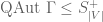
C(S_n^+)\rightarrow C(S_n^+)/\langle uA=Au\rangle=C(\text{QAut }\Gamma).

_______________________________________

Compact Matrix Quantum Groups acting on Graphs

Definition 1.6

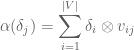
Let \Gamma be a finite graph and G a compact matrix quantum group. An action of G on \Gamma is an action of G on V (coaction of C(G) on C(V)) such that the associated magic unitary v=(v_{ij})_{i,j=1,\dots,|V|}, given by:

\displaystyle \alpha(\delta_j)=\sum_{i=1}^{|V|} \delta_i\otimes v_{ij},

commutes with the adjacency matrix, uA=Au.

By the universal property, we have G\leq \text{QAut }\Gamma via the surjective *-homomorphism:

C(\text{QAut }\Gamma)\rightarrow C(G), u\mapsto v.

Theorem 1.8 (Banica)

Let X_n=\{1,\dots,n\}, and \alpha:F(X_n)\rightarrow F(X_n)\otimes C(G), \alpha(\delta_j)=\sum_i\delta_i\otimes v_{ij} be an action, and let F(K) be a linear subspace given by a subset K\subset X_n. The matrix v commutes with the projection onto F(K) if and only if \alpha(F(K))\subseteq F(K)\otimes C(G)

Corollary 1.9

The action \alpha: F(V)\rightarrow F(V)\otimes C(\text{QAut }\Gamma) preserves the eigenspaces of A:

\alpha(E_\lambda)\subseteq E_\lambda\otimes C(\text{QAut }\Gamma)

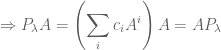
Proof: Spectral decomposition yields that each E_\lambda, or rather the projection P_\lambda onto it, satisfies a polynomial in A:

\displaystyle P_\lambda=\sum_{i}c_iA^i

\displaystyle \Rightarrow P_\lambda A=\left(\sum_i c_i A^i\right)A=A P_\lambda,

as A commutes with powers of A \qquad \bullet

A Criterion for a Graph to have Quantum Symmetry

Definition 2.1

Let V=\{1,\dots,|V|\}. Permutations \sigma,\,\tau: V\rightarrow V are disjoint if \sigma(i)\neq i\Rightarrow \tau(i)=i, and vice versa, for all i\in V.

In other words, we don’t have \sigma and \tau permuting any vertex.

Theorem 2.2

Let \Gamma be a finite graph. If there exists two non-trivial, disjoint automorphisms \sigma,\tau\in\text{Aut }\Gamma, such that o(\sigma)=n and o(\tau)=m, then we get a surjective *-homomorphism C(\text{QAut }\Gamma)\rightarrow C^*(\mathbb{Z}_n\ast \mathbb{Z}_m). In this case, we have the quantum group \widehat{\mathbb{Z}_n\ast \mathbb{Z}_m}\leq \text{QAut }\Gamma, and so \Gamma has quantum symmetry.


Read the rest of this entry »

Warning: This is written by a non-expert (I know only about finite quantum groups and am beginning to learn my compact quantum groups), and there is no attempt at rigour, or even consistency. Actually the post shows a wanton disregard for reason, and attempts to understand the incomprehensible and intuit the non-intuitive. Speculation would be too weak an adjective.

Groups

A group is a well-established object in the study of mathematics, and for the purposes of this post we can think of a group G as the set of symmetries on some kind of space, given by a set X together with some additional structure D(X). The elements of G  act on X as bijections:

G \ni g:X\rightarrow X,

such that D(X)=D(g(X)), that is the structure of the space is invariant under g.

For example, consider the space (X_n,|X_n|), where the set is X_n=\{1,2,\dots,n\}, and the structure is the cardinality. Then the set of all of the bijections X_n\rightarrow X_n is a group called S_n.

A set of symmetries G, a group, comes with some structure of its own. The identity map e:X\rightarrow X, x\mapsto x is a symmetry. By transitivity, symmetries g,h\in G can be composed to form a new symmetry gh:=g\circ h\in G. Finally, as bijections, symmetries have inverses g^{-1}, g(x)\mapsto x.

Note that:

gg^{-1}=g^{-1}g=e\Rightarrow (g^{-1})^{-1}=g.

A group can carry additional structure, for example, compact groups carry a topology in which the composition G\times G\rightarrow G and inverse {}^{-1}:G\rightarrow G are continuous.

Algebra of Functions

Given a group G together with its structure, one can define an algebra A(G) of complex valued functions on G, such that the multiplication A(G)\times A(G)\rightarrow A(G) is given by a commutative pointwise multiplication, for s\in G:

(f_1f_2)(s)=f_1(s)f_2(s)=(f_2f_1)(s).

Depending on the class of group (e.g. finite, matrix, compact, locally compact, etc.), there may be various choices and considerations for what algebra of functions to consider, but on the whole it is nice if given an algebra of functions A(G) we can reconstruct G.

Usually the following transpose maps will be considered in the structure of A(G), for some tensor product \otimes_\alpha such that A(G\times G)\cong A(G)\otimes_\alpha A(G), and m:G\times G\rightarrow G, (g,h)\mapsto gh is the group multiplication:

\begin{aligned}  \Delta: A(G)\rightarrow A(G)\otimes_{\alpha}A(G)&,\,f\mapsto f\circ m,\,\text{the comultiplication}  \\ S: A(G)\rightarrow A(G)&,\, f\mapsto f\circ {}^{-1},\,\text{ the antipode}  \\ \varepsilon: A(G)\rightarrow \mathbb{C}&,\, f\mapsto f\circ e,\,\text{ the counit}  \end{aligned}

See Section 2.2 to learn more about these maps and the relations between them for the case of the complex valued functions on finite groups.

Quantum Groups

Quantum groups, famously, do not have a single definition in the same way that groups do. All definitions I know about include a coassociative (see Section 2.2) comultiplication \Delta: A(G)\rightarrow A(G)\otimes_\alpha A(G) for some tensor product \otimes_\alpha (or perhaps only into a multiplier algebra M(A(G)\otimes_\alpha A(G))), but in general that structure alone can only give a quantum semigroup.

Here is a non-working (quickly broken?), meta-definition, inspired in the usual way by the famous Gelfand Theorem:

A quantum group G is given by an algebra of functions A(G) satisfying a set of axioms \Theta such that:

  • whenever A(G) is noncommutative, G is a virtual object,
  • every commutative algebra of functions satisfying \Theta is an algebra of functions on a set-of-points group, and
  • whenever commutative algebras of functions A(G_1)\cong_{\Theta} A(G_2), G_1\cong G_2 as set-of-points groups.

Read the rest of this entry »

Keep in mind at all times:

“Any and all work, submitted at any time, will receive feedback.”

“Do not hesitate to contact me with questions at any time. My usual modus operandi is to answer all queries in the morning but sometimes I may respond sooner.”

25% Integration Test

60 minute, 25% Further Integration Test, 19:30 Tuesday 12 May 2020

This test will examine Chapter 4. A Summer 2020 paper was written, and this test will comprise of Q. 4 from that exam. The question comprises 25% of that exam, and that translates to 30 minutes of exam time. I will extend this to 45 minutes and allow 15 minutes to upload. 

Here is video based on Q. 4, on p.226 of your manual.

The material for this test was covered in Week 10, Easter Week 1, and Easter Week 2 (lectures and exercises).

If you have any further questions on these topics, I am answering emails seven days a week. Email before midnight tonight to be guaranteed a response Monday 11 May. I cannot guarantee that I answer emails sent on Monday (although of course I will try).

10% Vectors Test

60 minute, 10% Vectors Test, 19:30 Tuesday 19 May 2020

This test will re-examine Chapter 1. A Summer 2020 paper was written, and this test will comprise of Q. 1 from that exam. The question comprises 25% of that exam, and that translates to 30 minutes of exam time. I will extend this to 45 minutes and allow 15 minutes to upload. 

Here is a video based on Q. 1, on p.222 of your manual.

Chapter 1 Exercises may be found on:

  • p.29
  • p.39
  • p.46

You can submit work for feedback by midnight Saturday 16 May to Vectors Exercises on Canvas. After this, email before midnight Monday 18 May to be guaranteed a response Tuesday 19 May. I cannot guarantee that I answer emails sent on Tuesday (although of course I will try).


Keep in mind at all times:

“Any and all work, submitted at any time, will receive feedback.”

“Do not hesitate to contact me with questions at any time. My usual modus operandi is to answer all queries in the morning but sometimes I may respond sooner.”

40% Test 1

90 minute, 40% Test, 11:00 Monday 11 May 2020

This test will examine Chapter 2, Section 3.6, and Chapter 4. A Summer 2020 paper was written, and this test will comprise of Q. 2, 3 (d), and 4 from that exam. The question comprises 40% of that exam, and that translates to 48 minutes of exam time. I will extend this to 75 minutes and allow 15 minutes to upload. 

Here is tutorial video for this test.

Section 3.6 and Chapter 4 material can be found in Week 10, Easter Week 1, and Easter Week 2 (lectures and tutorial).

Chapter 2 Exercises that you should be looking at include:

  • p.86, Q. 1-4
  • p.91, Q. 1-7
  • p.86, Q. 5-6 (harder)

I have developed the following for you to practise your differentiation which you need for Chapter 2 here:

If you have any further questions on these topics, I am answering emails seven days a week. Email before midnight tonight to be guaranteed a response Monday 11 May. I cannot guarantee that I answer emails sent on Monday (although of course I will try).

20% Linear Systems Test

90 minute, 20% Linear Systems Test, 11:00 Thursday 21 May 2020

This test will re-examine Chapter 1. A Summer 2020 paper was written, and this test will comprise of Q. 1 from that exam. The question comprises 35% of that exam, and that translates to 42 minutes of exam time. I will extend this to 75 minutes and allow 15 minutes to upload. 

Here is video based on Q. 1 from the Summer 2019 paper on the back of your manual.

Chapter 1 Exercises may be found on:

  • p.28
  • p.38
  • p.44
  • p.51

You can submit work for feedback by midnight Monday 18 May to Linear Systems Revision Exercises on Canvas. After Monday, email before midnight Wednesday 20 May to be guaranteed a response Thursday 21 May. I cannot guarantee that I answer emails sent on Thursday (although of course I will try).