I am emailing a link of this to everyone on the class list every week. If you are not receiving these emails or want to have them sent to another email address feel free to email me at jpmccarthymaths@gmail.com and I will add you to the mailing list.

Manuals

You will need to purchase the manual from the CIT Copy Centre beside the Student Centre (in the same room as where you get your photos taken for your student card). Note that this is a cash-free area so you will need to put the appropriate amount of funds on your student card.

The Copy Centre will be open until 19:30 the first and second weeks of the term but from next week goes back to normal opening hours — closing at 16:30.

Quiz 1 Results and Solutions

Below find the results. You are identified by the last four digits of your student number unless you are excelling. The marks are out of 2.5 percentage points. Your best eight quizzes go to the 20% mark for quizzes. The R % column is your running percentage (for best eight quizzes). One student didn’t write down their name. They should email me. Solutions and marking scheme here.

S/N Quiz 1 R%
Fahey 2.5 100
Buckley 2.5 100
Nolan 2.43 97.2
8332 2.37 94.8
8212 2.37 94.8
1486 2.24 89.6
8426 2.24 89.6
2128 2.24 89.6
9464 2.17 86.8
6645 2.17 86.8
9896 1.97 78.8
2237 1.71 68.4
3481 1.71 68.4
2942 1.71 68.4
3703 1.71 68.4
1321 1.45 58
7879 1.12 44.8
2073 0.99 39.6
9555 0.53 21.2
Not registered but did test. 0.53 21.2
2257 0.53 21.2
7209 0.39 15.6
8354 0.39 15.6
2070 0.33 13.2
3872 0.26 10.4
2092 0 0
1298 ?
4402 ?
8425 ?

Read the rest of this entry »

I am emailing a link of this to everyone on the class list every week. If you are not receiving these emails or want to have them sent to another email address feel free to email me at jpmccarthymaths@gmail.com and I will add you to the mailing list.

Week 2

We continued working with the dot product and then introduced the cross product.

Week 3

We will look at the applications of vectors to work and moments. We might begin Chapter 2: Matrices.

Read the rest of this entry »

I am emailing a link of this to everyone on the class list every week. If you are not receiving these emails or want to have them sent to another email address feel free to email me at jpmccarthymaths@gmail.com and I will add you to the mailing list.

Week 2

We developed the Euler Method for approximating the solution of differential equations. As we will need Taylor Series to analyse the error in this approximation — and improve Euler’s Method — we started looking at that.

In VBA we started programming the Euler Method to solve the problem of a damper.

Read the rest of this entry »

I am emailing a link of this to everyone on the class list every week. If you are not receiving these emails or want to have them sent to another email address feel free to email me at jpmccarthymaths@gmail.com and I will add you to the mailing list.

Manuals

You will need to purchase the manual from the CIT Copy Centre beside the Student Centre (in the same room as where you get your photos taken for your student card). Note that this is a cash-free area so you will need to put the appropriate amount of funds on your student card.

The Copy Centre will be open until 19:30 the first and second weeks of the term.

Week 1

In Week 1 we explained the kind of thing that we would be looking at in this module. We did a quick review of integral calculus.

Week 2

In Week 2 we will look at u-substitutions. Then we will study Integration by Parts: this is the start of the new material (i.e. not MATH6019 material).

We will not have a Maple Lab until Week 3.

Read the rest of this entry »

I am emailing a link of this to everyone on the class list every week. If you are not receiving these emails or want to have them sent to another email address feel free to email me at jpmccarthymaths@gmail.com and I will add you to the mailing list.

Week 1

We started the first chapter on Linear Algebra. Essentially, for us, simultaneous equations. We looked at Gaussian Elimination — and saw the case of infinite solutions.

If you download Maple (see Student Resources), there is a Maple Tutor that is easy to use and will help you. Open up Maple and go to Tools -> Tutors ->Linear Algebra -> Gaussian Elimination.

Week 2

You will work some more on Gaussian Elimination before we started looking at Gaussian Elimination with Partial Pivoting — absolutely necessary if you are using decimal rounding

Assessment 1

Assessment 1 will have a hand-in date of Friday March 3 (Week 5). Expect to see the assignment next week.

Study

Please feel free to ask me questions about the exercises via email or even better on this webpage.

Student Resources

Please see the Student Resources tab on the top of this page for information on the Academic Learning Centre, etc..

I am emailing a link of this to everyone on the class list every week. If you are not receiving these emails or want to have them sent to another email address feel free to email me at jpmccarthymaths@gmail.com and I will add you to the mailing list.

Manuals

The manuals are  available in the Copy Centre and must be purchased as soon as possible.

Tutorials

Tutorial for Group A: Mondays at 15:00 in B145

Tutorial for Group B: Mondays at 14:00 in B143

Week 1

We began our study of Chapter 2, Vector Algebra. We looked at how to both visualise vectors and describe them algebraically. We learned how to find the magnitude of a vector, add them and scalar multiply them. We spoke about displacement vectors and introduced the vector product known as the dot product.

Week 2

We will continue working with the dot product and then introduce the cross product.

Test 1

The test will be in Week 5. There is a sample test in the notes.

Study

Please feel free to ask me questions about the exercises via email or even better on this webpage.

Student Resources

Please see the Student Resources tab on the top of this page for information on the Academic Learning Centre, etc.

I am emailing a link of this to everyone on the class list every week. If you are not receiving these emails or want to have them sent to another email address feel free to email me at jpmccarthymaths@gmail.com and I will add you to the mailing list.

FAO: DME 2-A

Your VBA Lab is now in A285 rather than A271.

Week 1

In Week 1, by briefly looking at a number of examples (many of which we have seen before), we had a review of some central ideas from approximation theory such as approximation, measurement error, accuracy & precision, iteration, convergence, meshing, error, etc. We started talking about Taylor Series.

In VBA we had a quick review lab, focussing on plotting data, command buttons, message boxes, input boxes, If-statements and do-loops.

Read the rest of this entry »

As I said in the previous post, there is a duality:

Points on a Curve (Geometry) \Leftrightarrow Solutions of an Equation (Algebra)

This means we can answer geometric questions using algebra and answer algebraic questions using geometry.

Problem

Consider the following two questions:

  1. Find the tangents to a circle \mathcal{C} of a given slope.
  2. Find the tangents to a circle \mathcal{C} through a given point.

Both can be answered using the duality principle.

Example

Find the tangents to the circle

\mathcal{C}\equiv x^2+y^2-4x+6y-12=0

that are

(a) parallel to the line L\equiv 4x+3y+20=0

(b) through the point (-10,-5) [caution: the numbers here are disgusting]
Solution (a) i:

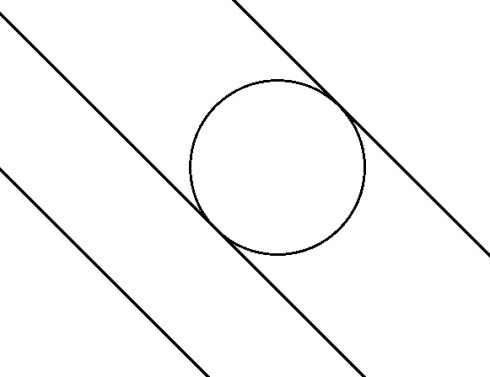
 First of all a sketch (and the remark that a tangent is a line):

circle.jpg

Here we see the circle \mathcal{C} and the line L on the bottom left. The two tangents we are looking for are as shown. They have the same slope as L and have only one intersection with \mathcal{C}. These two pieces of information will allow us to find the equations of the tangents.

Read the rest of this entry »

Arguably, the three central concepts in the theory of differential calculus are that of a function, that of a tangent and that of a limit. Here we introduce functions and tangents.

Functions

When looking at differential calculus, two good ways to think about functions are via algebraic geometry and interdependent variables. Neither give the proper, abstract, definition of a function, but both give a nice way of thinking about them.

Algebraic Geometry Approach

Let us set up the plane, \Pi. We choose a distinguished point called the origin and a distinguished direction which we call ‘positive x‘. Draw a line through the origin in the direction of positive x. This is the x-axis. Choose a unit distance for the x-direction.

Now, perpendicular to the x-axis, draw a line through the origin. This is the y-axis. By convention positive y is anti-clockwise of positive x. Choose a unit distance for the y-direction.

This is the plane, \Pi:

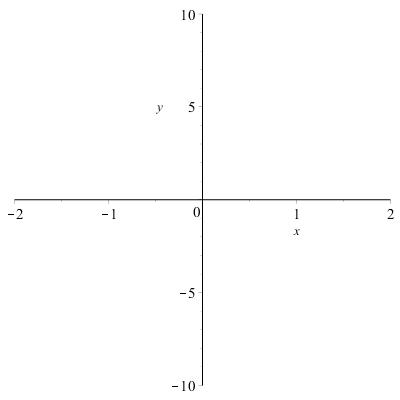
axes.jpg

Now points on the plane can be associated with a pair of numbers (a,b). For example, the point a distance one along the positive x and five along the negative y can be denoted by the coordinates (1,-5):

point.jpg

Similarly, I can take a pair of numbers, say (-1,3), and this corresponds to a point on the plane.

This gives a duality:

points on the plane \Leftrightarrow pairs of numbers

Now consider the completely algebraic objects

x=3\,,\,\,y=2\,,\,\,y=x\,,\,\,y=x^2\,,\,\,y=x+2\,,\,\,x^2+y^2=1.

Read the rest of this entry »

Assessment 5

Assessment 5 will be on Tuesday, 6 December 2016.

The following  group will sit the assessment at 17:15 (arrive around 17:05):

  • COMP1B-X

The following group will sit the assessment at 18:15 (arrive around 18:05)

  • COMP1B-Y

Keep an eye on your CIT Blackboard and email for the latest and definitive assessment information.

Week 12

We looked at graphing and mathematical modelling.

Week 13

Two tutorials:

  • COMP1B-Y: Monday 10:00 in F1.3
  • COMP1B-X: Monday 15:00 in B251
  • COMP1B-X and 1B-Y: Tuesday 14:00 in B225

Study

Please feel free to ask me questions about the exercises via email or even better on this webpage.

Student Resources

Please see the Student Resources tab on the top of this page for information on the Academic Learning Centre, etc.