I am emailing a link of this to everyone on the class list every Friday afternoon. If you are not receiving these emails or want to have them sent to another email address feel free to email me at jpmccarthymaths@gmail.ie and I will add you to the mailing list.

Lectures

We have finished section 1.3.

Tutorials

The tutorials start on Wednesday.

At the start of the tutorial I will answer any questions about the notes/theory/course.

After this however I am going to put ye into two competing groups.

Read the rest of this entry »

I am emailing a link of this to everyone on the class list every Friday afternoon. If you are not receiving these emails or want to have them sent to another email address feel free to email me at jpmccarthymaths@gmail.ie and I will add you to the mailing list.

Applications of Linear Algebra to Civil Engineering

A quick Google of ‘applications of linear algebra to civil engineering’; shows up a lot of the following.

  • Truss systems give rise to linear systems — as does any analysis of equilibria
  • Traffic Flow Problems
  • Electrical Circuits
  • Numerical Solution of Differential Equations (e.g. Beam Equations)
  • Stress and Strain
  • Elastic Systems — such as systems of springs and pulleys
  • Torque

Also a lot of the theory of differential equations is best analysed using (infinite dimensional) linear algebra. For example, we said that the solutions of second order linear homogenous differential equations must be two dimensional. This is a linear algebra result.

I am emailing a link of this to everyone on the class list every Friday afternoon. If you are not receiving these emails or want to have them sent to another email address feel free to email me at jpmccarthymaths@gmail.ie and I will add you to the mailing list.

Notes

So far we have covered up to and including the Chain Rule: MATH6015 Lecture Notes (with gaps).

Also I don’t know why I didn’t advise this earlier — you would be well worth investing in a ring binder (to be kept at home or whatever) for your notes. You can see already the amount of sheets. You should be organised with these and only bring the ones we are working on to class.

Test!

The first test will take place at 9 am on Friday 19 October (Week 5). It is a test that could arguably take 42 minutes but I’ll give ye from 9.05 — 10 am. Please find a sample. I will give ye a copy on Monday. You will be given a copy of these tables. Don’t worry I’ll scribble out the “UCC”!

Note that the format will be the same of this.

  1. Differentiation from First Principles
  2. Tangent Lines
  3. Differentiate by Rule
  4. Differentiate by Rule
  5. Differentiate by Rule
  6. Rates of Change
  7. Rate of Change/ Geometry of Graph

Next Week

On Monday we will have a tutorial where we will try and get a hang of the Chain Rule. In the rest of the week we shall look at applying what we’ve learned to rates of change. Also we will ask what the derivative can tell us about the geometry of a graph.

I am emailing a link of this to everyone on the class list every Friday afternoon. If you are not receiving these emails or want to have them sent to another email address feel free to email me at jpmccarthymaths@gmail.ie and I will add you to the mailing list.

Notes

As of 5 October: MATH6000 Lecture Notes (with gaps).

Also an E-Book: Engineering Mathematics by John Bird.

Also I don’t know why I didn’t advise this earlier — you would be well worth investing in a ring binder (to be kept at home or whatever) for your notes. You can see already the amount of sheets. You should be organised with these and only bring the ones we are working on to class.

Test!

Your first assessment is on this Wednesday 10 October in Week 4. The exact time and location depends on your class group:

Common Entry Science: 17:00 in the West Atrium

Biosciences:                              17:00 in the West Atrium

Computing:                               18:00 in the West Atrium

The test will be a 45 minute, multiple-choice test (15 questions equally-weighted questions), without negative marking and calculators will not be permitted.

The sample, which you should be very familiar with, may be found here.

Do not miss this first assessment. The policy on missed assessments is very strict in CIT as you can see here.

Advice for Assessment One

Read the rest of this entry »

Let G be a group and let A:=C^*(G)  be the C*-algebra of the group G. This is a C*-algebra whose elements are complex-valued functions on the group G. We define operations on A in the ordinary way save for multiplication

\displaystyle (fg)(s)=\sum_{t\in G}f(t)g(t^{-1}s),

and the adjoint f^*(s)=\overline{f(s^{-1})}. Note that the above multiplication is the same as defining \delta_s\delta_t=\delta_{st} and extending via linearity. Thence A is abelian if and only if G is.

To give the structure of a quantum group we define the following linear maps:

\Delta:A\rightarrow A\otimes A\Delta(\delta_s)=\delta_s\otimes\delta_s.

\displaystyle \varepsilon:A\rightarrow \mathbb{C}\varepsilon(\delta_s)=1.

S:A\rightarrow AS(\delta_s)=\delta_{s^{-1}}.

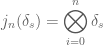
The functional h:A\rightarrow \mathbb{C} defined by h=\mathbf{1}_{\{\delta_e\}} is the Haar state on A. It is very easy to write down the j_n:

\displaystyle j_n(\delta_s)=\bigotimes_{i=0}^n\delta_s.

To do probability theory consider states \varepsilon,\,\phi on A and form the product state:

\displaystyle \Psi=\varepsilon\otimes\bigotimes_{i=1}^\infty \phi.

Whenever \phi is a state of A such that \phi(\delta_s)=1 implies that s=e, then the distribution of the random variables j_n converges to h.

At the moment we will use the one-norm to measure the distance to stationary:

d(\Psi\circ j_n,h)=\|\Psi\circ j_n-h\|_1.

A quick calculation shows that:

d(\Psi\circ j_n,h)=\sum_{s\neq e}|\phi(\delta_s)|^n.

When, for example, \phi(\delta_s)=2/m^2 when s are transpositions in S_m, then we have

d(\Psi\circ j_n,h)={m\choose 2}\left(\frac{2}{m^2}\right)^n.

I am emailing a link of this to everyone on the class list every Friday afternoon. If you are not receiving these emails or want to have them sent to another email address feel free to email me at jpmccarthymaths@gmail.ie and I will add you to the mailing list.

We have covered up to the point where we showed not all real numbers are fractions.

Tutorial Slot

We are going with Wednesdays 10-11 in Windle room ANLT (beside the Old Bar). These start in Week 3 (10 October 2012).

Tutorial Question Bank

Question 35 from the Additional but Harder Exercises for De nitions I (in notes).

I am emailing a link of this to everyone on the class list every Friday afternoon. If you are not receiving these emails or want to have them sent to another email address feel free to email me at jpmccarthymaths@gmail.ie and I will add you to the mailing list.

Notes

As of 29 September: MATH6000 notes.

Also an E-Book: Engineering Mathematics by John Bird.

Test Notice

Your first assessment will be on Wednesday 10 October in Week 4. The exact time will depend on your class group and will be communicated to you this week. The test will be a 45 minute, multiple-choice test (15 questions equally-weighted questions) and calculators will not be permitted.

A sample, which is also up on Blackboard and will be given to you Monday, may be found here.

Do not miss this first assessment. The policy on missed assessments is very strict in CIT as you can see here.

Read the rest of this entry »

I am emailing a link of this to everyone on the class list every Friday afternoon. If you are not receiving these emails or want to have them sent to another email address feel free to email me at jpmccarthymaths@gmail.ie and I will add you to the mailing list.

Exercise Answers

Section 1.1

Q. 8 f(1.8)\approx 16.56, f(2.25)\approx 24.75. Q. 9 f(3.5)\approx 3.75, f(5.25)\approx 13\frac{13}{16}. Q. 10 f(9)\approx 2.200, f(8.2)\approx 2.105. Q. 11 f(3.5)\approx 1.419, f(4.2)\approx 1.522. Q. 12 f(3.5)\approx 12.25, f(5.25)\approx 28\frac{1}{16}. Q. 14 10.08. Q. 15 11.44. Q. 16 f'(1.5)\approx 48, f'(1.8)\approx 76.8. Q. 17 f'(3.4)\approx 3.6 and f'(4)\approx 4.2.

Section 1.3

To check that we have the correct solutions to simultaneous equations/linear systems we can plug in our values in to ALL of the equations and see that our solution set satisfies all of the equations. Note that solving two out of three equations does not mean that we have a solution. Quite often an arithmetic slip will give us a solution set that only fails for one of the equations. Hence I give solutions to the 3\times 3 systems in terms of the coordinates (x_1,x_2,x_3).

Q. 2 (iv) \displaystyle \left(\frac19 , -\frac73 , \frac{10}{9}\right), (v) \displaystyle \left(-21-15z,-17-11t,t\right) for t\in\mathbb{R}, (vi) (-7,-9,1), (vii) \displaystyle \left(\frac12 , -\frac12 , 4\right), (viii) (2,2,-1), (ix) (0,2,-2). Q. 4 All false.

I am emailing a link of this to everyone on the class list every Friday afternoon. If you are not receiving these emails or want to have them sent to another email address feel free to email me at jpmccarthymaths@gmail.ie and I will add you to the mailing list.

Notes

So far we have covered the quotient rule: MATH6015 notes.

Answers to Exercises

Page 13

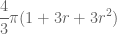
Q. 1(a) False, (b) False ,(c) False. Q. 3 12,\,16,\,3a^2-a+2,3a^2+a+2,\,3a^2+5a+4,\,6a^2-2a+4,12a^2-2a+2, \,3a^4-a^2+2,\,9a^4-6a^3+13a^2-4a+4, 3h^2+6ah-h+3a^2-a+2. Q. 4 \displaystyle \frac{4}{3}\pi(1+3r+3r^2). Q. 5 A(x)=x(10-x). Q. 7 (a) y=2x+c with c\in\mathbb{R}, (b) y=mx+(1-2m)  for m\in\mathbb{R}, (c) y=2x-3. 8 (b) a change of 1^\circ C means a change of \displaystyle\frac95 F.

Page 21

Q. 1( a) 59, (b) 256, (c) 0. Q.2 (a) \displaystyle \frac35, (b) \displaystyle\frac65, (c) \displaystyle \frac32, (d) 32.

Page 30

(i) 2x-2, (ii) 2x+5, (iii) 3, (iv) 4x-5, (v) 2-2x

Page 32

Q. 1. (i) 5, (ii) 40x^7-10x^7, (iii) \displaystyle -\frac{7\sqrt{10}}{x^8}, (iv) \displaystyle -\frac{2}{5x^{7/5}} Q. 2 10x^4. Q. 3 3-10x . Q. 4 8x-24. Q. 5 18x+6. Q. 6 \displaystyle 3x^2+\frac{1}{\sqrt{x}}. Q. 7 \displaystyle \frac{3\sqrt{x}}{2}+\frac{1}{\sqrt{x}}. Q. 8 1029x^2+294x+21. Q. 9 \displaystyle \frac{2}{u^2}+2u+3u^2. Q. 10 \displaystyle y=-\frac14 x+1.

Page 34

Q. 1 \cos x+10\sec^2x. Q. 2 y=x+1.  Q. 3 x=2 and -3.

Page 37

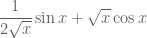
Q. 1 x\cos x+\sin x. Q. 2 \displaystyle \frac{\cos x}{x^2}-\frac{2\sin x}{x^2}. Q. 3 \displaystyle \frac{1}{2\sqrt{x}}\sin x+\sqrt{x}\cos x. Q. 4 e^x(3-\sin x)+e^x(\cos x+3x). Q. 5 \displaystyle \frac{1}{2\sqrt{x}}\log x+\frac{1}{\sqrt{x}}. Q. 6  \displaystyle \frac{1}{x^3}-\frac{2\log x}{x^3}. Q. 7 y=e. Q. 8 y=0.

Page 40

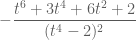
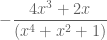
Q. 1 \displaystyle \frac{5}{(2x+1)^2}. Q. 2 \displaystyle -\frac{t^6+3t^4+6t^2+2}{(t^4-2)^2}. Q. 3 \displaystyle -\frac{4x^3+2x}{(x^4+x^2+1)}. Q. 4 \displaystyle \frac{2t-2t^2}{(3t^2-2t+1)^2}. Q. 5 \displaystyle \frac{1}{\sqrt{x}(\sqrt{x}+1)^2}. Q. 6 \displaystyle \frac{m}{(1+mx)^2}. Q. 7 \displaystyle -\frac{x^2+1}{(x^2-1)^2}. Q. 8 \displaystyle \frac{x\cos x}{(x+\cos x)^2}. Q. 9 \displaystyle -\frac{4e^{2x}}{(e^{2x}-1)^2}. Q. 10 \displaystyle \frac{1+\log (2)}{u(1+\log(2u))^2}. Q. 11 \displaystyle \frac{1-2\log(x)}{x^3}. Q. 12 \displaystyle 0. Q. 13 \displaystyle y=\frac12 x+\frac12. Q. 14 \displaystyle y=-x+1. Q. 15 \displaystyle \frac{1}{2\sqrt{x}}-3.

Next Week

We will be doing the Chain Rule. This is very important for differentiation and we need to be good at the product rule and the quotient rule before we start it. Therefore we will have a tutorial on Monday. If we cover the Chain Rule with time to spare we may be as well to have another tutorial. We’ll see.

I am emailing a link of this to everyone on the class list every Friday afternoon. If you are not receiving these emails or want to have them sent to another email address feel free to email me at jpmccarthymaths@gmail.ie and I will add you to the mailing list.

Continuous Assessment

The weeks of the tests can be seen in the module descriptor.

Read the rest of this entry »