I am emailing a link of this to everyone on the class list every week. If you are not receiving these emails or want to have them sent to another email address feel free to email me at jippo@campus.ie and I will add you to the mailing list.
This Week
We finished the chapter on area and volume and we have began the chapter on differential equations.
In tutorials we looked at p. 59 Q. 1(a), 2(a)(c)(f), 3(c) and p.64 Q. 4(e)(f).
Mistakes in Notes!!
- The formula for the volume of a doughnut/torus on p.97 is correct — there is a
 term.
term.
- Autumn 2011 Q.2(b)(ii) P. 99 My geometric intuition led me astray here I am afraid. The equation that governs the rotation about the
 -axis (and the generalisation to rotations about
  ) use a summation of cylinders and the “big volume” – “hole” idea works perfectly. However, when rotating around the
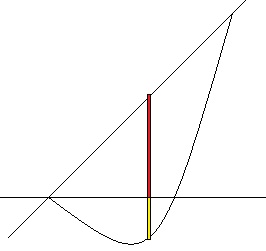
  -axis things are different and we derived our formula using cylindrical shells (animation). This means that the “big volume” – “hole” perspective is not going to work. What is actually happening in this question is we are generating a cylindrical shell as per the animation above by rotating the below strip about the -axis.
In this case the height of the strip (corresponding to height of the red plus the yellow) is given by  . This is directly analogous to the situation where we find the area between two curves as the integral of “top curve minus bottom” curve. Therefore I should have never put the
  in front of
![\displaystyle V=\int_0^32\pi x[x-(x^2-2x)]\,dx,](https://s0.wp.com/latex.php?latex=%5Cdisplaystyle+V%3D%5Cint_0%5E32%5Cpi+x%5Bx-%28x%5E2-2x%29%5D%5C%2Cdx%2C&bg=ffffff&fg=545454&s=0&c=20201002)
and the answer is  . Note that we shouldn’t blindly change the
  that we got in class. If we use our formulae correctly then we shouldn’t get meaningless answers. In fact this question serves a timely reminder that to use a “formula” with total aptitude you should probably know how to derive it — this suggests the extent and limits of its application.
Thus, if we ever want to find the volume generated by rotating a region  , lying in the right-half plane, (bounded by curves
  and
and  ), about the -axis, we should use:
![\displaystyle V=\int_a^b 2\pi x[\text{``top curve''- ``bottom curve''}]\,dx](https://s0.wp.com/latex.php?latex=%5Cdisplaystyle+V%3D%5Cint_a%5Eb+2%5Cpi+x%5B%5Ctext%7B%60%60top+curve%27%27-+%60%60bottom+curve%27%27%7D%5D%5C%2Cdx&bg=ffffff&fg=545454&s=0&c=20201002) .
.
Exercise from Notes
Evaluate the integrals in Summer 2011 Q. 2(c)
Test Results
Sunday all going well.

 .
. .
. .
. .
. .
. but we require
 )
) )
) )
) )
)

 J.P. McCarthy: Math Page

Recent Comments