
You are currently browsing the category archive for the ‘MATH6037’ category.
Remarks in italics are by me for extra explanation. These comments would not be necessary for full marks in an exam situation. Exercises taken from p.48 of these notes.
Question 1
(i)
Multiplying the first and last coefficients: 



(ii)
Taking out the common factor 

(iii)
Multiplying the first and last coefficients: 



Remarks in italics are by me for extra explanation. These comments would not be necessary for full marks in an exam situation. Exercises taken from p.35 of https://jpmccarthymaths.wordpress.com/2011/02/01/math6037-general-information/
These questions all require integration by parts although they don’t explicitly say so.
Question 1
We must choose a 


Hence by the integration by parts formula:


We check our solution by differentiating 

as required.
Remarks in italics are by me for extra explanation. These comments would not be necessary for full marks in an exam situation. Exercises taken from https://jpmccarthymaths.wordpress.com/2011/02/01/math6037-general-information/
Question 1
(a)
Now:


hence:
![\int_0^1 (2x+5)\,dx=\left[x^2+5x\right]_0^1 =(1^2+5(1))-(0^2+5(0))=6](https://s0.wp.com/latex.php?latex=%5Cint_0%5E1+%282x%2B5%29%5C%2Cdx%3D%5Cleft%5Bx%5E2%2B5x%5Cright%5D_0%5E1+%3D%281%5E2%2B5%281%29%29-%280%5E2%2B5%280%29%29%3D6&bg=ffffff&fg=545454&s=0&c=20201002)
(b)
There is no obvious anti-derivative and there is no obvious manipulation hence we are looking for the function-dervative pattern to make a substitution (or else use the LIATE rule). Notice that the top is the derivative of the bottom. Hence we will let
Let 


Now put everything back into the integrand, suppressing the limits:
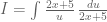
![=\int \frac{du}{u}=\ln u =[\ln (x^2+5x+1)]_0^1](https://s0.wp.com/latex.php?latex=%3D%5Cint+%5Cfrac%7Bdu%7D%7Bu%7D%3D%5Cln+u+%3D%5B%5Cln+%28x%5E2%2B5x%2B1%29%5D_0%5E1&bg=ffffff&fg=545454&s=0&c=20201002)

Now, what do we have to raise 


Module Description:
More detailed General Information on this module (* not all one hundred percent accurate at time of publication) may be found after the table of contents in this set of incomplete notes:
(last updated 04 May. )
MATH6037 please skip to the end of this entry.
The sum, product and quotient rules show us how to differentiate a great many different functions from the reals to the reals. However some functions, such as 

Proposition 4.1.8 (Chain Rule)
Let 


 J.P. McCarthy: Math Page
Recent Comments