
You are currently browsing the category archive for the ‘MATH6037’ category.
Question 1
Find the Laplace transform of the following functions.
(i)

Solution
Using linearity:

Now using the tables:

Read the rest of this entry »
Question 3
Find, from first principles, 
Solution
Using the definition:

To ease the steps, first we will evaluate the indefinite integral:
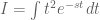
This integral needs to be integrated by parts (this hint would be proffered in an exam situation). Using the LIATE rule, choose 


In this context 


Question 1
Determine whether the integrals are convergent or divergent. Evaluate those that are convergent.
This exercise is more to get us used to evaluating infinite integrals — none of these bar (iii) are necessarily related to Laplace transforms.
(i)

Solution
We first try and evaluate

Try the substitution 



Now evaluating 


Now taking the limit as 

The integral is convergent with value 
Due to Miguel being away next Wednesday I have decided to postpone the Maple test until the week after.
The results are down the bottom. You are identified by the last three digits of your student number. If there is a blank it means that you did not write down a student number. If you want email me on jippo@campus.ie and I can confirm your score — otherwise you’ll be waiting until Wednesday.
The scores are itemized as you can see. At the bottom there are some average scores. Finally the last column displays your Continuous Assessment mark for the Test (out of 15).
If you would like to see your paper or have it discussed please email me at jippo@campus.ie
| St No | Q1 | Q2 | Q3 | Q4 | Q5 | Q6 | Q7 | Total | % | CA |
| 219 | 10 | 10 | 10 | 10 | 10 | 10 | 10 | 70 | 100 | 15 |
| 4 | 7 | 10 | 10 | 10 | 9 | 8 | 58 | 83 | 13 | |
| 993 | 8 | 9 | 10 | 6 | 8 | 9 | 1 | 51 | 73 | 11 |
| 102 | 9 | 4 | 8 | 10 | 6 | 10 | 3 | 50 | 71 | 11 |
| 960 | 6 | 7 | 10 | 10 | 2 | 10 | 4 | 49 | 70 | 11 |
| 787 | 4 | 4 | 10 | 5 | 1 | 7 | 10 | 41 | 59 | 9 |
| 4 | 6 | 10 | 10 | 6 | 2 | 1 | 39 | 56 | 9 | |
| 675 | 10 | 4 | 4 | 8 | 3 | 2 | 3 | 34 | 49 | 8 |
| 6 | 0 | 9 | 4 | 2 | 2 | 4 | 27 | 39 | 6 | |
| 5 | 0 | 1 | 7 | 5 | 1 | 7 | 26 | 37 | 6 | |
| 271 | 3 | 0 | 4 | 8 | 4 | 2 | 2 | 23 | 33 | 5 |
| 4 | 0 | 2 | 5 | 4 | 2 | 2 | 19 | 27 | 5 | |
| Ave | 6.08 | 4.25 | 7.33 | 7.75 | 5.08 | 5.50 | 4.58 | 40.58 | 57.98 | 9.08 |
Remarks in italics are by me for extra explanation. These comments would not be necessary for full marks in an exam situation. Exercises taken from p.87 of these notes.
Question 1
Estimate 

Solution
Part (a)
For the Trapezoidal Rule, we have 


![\int_0^1\cos(x^2)\,dx\approx\frac{0.25}{2}[\cos(0)+2[\cos(0.25^2)+\cos(0.5^2)+\cos(0.75^2)]](https://s0.wp.com/latex.php?latex=%5Cint_0%5E1%5Ccos%28x%5E2%29%5C%2Cdx%5Capprox%5Cfrac%7B0.25%7D%7B2%7D%5B%5Ccos%280%29%2B2%5B%5Ccos%280.25%5E2%29%2B%5Ccos%280.5%5E2%29%2B%5Ccos%280.75%5E2%29%5D&bg=ffffff&fg=545454&s=0&c=20201002)
![+\cos(1)]\approx 0.895795](https://s0.wp.com/latex.php?latex=%2B%5Ccos%281%29%5D%5Capprox+0.895795&bg=ffffff&fg=545454&s=0&c=20201002)
Remarks in italics are by me for extra explanation. These comments would not be necessary for full marks in an exam situation. Exercises taken from p.75 of these notes.
Question 1
If 


Solution
Solving the equation 




Hence 


Read the rest of this entry »
Remarks in italics are by me for extra explanation. These comments would not be necessary for full marks in an exam situation. Exercises taken from p.63 of these notes.
Question 1
Use differentials to estimate the amount of tin in a closed tin closed tin can with diameter 8 cm and height 12 cm if the can is 0.04 cm thick.
Solution
Assuming that the measurements of 8 cm and 12 cm are taken from the outside of the can, then we could estimate the change in volume of a cylinder if the radius were increased by 0.04 cm to 4 cm and the height increased by 0.08 cm to 12 cm (convince yourself of this with a picture.). Now the tin in the can comprises the difference between a 

The MATH6037 test will be held at 7 p.m. Wednesday 16/03/11. The test is worth 15% of your final mark. The test will be 60 minutes long and you must answer all questions. All questions carry equal marks and I will attach a set of tables. You will get a copy of these tables tomorrow night.
Please find a sample here.
Remarks in italics are by me for extra explanation. These comments would not be necessary for full marks in an exam situation. Exercises taken from p.58 of these notes.
Question 1
(i)

————————————————————————————————————————————————–

(ii)


 J.P. McCarthy: Math Page
Recent Comments