
You are currently browsing the category archive for the ‘Research’ category.
Just some notes on section 1 of this paper. Flags and notes are added but mistakes are mine alone.
Definition
Let
be the algebra of continuous functions on a compact matrix quantum group. Such an object is given by a matrix
which generates
such that
,
and both
and
are invertible in
.
Any subgroup 



We say that 

The transpose 
Proposition
The C*algebra generated by the
is also the algebra of continuous functions on a compact matrix quantum group.
Background
I am trying to prove an Ergodic Theorem for Random Walks on Finite Quantum Groups. A random walk on a quantum group driven by 


The classical theorem for finite groups:
Ergodic Theorem for Random Walks on Finite Groups
A random walk on a finite group
driven by a probability
is not concentrated on a proper subgroup nor the coset of a proper normal subgroup.
Not concentrated on a proper subgroup gives irreducibility. A random walk is irreducible if for all 


Not concentrated on the coset of a proper normal subgroup gives aperiodicity. Something which should be equivalent to aperiodicity is if

is equal to one (perhaps via invariance ![\mathbb{P}[\xi_{i+1}=t|\xi_{i}=s]=\mathbb{P}[\xi_{i+1}=th|\xi_{i}=sh]](https://s0.wp.com/latex.php?latex=%5Cmathbb%7BP%7D%5B%5Cxi_%7Bi%2B1%7D%3Dt%7C%5Cxi_%7Bi%7D%3Ds%5D%3D%5Cmathbb%7BP%7D%5B%5Cxi_%7Bi%2B1%7D%3Dth%7C%5Cxi_%7Bi%7D%3Dsh%5D&bg=ffffff&fg=545454&s=0&c=20201002)
If 




In Markov chain theory, ergodicity is equivalent to irreduciblity and aperiodicity.
The theorem in the quantum case should look like:
Ergodic Theorem for Random Walks on Finite Quantum Groups
A random walk on a finite quantum group
Irreducibility
At the moment I have some part of X;the irreducibility bit. As is well known since Pal (1996), it is possible to have a probability not concentrated on a quantum subgroup be reducible. This led Franz & Skalski to generalise quantum subgroups to group-like-projections, which I will say correspond to quasi-subgroups following Kasprzak & Sołtan.
I have shown that if 



I have also shown on the other hand that if the random walk is reducible that it must be concentrated on a proper quasi-subgroup. Franz & Skalski show that group-like-projections also have a correspondence with idempotent states. The Césaro Means

converge to an idempotent state 


I believe this result — irreducible if and only if not concentrated on a quasi-subgroup — holds more generally than just in finite quantum groups.
Slides of a talk given to the Functional Analysis seminar in Besancon.
Some of these problems have since been solved.
“e in support” implies convergence
Consider a




where 
An element in a direct sum is positive if and only if both elements are positive. The Haar element is positive and so 



Therefore let

be the density of 
Now we can explicitly write

This has stochastic operator

Let 



and thus
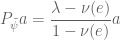
Therefore, as 


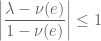

This means that the eigenvalues of 

If 



which converges to 

If 

Total Variation Decrasing
Uses Simeng Wang’s 
Periodic  is concentrated on a coset of a proper normal subgroup of


Supported on Subgroup implies Reducible
I have a proof that reducible is equivalent to supported on a pre-subgroup.
Diaconis–Shahshahani Upper Bound Lemma for Finite Quantum Groups, Journal of Fourier Analysis and Applications, doi: 10.1007/s00041-019-09670-4 (earlier preprint available here)
Abstract
A central tool in the study of ergodic random walks on finite groups is the Upper Bound Lemma of Diaconis and Shahshahani. The Upper Bound Lemma uses Fourier analysis on the group to generate upper bounds for the distance to random and thus can be used to determine convergence rates for ergodic walks. The Fourier analysis of quantum groups is remarkably similar to that of classical groups. This allows for a generalisation of the Upper Bound Lemma to an Upper Bound Lemma for finite quantum groups. The Upper Bound Lemma is used to study the convergence of ergodic random walks on the dual group 
In a recent preprint, Haonan Zhang shows that if 


The algebra of functions 

As it happens, where 


To help with intuition, making the incorrect assumption that 

as for classical groups 
That is the condition 
Consider a random walk on a classical (the algebra of functions on
The following is a very non-algebra-of-functions-y proof that 
Proof: Let 

We claim that the random walk on
The driving probability
If 


Therefore,
Apart from the big reason — that this proof talks about points galore — this kind of proof is not available in the quantum case because there exist
So we have some questions:
- Is there a proof of the classical result (above) in the language of the algebra of functions on
- And can this proof be adapted to the quantum case?
- Is the claim perhaps true for all finite quantum groups but not all compact quantum groups?
Quantum Subgroups
Let 




The Classical Case
In the classical case, where the algebras of functions on
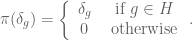
There is a natural embedding, in the classical case, if 
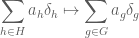
with 


Furthermore, 

which resembles 
In the case where

where the i.i.d. 

We can also prove this using the language of the commutative algebra of functions on

Consider now two probabilities on 


Consider





that is 
Some Questions
Back to quantum groups with non-commutative algebras of functions.
- Can we embed
and do we have
, giving the projection-like quality to
- Is
a suitable definition for
If this is the case, the above proof carries through to the quantum case.
- If there is no such embedding, what is the appropriate definition of a
- If
Edit
UwF has recommended that I look at this paper to improve my understanding of the concepts involved.
Slides of a talk given at the Irish Mathematical Society 2018 Meeting at University College Dublin, August 2018.
Abstract Four generalisations are used to illustrate the topic. The generalisation from finite “classical” groups to finite quantum groups is motivated using the language of functors (“classical” in this context meaning that the algebra of functions on the group is commutative). The generalisation from random walks on finite “classical” groups to random walks on finite quantum groups is given, as is the generalisation of total variation distance to the quantum case. Finally, a central tool in the study of random walks on finite “classical” groups is the Upper Bound Lemma of Diaconis & Shahshahani, and a generalisation of this machinery is used to find convergence rates of random walks on finite quantum groups.
Amaury Freslon has put a pre-print on the arXiv, Cut-off phenomenon for random walks on free orthogonal quantum groups, that answers so many of these questions, some of which appeared as natural further problems in my PhD thesis.
It really is a fantastic paper and I am delighted to see my PhD work cited: it appears that while I may have taken some of the low hanging fruit, Amaury has really extended these ideas and has developed some fantastic examples: all beyond my current tools.
This pre-print gives me great impetus to draft a pre-print of my PhD work, hopefully for publication. I am committed to improving my results and presentation, and Amaury’s paper certainly provides some inspiration is this direction.
As things stand I do not have to tools to develop results as good as Amaury’s. Therefore I am trying to develop my understanding of compact quantum groups and their representation theory. Afterwards I can hopefully study some of the remaining further problems mentioned in the thesis.
As suggested by Uwe Franz, representation theoretic methods (such as presented by Diaconis (1988) for the classical case), might be useful for analysing random walks on quantum homogeneous spaces.
Distances between Probability Measures
Let 

The algebra 
Define a (bijective) map 

for 
Then, where 



(Quantum Total Variation Distance (QTVD))
Standard non-commutative 

(supremum presentation)
In the classical case, using the test function 


In the classical case the set of indicator functions on the subsets of the group exhaust the set of projections in

(Projection Distance)
In all cases the quantum total variation distance and the supremum presentation are equal. In the classical case they are equal also to the projection distance. Therefore, in the classical case, we are free to define the total variation distance by the projection distance.
Quantum Projection Distance  Quantum Variation Distance?
Perhaps, however, on truly quantum finite groups the projection distance could differ from the QTVD. In particular, a pair of states on a 
Slides of a talk given at the Topological Quantum Groups and Harmonic Analysis workshop at Seoul National University, May 2017.
Abstract A central tool in the study of ergodic random walks on finite groups is the Upper Bound Lemma of Diaconis & Shahshahani. The Upper Bound Lemma uses the representation theory of the group to generate upper bounds for the distance to random and thus can be used to determine convergence rates for ergodic walks. These ideas are generalised to the case of finite quantum groups.


Recent Comments