You are currently browsing the category archive for the ‘Research’ category.

After a long time I have finally completed my PhD studies when I handed in my hardbound thesis (a copy of which you can see here).

It was a very long road but thankfully now the pressure is lifted and I can enjoy my study of quantum groups and random walks thereon for many years to come.

The following is taken (almost) directly from the first draft of my PhD thesis.

The Quantisation Functor

This functor can be used to motivate the correct notion of (the algebra of functions on) a quantum group. Note that the ‘quantised’ objects that are arrived at via this ‘categorical quantisation’ are nothing but the established definitions so this section should be considered as little more than a motivation. The author feels that introductory texts on quantum groups could include these ideas and that is why they are included here. This quantisation is the translation of statements about a finite group, G into statements about the algebra of functions on G, F(G).

This notion of quantisation sits naturally in category theory where two functors — the \mathbb{C} functor and the dual functor — lead towards a satisfactory quantisation.

Read the rest of this entry »

I gave this talk at the CIT Spring Seminar Series.

This is about as short and introduction to quantum groups as you can imagine: I only had 15 minutes!

Let \mathbb{G} be a finite quantum group described by A=\mathcal{C}(\mathbb{G}) with an involutive antipode (I know this is true is the commutative or cocommutative case. I am not sure at this point how restrictive it is in general. The compact matrix quantum groups have this property so it isn’t a terrible restriction.) S^2=I_A. Under the assumption of finiteness, there is a unique Haar state, h:A\rightarrow \mathbb{C} on A.

Representation Theory

A representation of \mathbb{G} is a linear map \kappa:V\rightarrow V\otimes A that satisfies

\left(\kappa\otimes I_A\right)\circ\kappa =\left(I_V\otimes \Delta\right)\circ \kappa\text{\qquad and \qquad}\left(I_V\otimes\varepsilon\right)\circ \kappa=I_V.

The dimension of \kappa is given by \dim\,V. If V has basis \{e_i\} then we can define the matrix elements of \kappa by

\displaystyle\kappa\left(e_j\right)=\sum_i e_i\otimes\rho_{ij}.

One property of these that we will use it that \varepsilon\left(\rho_{ij}\right)=\delta_{i,j}.

Two representations \kappa_1:V_1\rightarrow V_1\otimes A and \kappa_2:V_2\rightarrow V_2\otimes A are said to be equivalent, \kappa_1\equiv \kappa_2, if there is an invertible intertwiner between them. An intertwiner between \kappa_1 and \kappa_2 is a map T\in L\left(V_1,V_2\right) such that

\displaystyle\kappa_2\circ T=\left(T\otimes I_A\right)\circ \kappa_1.

We can show that every representation is equivalent to a unitary representation.

Timmermann shows that if \{\kappa_\alpha\}_{\alpha} is a maximal family of pairwise inequivalent irreducible representation that \{\rho_{ij}^\alpha\}_{\alpha,i,j} is a basis of A. When we refer to “the matrix elements” we always refer to such a family. We define the span of \{\rho_{ij}\} as \mathcal{C}\left(\kappa\right), the space of matrix elements of \kappa.

Given a representation \kappa, we define its conjugate, \overline{\kappa}:\overline{V}\rightarrow\overline{V}\otimes A, where \overline{V} is the conjugate vector space of V, by

\displaystyle\overline{\kappa}\left(\bar{e_j}\right)=\sum_i \bar{e_i}\otimes\rho_{ij}^*,

so that the matrix elements of \overline{\kappa} are \{\rho_{ij}^*\}.

Timmermann shows that the matrix elements have the following orthogonality relations:

  • If \alpha and \beta are inequivalent then h\left(a^*b\right)=0, for all a\in \mathcal{C}\left(\kappa_\alpha\right) and b\in\mathcal{C}\left(\kappa_\beta\right).
  • If \kappa is such that the conjugate, \overline{\kappa}, is equivalent to a unitary matrix (this is the case in the finite dimensional case), then we have

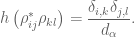
\displaystyle h\left(\rho_{ij}^*\rho_{kl}\right)=\frac{\delta_{i,k}\delta_{j,l}}{d_\alpha}.

This second relation is more complicated without the S^2=I_A assumption and refers to the entries and trace of an intertwiner F from \kappa to the coreprepresention with matrix elements \{S^2\left(\rho_{ij}\right)\}. If S^2=I_A, then this intertwiner is simply the identity on V and so the the entries \left[F\right]_{ij}=\delta_{i,j} and the trace is d=\dim V.

Denote by \text{Irr}(\mathbb{G}) the set of unitary equivalence classes of irreducible unitary representations of \mathbb{G}. For each \alpha\in\text{Irr}(\mathbb{G}), let \kappa_\alpha:V_{\alpha}\rightarrow V_{\alpha}\otimes A be a representative of the class \alpha where V_\alpha is the finite dimensional vector space on which \kappa_\alpha acts.

Diaconis-Van Daele Fourier Theory

Read the rest of this entry »

Taken from An Invitation to Quantum Groups and Duality by Timmermann.

Let A be a quantum group with a comultiplication \Delta. We make the following definitions. A corepresentation of A on a complex vector space V is a linear map \chi:V\rightarrow V\otimes A that dualises representations with the coassociativity and counit properties:

(I\otimes \Delta)\circ \chi=(\chi\otimes I)\circ \chi, and

(I \otimes\varepsilon)\circ\chi=I.

Now we wish to dualise the terms invariantirreducible, unitary, intertwiner, equivalent, matrix elements. As we want a theory dual to group representation we won’t use Timmermann’s definitions at face value but instead construct them from their group representation counterparts. This might prove difficult. In attempting to dualise group representation theory as quantum group corepresentation theory is ‘everything’ dualised?  Our first term here provides a problem. Do we need an invariant corepresentation or a ‘coinvariant representation’?

Invariant

An invariant subspace of a group representation \Phi:(V,G) is a subspace W\subset V such that

\Phi(w,g)\in W for all w\in W and g\in G.

This means that for the family of linear maps \{\rho(g):g\in G\}W is stable subspace. How this is dualised is important in how we may hope to write a corepresentation as a direct sum of irreducible corepresentations so we need the right definition. Timmermann calls W\subset V invariant if \chi(W)\subset W\otimes A. If we could view the co-representation as a family of endomorphisms on V then we might be able to write down a definition of co-invariant or maybe say that Timmermann’s definition is what we need.

As an example of what we might need to do let \Phi:F(G)\times G\rightarrow G be the regular action of a group and let W\subset be the subspace of constant functions. This set is invariant. Thinking about this yields a definition of co-invariant. 

A subspace W\subset V is co-invariant for \chi if W\otimes A\subset \chi(W).

Timmermann’s definition makes good sense. One is confused between invariant co-representation and co-invariant co-representation. I am guessing that Timmermann’s definition will allow us to do what we want.

Read the rest of this entry »

In Group Representations in Probability and Statistics, Diaconis presents his celebrated Upper Bound Lemma for a random walk on a finite  group G driven by \nu\in M_p(G). It states that

\displaystyle \|\nu^{\star k}-\pi\|^2\leq \frac{1}{4}\sum d_\rho \text{Tr }(\widehat{\nu(\rho)}^k(\widehat{\nu(\rho)}^\ast)^k),

where the sum is over all non-trivial irreducible representations of G.

In this post, we begin this study by looking a the (co)-representations of a quantum group A. The first thing to do is to write down a satisfactory definition of a representation of a group which we can quantise later. In the chapter on Diaconi-Fourier Theory here we defined a representation of a group as a group homomorphism

\rho:G\rightarrow GL(V)

While this was perfectly adequate for when we are working with finite groups, it might not be as transparently quantisable. Instead we define a representation of a group as an action

\Phi:V\times G\rightarrow V.

such that the map \rho(g):V\rightarrow V\rho(g)x=\Phi(x,g) is linear.

Read the rest of this entry »

Let G be a group and let A:=C^*(G)  be the C*-algebra of the group G. This is a C*-algebra whose elements are complex-valued functions on the group G. We define operations on A in the ordinary way save for multiplication

\displaystyle (fg)(s)=\sum_{t\in G}f(t)g(t^{-1}s),

and the adjoint f^*(s)=\overline{f(s^{-1})}. Note that the above multiplication is the same as defining \delta_s\delta_t=\delta_{st} and extending via linearity. Thence A is abelian if and only if G is.

To give the structure of a quantum group we define the following linear maps:

\Delta:A\rightarrow A\otimes A\Delta(\delta_s)=\delta_s\otimes\delta_s.

\displaystyle \varepsilon:A\rightarrow \mathbb{C}\varepsilon(\delta_s)=1.

S:A\rightarrow AS(\delta_s)=\delta_{s^{-1}}.

The functional h:A\rightarrow \mathbb{C} defined by h=\mathbf{1}_{\{\delta_e\}} is the Haar state on A. It is very easy to write down the j_n:

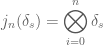
\displaystyle j_n(\delta_s)=\bigotimes_{i=0}^n\delta_s.

To do probability theory consider states \varepsilon,\,\phi on A and form the product state:

\displaystyle \Psi=\varepsilon\otimes\bigotimes_{i=1}^\infty \phi.

Whenever \phi is a state of A such that \phi(\delta_s)=1 implies that s=e, then the distribution of the random variables j_n converges to h.

At the moment we will use the one-norm to measure the distance to stationary:

d(\Psi\circ j_n,h)=\|\Psi\circ j_n-h\|_1.

A quick calculation shows that:

d(\Psi\circ j_n,h)=\sum_{s\neq e}|\phi(\delta_s)|^n.

When, for example, \phi(\delta_s)=2/m^2 when s are transpositions in S_m, then we have

d(\Psi\circ j_n,h)={m\choose 2}\left(\frac{2}{m^2}\right)^n.

Taken from Random Walks on Finite Quantum Groups by Franz & Gohm.

Theorem

Let \phi be a state on a finite quantum group A. Then the Cesaro mean
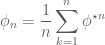
\displaystyle \phi_n=\frac{1}{n}\sum_{k=1}^n\phi^{\star n}n\in\mathbb{N}

converges to an idempotent state on A, i.e. to a state \pi such that \pi\star\pi=\pi.

Proof : Let \phi' be an accumulation point of \{\phi_n\}_{n\geq0}, this exists since the states on A form a compact set. We have

\|\phi_n-\phi\star \phi_n\|=\frac{1}{n}\|\phi-\phi^{n+1}\|\leq \frac{2}{n}.

I have no idea where the equality comes from.

Choose sequence \{n_k\}_{k\geq 0} such that \phi_{n_k}\rightarrow \phi', we get \phi\star\phi'=\phi' and similarly \phi'\star \phi=\phi'. By linearity this implies \phi_n\star\phi'=\phi'=\phi'\star \phi_n. If \phi'' is another accumulation point of \{\phi_n\}_{n\geq 0} and \{m_{\ell}\}_{\ell\geq 0} a sequence such that \phi_{m_\ell}\rightarrow\phi'', then we get \phi''\star\phi'=\phi'=\phi'\star\phi'' and thus \phi'=\phi'' by symmetry (??). Therefore the sequence \{\phi_n\}_{n\geq0} has a unique accumulation point, i.e. it converges \bullet

Remark

If \phi is faithful, then the Cesaro limit \pi is the Haar state on A (prove this).

Remark

Due to cyclicity the sequence \{\phi^{\star n}\}_{n\geq 0} does not converge in general. Take, for example, the state \phi=\eta_2 (p.28) on the Kac-Paljutkin quantum group A, then we have

\eta_2^{\star n}=\left\{\begin{array}{ccc}\eta_2&\text{if}& n\text{ is odd}\\ \varepsilon&\text{if}&n\text{ is even}\end{array}\right.,

but

\displaystyle \lim_{n\rightarrow\infty}\frac1{n}\sum_{k=1}^n\eta_2^{\star k}=\frac{\varepsilon+\eta_2}2.

Taken from Random Walks on Finite Quantum Groups by Franz & Gohm

In this section we will show how one can recover a classical Markov chain from a quantum Markov chain. We will apply a folklore theorem that says one gets a classical Markov process, if a quantum Markov process can be restricted to a commutative algebra.

We might like to do more. This result recovers a Markov chain — if the quantum process is in fact a random walk on a finite quantum group can we recover the group, the transition probabilities (yes), the driving probability measure?? 

Conjecture

If we restrict a random walk on a finite quantum group to a commutative subalgebra we can recover a random walk on a finite group.

For random walks on quantum groups we have the following result.

Theorem 6.1

Let A be a finite quantum group \{j_n\}_{n\geq 0} a random walk on a finite dimensional A-comodule algebra B, and B_0 a unital abelian sub-*-algebra of B. The algebra B_0 is isomorphic to the algebra of functions on a finite set, say B_0\cong F(X) where X={1,\dots,d}.

If the transition operator T_\phi of \{j_n\}_{n\geq 0} leaves B_0 invariant, then there exists a classical Markov chain \{\xi_n\}_{n\geq 0} with values in X, whose probabilities can be computed as time-ordered moments of \{j_n\}_{n\geq 0}, i.e.

P(\xi_0=i_0,\dots,\xi_\ell=i_\ell)=\Psi\left(j_0\left(\mathbf{1}_{\{i_0\}}\right)\cdots j_\ell\left(\mathbf{1}_{\{i_\ell\}}\right)\right)

for all \ell\geq 0 and i_0,\dots,i_\ell\in X.

Read the rest of this entry »

Taken from Random Walks on Finite Quantum Groups by Franz & Gohm

In this section we want to represent the algebras on Hilbert spaces and obtain spatial implementations for the random walk. On a finite quantum group A we can introduce an inner product

\langle a,b\rangle=\eta(a^*b),

where a,\,b\in A and \eta and \eta is the Haar state. Because the Haar state is faithful we can think of A as a finite dimensional Hilbert space. Further we denote by \|\cdot\| the norm associated to this inner product. We consider the linear operator

W:A\otimes A\rightarrow A\otimes Ab\otimes a\mapsto \Delta(b)(1_A\otimes a).

It turns out that this operator contains all information about the quantum group and thus it is called its fundamental operator. We discuss some of its properties.

Read the rest of this entry »