
You are currently browsing the category archive for the ‘General’ category.
TL;DR: The margin of error gets smaller with the proportion: the given margin of error is most relevant the closer to 50% the support.
Warning: I am taking the polls to be of the form
Will you vote for party X: yes or no?
There is more than a little confusion about the margin of error in political polling amongst the Irish political commentators.
Polls frequently come with margins of error such as “3%” and if a small party polls less than this some people comment that the real support could be zero.
In this piece, I will present a new way of interpreting low poll numbers, show how it is derived, further explain where the approximate 3% figure comes from and show what the calculation should be for mid-ranking proportions.
The main point is that none of these margins of error are accurate for small proportions.
For those who don’t like the mathematics of it all I will explain in a softer way why polling at 1-2% is very unlikely when your true support is 0.5%.
The reality of the situation is that a far greater proportion than 5.2% of Leaving Cert students sitting Higher Level maths are presenting work that should confer less than 40% on their exam and those in the system know that the marking scheme receives a thorough massaging in order to get 94.8% of this cohort through.
A number of students are simply not allowed fail because failing 8-20+% of those sitting would be a political and logistical nightmare.
The final result of this fear of failing students, is the dumbing down of Higher Level maths and this is good for nobody.
I feel a solution to this is to do away with the pass/fail regime for maths: keep LC points for grades above 40% but mark the papers properly. This would effectively do away with the requirement for a pass in maths for third level courses, save for those such as engineering and science who want students with certain grades.
This will allow students take on Higher Level maths in good faith with the knowledge that if they do get less than 40%, it will not be a total disaster and they will still be able to attend a third level institution.
There is still a cut off in that 35% would confer 0 points and 40% would confer 70 points but this cut-off already exists (in theory!) but it is the failing not the lack of points that is somehow forcing the Department of Education to pass these students who really should be failing.
We should keep the bonus points for higher level maths because we should want our pupils to have good maths skills for the smart economy. However, at the moment, the stick of failing is proving to have more impact than the carrot of the 25 extra points.
Let 


Representation Theory
A representation of 

The dimension of 


One property of these that we will use it that 
Two representations 



We can show that every representation is equivalent to a unitary representation.
Timmermann shows that if 


Given a representation 


so that the matrix elements of 

Timmermann shows that the matrix elements have the following orthogonality relations:
- If
and
are inequivalent then
for all
and
.
- If
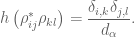
This second relation is more complicated without the 

![\left[F\right]_{ij}=\delta_{i,j}](https://s0.wp.com/latex.php?latex=%5Cleft%5BF%5Cright%5D_%7Bij%7D%3D%5Cdelta_%7Bi%2Cj%7D&bg=ffffff&fg=545454&s=0&c=20201002)

Denote by 


Diaconis-Van Daele Fourier Theory
I will be giving this talk with some of the fourth and fifth class pupils at Gaelscoil an Ghoirt Alainn, Mayfield in a few weeks.
A few historical and actual inaccuracies to keep things simple!
We define the transfer function of a black box model as

where 


These 


Applying the Inverse Laplace transform we have an input:

These 
A positive real pole is a pole 


A negative real pole 


A zero pole 

A purely imaginary pole 

A genuinely complex pole 

While the 

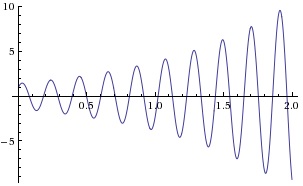
Note that this behaviour is unstable.
When we have complex pole 


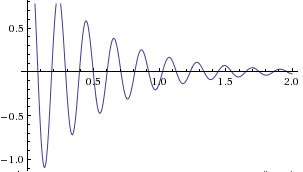
This is inherently stable behaviour.
This is the first in a series of posts that are an attempt by me to understand why my Industrial Measurement and Control students need to study the Laplace Transform.
Consider a black box model that takes as an input signal a function 


Definition
The transfer function of a black box model is defined as
where
Note we have the Laplace transform of a function 


Poles of 


If the coefficients of
I went through the first four weird facts from this talk with the some of the fifth and sixth class pupils at Gaelscoil an Ghoirt Alainn, Mayfield.
We have 


Also 


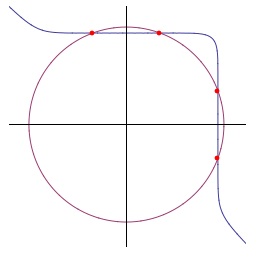
We have 
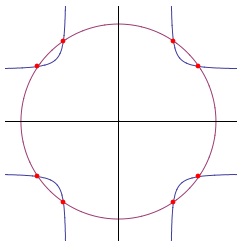
Also 
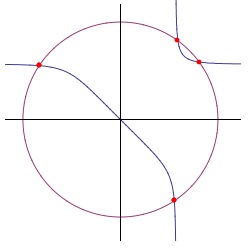
Just a nice little problem I saw. The solution is not difficult but here I present a different one which I like.
Let 


Find the eigenvalues and eigenfunctions of the linear map 

 J.P. McCarthy: Math Page
Recent Comments