
You are currently browsing the category archive for the ‘MATH6037’ category.
This is the first in a series of posts that are an attempt by me to understand why my Industrial Measurement and Control students need to study the Laplace Transform.
Consider a black box model that takes as an input signal a function 


Definition
The transfer function of a black box model is defined as

where 

Note we have the Laplace transform of a function 


Poles of 


If the coefficients of
I am emailing a link of this to everyone on the class list every week. If you are not receiving these emails or want to have them sent to another email address feel free to email me at jpmccarthymaths@gmail.com and I will add you to the mailing list.
Continuous Assessment
You are identified by the last four digits of your student number unless you are winning the league. The individual quiz marks are out of 2.5 percentage points. Your best eight quizzes go to the 20% mark for quizzes. The R % column is your running percentage (for best eight quizzes), MPP is your Maple Percentage Points and the GPP is your Gross Percentage Points (for best eight quizzes and Maple). Most of the columns are rounded but column six, for quiz five, is correct.
| S/N | Q1 | Q2 | Q3 | Q4 | Q5 | Q6 | Q7 | Q8 | Q9 | Q10 | Q11 | R % | QPP | MPP | GPP |
| Kelliher | 3 | 3 | 3 | 3 | 2.3 | 98 | 12.3 | 4.5 | 16.8 | ||||||
| 8335 | 2 | 3 | 2 | 3 | 2.5 | 98 | 12.3 | 4.5 | 16.8 | ||||||
| 3281 | 2 | 3 | 3 | 3 | 2.1 | 96 | 12.0 | 4.5 | 16.5 | ||||||
| 5527 | 2 | 3 | 3 | 3 | 2.5 | 94 | 11.9 | 4.5 | 16.4 | ||||||
| 7878 | 2 | 2 | 2 | 2 | 2.1 | 85 | 10.6 | 4.5 | 15.1 | ||||||
| 8416 | 2 | 1 | 2 | 3 | 2.5 | 84 | 10.5 | 4.5 | 15.0 | ||||||
| 8478 | 2 | 2 | 2 | 2 | 0 | 82 | 8.2 | 4.5 | 12.7 | ||||||
| 1864 | 1 | 2 | 3 | 2 | 1.24 | 76 | 9.5 | 4.5 | 14.0 | ||||||
| 8403 | 2 | 1 | 2 | 3 | 1.3 | 76 | 9.5 | 4.5 | 14.0 | ||||||
| 4198 | 0 | 1 | 2 | 3 | 1.7 | 74 | 7.4 | 4.5 | 11.9 | ||||||
| 6548 | 2 | 1 | 2 | 3 | 1.6 | 71 | 8.9 | 4.5 | 13.4 | ||||||
| 8603 | 1 | 2 | 2 | 2 | 0 | 67 | 6.7 | 3 | 9.7 | ||||||
| 8556 | 1 | 1 | 2 | 2 | 0 | 66 | 6.6 | 4.5 | 11.1 | ||||||
| 2567 | 2 | 2 | 2 | 1 | 1.8 | 65 | 8.2 | 4.5 | 12.7 | ||||||
| 1852 | 1 | 1 | 2 | 2 | 2.1 | 57 | 7.1 | 4.5 | 11.6 | ||||||
| 2859 | 2 | 1 | 0 | 1 | 1.6 | 55 | 5.5 | 4.5 | 10.0 | ||||||
| 5546 | 0 | 0 | 1 | 1 | 1.9 | 53 | 4.0 | 4.5 | 8.5 | ||||||
| 7950 | 0 | 0 | 1 | 0 | 1.8 | 52 | 2.6 | 3 | 5.6 | ||||||
| 9464 | 1 | 1 | 2 | 1 | 1.24 | 46 | 5.7 | 4.5 | 10.2 | ||||||
| 7209 | 2 | 1 | 2 | 1 | 0.16 | 44 | 5.5 | 4.5 | 10.0 | ||||||
| 8455 | 0 | 1 | 1 | 1 | 1.9 | 38 | 4.8 | 4.5 | 9.3 | ||||||
| 4775 | 1 | 0 | 1 | 0 | 0.4 | 22 | 2.2 | 4.5 | 6.7 | ||||||
| 5553 | 0 | 1 | 0 | 0 | 0.1 | 17 | 1.3 | 4.5 | 5.8 |
I am emailing a link of this to everyone on the class list every week. If you are not receiving these emails or want to have them sent to another email address feel free to email me at jpmccarthymaths@gmail.com and I will add you to the mailing list.
Continuous Assessment
You are identified by the last four digits of your student number unless you are winning the league. The individual quiz marks are out of 2.5 percentage points. Your best eight quizzes go to the 20% mark for quizzes. The R % column is your running percentage (for best eight quizzes), MPP is your Maple Percentage Points and the GPP is your Gross Percentage Points (for best eight quizzes and Maple). Most of the columns are rounded but column five, for quiz four, is correct.
| S/N | Q1 | Q2 | Q3 | Q4 | Q5 | Q6 | Q7 | Q8 | Q9 | Q10 | Q11 | R % | QPP | MPP | GPP |
| Kelliher | 3 | 3 | 3 | 2.5 | 100 | 10.0 | 3 | 13.0 | |||||||
| 3281 | 2 | 3 | 3 | 2.5 | 99 | 9.9 | 3 | 12.9 | |||||||
| 8335 | 2 | 3 | 2 | 2.5 | 98 | 9.8 | 3 | 12.8 | |||||||
| 5527 | 2 | 3 | 3 | 2.5 | 94 | 9.4 | 3 | 12.4 | |||||||
| 7878 | 2 | 2 | 2 | 1.9 | 85 | 8.5 | 3 | 11.5 | |||||||
| 1864 | 1 | 2 | 3 | 2.1 | 83 | 8.3 | 3 | 11.3 | |||||||
| 8403 | 2 | 1 | 2 | 2.5 | 82 | 8.2 | 3 | 11.2 | |||||||
| 8478 | 2 | 2 | 2 | 2.4 | 82 | 8.2 | 3 | 11.2 | |||||||
| 8416 | 2 | 1 | 2 | 2.5 | 80 | 8.0 | 3 | 11.0 | |||||||
| 4198 | 0 | 1 | 2 | 2.5 | 76 | 5.7 | 3 | 8.7 | |||||||
| 6548 | 2 | 1 | 2 | 2.5 | 73 | 7.3 | 3 | 10.3 | |||||||
| 8603 | 1 | 2 | 2 | 2.4 | 67 | 6.7 | 3 | 9.7 | |||||||
| 8556 | 1 | 1 | 2 | 2.2 | 66 | 6.6 | 3 | 9.6 | |||||||
| 2567 | 2 | 2 | 2 | 1.28 | 64 | 6.4 | 3 | 9.4 | |||||||
| 7209 | 2 | 1 | 2 | 0.5 | 54 | 5.4 | 3 | 8.4 | |||||||
| 2859 | 2 | 1 | 0 | 0.5 | 52 | 3.9 | 3 | 6.9 | |||||||
| 1852 | 1 | 1 | 2 | 1.5 | 50 | 5.0 | 3 | 8.0 | |||||||
| 9464 | 1 | 1 | 2 | 0.9 | 45 | 4.5 | 3 | 7.5 | |||||||
| 5546 | 0 | 0 | 1 | 1 | 42 | 2.1 | 3 | 5.1 | |||||||
| 7950 | 0 | 0 | 1 | 0 | 32 | 0.8 | 1.5 | 2.3 | |||||||
| 8455 | 0 | 1 | 1 | 0.7 | 29 | 2.9 | 3 | 5.9 | |||||||
| 5553 | 0 | 1 | 0 | 0 | 24 | 1.2 | 3 | 4.2 | |||||||
| 4775 | 1 | 0 | 1 | 0 | 24 | 1.8 | 3 | 4.8 |
I am emailing a link of this to everyone on the class list every week. If you are not receiving these emails or want to have them sent to another email address feel free to email me at jpmccarthymaths@gmail.com and I will add you to the mailing list.
Continuous Assessment
You are identified by the last four digits of your student number unless you are winning the league. The individual quiz marks are out of 2.5 percentage points. Your best eight quizzes go to the 20% mark for quizzes. The R % column is your running percentage (for best eight quizzes), MPP is your Maple Percentage Points and the GPP is your Gross Percentage Points (for best eight quizzes and Maple). The first two columns are rounded figures but the third, for quiz three, is correct.
The solutions to the last quiz may be found in the notes.
| S/N | Q1 | Q2 | Q3 | Q4 | Q5 | Q6 | Q7 | Q8 | Q9 | Q10 | Q11 | R % | QPP | MPP | GPP |
| Kelliher | 3 | 3 | 2.5 | 100 | 7.5 | 1.5 | 9 | ||||||||
| 3281 | 2 | 3 | 2.5 | 98.7 | 7.4 | 1.5 | 8.9 | ||||||||
| 8335 | 2 | 3 | 2.4 | 97 | 7.275 | 1.5 | 8.775 | ||||||||
| 5527 | 2 | 3 | 2.5 | 92 | 6.9 | 1.5 | 8.4 | ||||||||
| 7878 | 2 | 2 | 2.25 | 88 | 6.6 | 1.5 | 8.1 | ||||||||
| 1864 | 1 | 2 | 2.5 | 82.7 | 6.2 | 1.5 | 7.7 | ||||||||
| 8478 | 2 | 2 | 2.15 | 76.9 | 5.77 | 1.5 | 7.27 | ||||||||
| 8403 | 2 | 1 | 2.45 | 76 | 5.7 | 1.5 | 7.2 | ||||||||
| 8416 | 2 | 1 | 2.2 | 73.3 | 5.5 | 1.5 | 7 | ||||||||
| 2567 | 2 | 2 | 2.05 | 68 | 5.1 | 1.5 | 6.6 | ||||||||
| 7209 | 2 | 1 | 1.75 | 64.7 | 4.85 | 1.5 | 6.35 | ||||||||
| 6548 | 2 | 1 | 2.25 | 64 | 4.8 | 1.5 | 6.3 | ||||||||
| 8556 | 1 | 1 | 2.4 | 58 | 4.35 | 1.5 | 5.85 | ||||||||
| NR | 1 | 2 | 1.85 | 56.7 | 4.25 | 1.5 | 5.75 | ||||||||
| 9464 | 1 | 1 | 1.5 | 48 | 3.6 | 1.5 | 5.1 | ||||||||
| 1852 | 1 | 1 | 1.6 | 46.7 | 3.5 | 1.5 | 5 | ||||||||
| 2859 | 2 | 1 | 0 | 68 | 3.4 | 1.5 | 4.9 | ||||||||
| 4198 | 0 | 1 | 2 | 64 | 3.2 | 1.5 | 4.7 | ||||||||
| 8455 | 0 | 1 | 1.05 | 28.7 | 2.15 | 1.5 | 3.65 | ||||||||
| 4775 | 1 | 0 | 1 | 24 | 1.8 | 1.5 | 3.3 | ||||||||
| 5553 | 0 | 1 | 0 | 24 | 1.2 | 1.5 | 2.7 | ||||||||
| 5546 | 0 | 0 | 1.1 | 44 | 1.1 | 1.5 | 2.6 | ||||||||
| 7950 | 0 | 0 | 0.8 | 32 | 0.8 | 0 | 0.8 |
I am emailing a link of this to everyone on the class list every week. If you are not receiving these emails or want to have them sent to another email address feel free to email me at jpmccarthymaths@gmail.com and I will add you to the mailing list.
Continuous Assessment
Firstly an apology: question two on Quiz 2 was not in the Question Bank and I am sorry about this. Having said that, if you could do the other Integration by Parts questions, you should certainly have been able to do that one also. You really, really shouldn’t be learning off questions without understanding — it won’t serve you in the long run — the exam questions aren’t coming from a bank. Having said all that it was still unfair (and unintentional) so to make up for it we will have 11 quizzes rather than 10 (and still best out of eight). As far as I can see this is the fairest resolution.
Below find the results. You are identified by the last four digits of your student number unless you are winning the league. The individual quiz marks are out of 2.5 percentage points. Your best eight quizzes go to the 20% mark for quizzes. The R % column is your running percentage (for best eight quizzes), MPP is your Maple Percentage Points and the GPP is your Gross Percentage Points (for best eight quizzes and Maple).
The solutions to the last quiz may be found in the notes.
| S/N | Q1 | Q2 | Q3 | Q4 | Q5 | Q6 | Q7 | Q8 | Q9 | Q10 | Q11 | R % | QPP | MPP | GPP |
| Kelliher | 2.5 | 2.5 | 100 | 5 | 1.5 | 6.5 | |||||||||
| 3281 | 2.4 | 2.5 | 98 | 4.9 | 1.5 | 6.4 | |||||||||
| 8335 | 2.4 | 2.5 | 97.5 | 4.875 | 1.5 | 6.375 | |||||||||
| 5527 | 1.9 | 2.5 | 88 | 4.4 | 1.5 | 5.9 | |||||||||
| 7878 | 2.2 | 2.2 | 87 | 4.35 | 1.5 | 5.85 | |||||||||
| 1864 | 1.3 | 2.4 | 74 | 3.7 | 1.5 | 5.2 | |||||||||
| 8478 | 1.9 | 1.72 | 72.4 | 3.62 | 1.5 | 5.12 | |||||||||
| 2859 | 2.4 | 1 | 68 | 3.4 | 1.5 | 4.9 | |||||||||
| 8416 | 2.3 | 1 | 66 | 3.3 | 1.5 | 4.8 | |||||||||
| 8403 | 1.9 | 1.4 | 65 | 3.25 | 1.5 | 4.75 | |||||||||
| 7209 | 1.9 | 1.2 | 62 | 3.1 | 1.5 | 4.6 | |||||||||
| 2567 | 1.6 | 1.5 | 61 | 3.05 | 1.5 | 4.55 | |||||||||
| 6548 | 1.6 | 1 | 51 | 2.55 | 1.5 | 4.05 | |||||||||
| NR | 0.6 | 1.8 | 48 | 2.4 | 1.5 | 3.9 | |||||||||
| 9464 | 1.2 | 0.9 | 42 | 2.1 | 1.5 | 3.6 | |||||||||
| 8556 | 1.4 | 0.6 | 39 | 1.95 | 1.5 | 3.45 | |||||||||
| 1852 | 0.7 | 1.2 | 38 | 1.9 | 1.5 | 3.4 | |||||||||
| 5553 | 0.4 | 0.8 | 24 | 1.2 | 1.5 | 2.7 | |||||||||
| 4198 | 0 | 1.2 | 24 | 1.2 | 1.5 | 2.7 | |||||||||
| 8455 | 0.2 | 0.9 | 22 | 1.1 | 1.5 | 2.6 | |||||||||
| 4775 | 0.5 | 0.3 | 16 | 0.8 | 1.5 | 2.3 | |||||||||
| 5546 | 0 | 0 | N/A | 0 | 1.5 | 1.5 |
I am emailing a link of this to everyone on the class list every week. If you are not receiving these emails or want to have them sent to another email address feel free to email me at jpmccarthymaths@gmail.com and I will add you to the mailing list.
Note: We are supposed to be C212 rather than B212 as advertised by Conor.
Missing Manual
One of you left your manual somewhere… email me if you want it before Wednesday (I have it).
Quiz 1 Results and Solutions
Below find the results. You are identified by the last four digits of your student number unless you are winning the league. The marks are out of 2.5 percentage points. Your best eight quizzes go to the 20% mark for quizzes. The R % column is your running percentage (for best eight quizzes) and the GPP is your Gross Percentage Points (for best eight quizzes).
| S/N | Q1 | Q2 | Q3 | Q4 | Q5 | Q6 | Q7 | Q8 | Q9 | Q10 | R % | GPP |
| Kelliher | 2.5 | 100 | 2.5 | |||||||||
| 3281 | 2.4 | 96 | 2.4 | |||||||||
| 2859 | 2.4 | 96 | 2.4 | |||||||||
| 8335 | 2.375 | 95 | 2.4 | |||||||||
| 8416 | 2.3 | 92 | 2.3 | |||||||||
| 7878 | 2.15 | 86 | 2.2 | |||||||||
| 5527 | 1.9 | 76 | 1.9 | |||||||||
| 7209 | 1.9 | 76 | 1.9 | |||||||||
| 8478 | 1.9 | 76 | 1.9 | |||||||||
| 8403 | 1.85 | 74 | 1.9 | |||||||||
| 2567 | 1.55 | 62 | 1.6 | |||||||||
| 6548 | 1.55 | 62 | 1.6 | |||||||||
| 8556 | 1.35 | 54 | 1.4 | |||||||||
| 1864 | 1.3 | 52 | 1.3 | |||||||||
| 9464 | 1.2 | 48 | 1.2 | |||||||||
| 1852 | 0.7 | 28 | 0.7 | |||||||||
| **** | 0.6 | 24 | 0.6 | |||||||||
| **** | 0.5 | 20 | 0.5 | |||||||||
| 5553 | 0.4 | 16 | 0.4 | |||||||||
| 8455 | 0.2 | 8 | 0.2 | |||||||||
| 5546 | 0 | 0 | 0 | |||||||||
| 4198 | 0 | 0 | 0 |
I am emailing a link of this to everyone on the class list every week. If you are not receiving these emails or want to have them sent to another email address feel free to email me at jpmccarthymaths@gmail.com and I will add you to the mailing list.
Note: We are supposed to be C212 rather than B212 as advertised by Conor.
Quiz 1 Question Bank
Please see here for your question bank for Quiz 1 (in Week 2). Here you can find the tables that will be allowed.
Quiz 1 runs from 19:00 to 19:15 sharp on Wednesday 11 February.
Continuous Assessment
The Continuous Assessment is broken into Weekly Quizzes (20%) and Maple (10%).
There will be ten weekly quizzes and your eight best results will count (so 2.5% per quiz from eight quizzes). You will receive an email (i.e. this one) on Thursday/Friday detailing the examinable exercises.
Maple consists of five labs and a Maple Test in the sixth lab. Satisfactory participation in labs gives you 1.5% and the Maple Test is worth 2.5%. More on this in the coming days.
Week 1
In Week 1 we explained the kind of thing that we would be looking at in this module. We did a quick review of integral calculus.
Week 2
In Week 2 we will look at 
If we have a Maple lab we will do some basic plotting, differentiation and integration.
Week 6
As briefly mentioned in class, I will be away in Week 6 (11 March). I am proposing that we have a class over the Easter Break. In particular, I am thinking 1 April. Please email me if this not possible for you giving your reasons.
Notes
I have given out 15 sets of the notes. I received the €11 from everyone who got a manual. Please bring €11 for next week as more manuals will be printed. If you know someone who is not registered and who was absent in Week 1 please get them to email me at jpmccarthymaths@gmail.com so that I can order them a manual.
A student was asking did I have MATH6019-type notes that revision could be done with. You could look at an old higher level maths book, look in the library for anything with “Calculus” in the title.
Study
Please feel free to ask me questions about the exercises via email or even better on this webpage. Anyone can give me exercises they have done and I will correct them.
Student Resources
Please see the Student Resources tab on the top of this page for information on the Academic Learning Centre, etc..
I am emailing a link of this to everyone on the class list every week. If you are not receiving these emails or want to have them sent to another email address feel free to email me at jpmccarthymaths@gmail.com and I will add you to the mailing list.
Continuous Assessment Results
You are identified by the last four digits of your student number. The first column is your Test 1 result while the second is your Maple Labs participation. The third is your Maple Test Mark out of 5. The fourth is your continuous assessment mark out of 30. The last is the percentage you must have on the final to pass. If you have any issues with this please email me.
| Student Number | Test | Maple Labs | Maple Test | CA Mark | Pass |
| 8272 | 93 | 10 | 5 | 28.95 | 15.79 |
| 4673 | 90 | 10 | 3 | 26.5 | 19.29 |
| 1054 | 78 | 10 | 4 | 25.7 | 20.43 |
| 9455 | 65 | 10 | 5 | 24.75 | 21.79 |
| 0902 | 70 | 10 | 3 | 23.5 | 23.57 |
| 2344 | 61 | 10 | 3 | 22.15 | 25.50 |
| 2352 | 58 | 10 | 2 | 20.7 | 27.57 |
| 4346 | 28 | 10 | 3 | 17.2 | 32.57 |
| 3152 | 40 | 10 | 1 | 17 | 32.86 |
| 2343 | 25 | 10 | 3 | 16.75 | 33.21 |
| 2351 | 15 | 8 | 3 | 13.25 | 38.21 |
| 2345 | 28 | 6 | 3 | 13.2 | 38.29 |
| 4674 | 48 | 4 | 0 | 11.2 | 41.14 |
| 3150 | 25 | 6 | 0 | 9.75 | 43.21 |
| 1215 | 0 | 6 | 2 | 8 | 45.71 |
| 8171 | 30 | 0 | 0 | 4.5 | 50.71 |
Study
Please feel free to ask me questions via email or even better on this webpage — especially those of us who struggled in the test.
Please find a reference for some of the prerequisite material here.
Week 12
We finished our work on Laplace Methods and looked at the general solution of the damped harmonic oscillator. The following is the correct way to categorise over and underdamping:
Damped Harmonic Oscillator Analysis
The differential equation
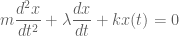
as discussed on page 154 is the equation of a damped harmonic oscillator. There are three behaviours. One way to analyse these is to define the following parameters


and follow the analysis as per the notes. However last night 8 May we outlined an even easier analysis.
First write the differential equation as it will be on your exam paper

Now find the Laplace Transform of the solution. It will look like

Now there are three cases depending on whether 

Underdamping 
In this case the roots are complex: no real roots implying no real factors hence we must complete the square

which is composed of shifted sines and cosines when we transform it back

Overdamping 
In this case the roots are real and distinct so we have two factors and hence a partial fraction expansion like this:

which is composed of two exponentially decaying terms when we transform back.

Critical Damping 
In this case the root are real and repeated hence we have repeated real factors and hence a partial fraction expansion like this:

which is composed of an exponentially decaying term and (before transforming) a shifted 

In Conclusion
If you are asked to analyse a damped harmonic oscillator of the form

then you have three options:
- Calculate
. Over-zero = Over-damping, Under-zero = Under-damping and Equal Zero = Critical-damping
- Calculate
and
as described on page 154 of the notes and compare. It is actually equivalent to method 1. In the Laplace marking scheme handout a damped harmonic oscillator is analysed using this method.
- Solve the differential equation using Laplace Methods and see which behaviour the solution corresponds to.
Week 13
We will hold a review tutorial on Wednesday 8 May in the usual room. First off, the layout of your exam is the same as Winter 2012: do question one worth 50/100 and two out of questions two, three, four; each worth 25/100.
I will field any questions ye might have at this time and if there are no questions we will do the exam paper from Autumn 2012.
Formulae to Learn?
Somebody asked me for a list of formulae that ye might need that are not on the tables. I would put the following on that list:
- The Midpoint Rule Formula Here
One could include
- The Differential; if
then

There are a number of others such as 
Math.Stack Exchange
If you find yourself stuck and for some reason feel unable to ask me the question you could do worse than go to the excellent site math.stackexchange.com. If you are nice and polite, and show due deference to these principles you will find that your questions are answered promptly. For example this question about completing the square.
I am emailing a link of this to everyone on the class list every week. If you are not receiving these emails or want to have them sent to another email address feel free to email me at jpmccarthymaths@gmail.com and I will add you to the mailing list.
Maple Test
I have given ye a sample Maple Test and ye will have your Maple Test Wednesday at 20:30.
Study
Please feel free to ask me questions via email or even better on this webpage — especially those of us who struggled in the test.
Please find a reference for some of the prerequisite material here.
Week 11
We continued our study of Laplace Methods and saw how they can solve differential equations.
Weeks 12
We finish our work on Laplace Methods and look at the general solution of the damped harmonic oscillator.
Week 13
We will hold a review tutorial on Wednesday 8 May in the usual room. First off, the layout of your exam is the same as Winter 2012: do question one worth 50/100 and two out of questions two, three, four; each worth 25/100.
I will field any questions ye might have at this time and if there are no questions we will do the exam paper from Autumn 2012.
Math.Stack Exchange
If you find yourself stuck and for some reason feel unable to ask me the question you could do worse than go to the excellent site math.stackexchange.com. If you are nice and polite, and show due deference to these principles you will find that your questions are answered promptly. For example this question about generalising what we will be doing in the next question.
I am emailing a link of this to everyone on the class list every week. If you are not receiving these emails or want to have them sent to another email address feel free to email me at jpmccarthymaths@gmail.com and I will add you to the mailing list.
Maple Test
I have given ye a sample Maple Testt and ye will have your Maple Test in Week 12.
Study
Please feel free to ask me questions via email or even better on this webpage — especially those of us who struggled in the test.
Please find a reference for some of the prerequisite material here.
Week 10
We continued our study of Laplace Methods with a review of partial fractions. We also spoke about the inverse of the Laplace transform. I also gave out solutions of the Winter 2012 Laplace questions so that ye can see how I mark these questions.
Weeks 11 & 12
We continue our work on Laplace Methods and see how they can solve differential equations.
Week 13
We will do the exam paper from Summer 2012.
Math.Stack Exchange
If you find yourself stuck and for some reason feel unable to ask me the question you could do worse than go to the excellent site math.stackexchange.com. If you are nice and polite, and show due deference to these principles you will find that your questions are answered promptly. For example this rather technical question about the inverse Laplace transform.

 J.P. McCarthy: Math Page
Recent Comments