First of all results are down the bottom. You are identified by the last five digits of your student number. The scores are itemized as you can see. At the bottom there are some average scores.

If you would like to see your paper or have it discussed please email me.

Students with no score were either absent in which case they score zero — or certified absent in which case their marks carry forward to the summer exam.

Note that the results are indeed quite good and if you got above 80 well done. For those of you who got less than this I would point out that this was a straightforward test. Those of you who failed are showing a critical lack of understanding and I would urge you to figure this stuff out.


Q.1/ 3.5

Q.2/ 5

Q.3/ 4

Total

Percentage

55642

19705

3.5

5

4

12.5

100

21351

3

2.5

5

10.5

84

85029

0

3.5

4

7.5

60

03724

09822

2.5

4.5

4

11

88

32081

2.5

2.5

4

9

72

06454

0

1.5

1

2.5

20

45915

2.5

4.5

4

11

88

27029

94575

2.5

4

4

10.5

84

73845

3.5

0.5

4

8

64

70672

3

5

4

12

96

07679

0

1

1

2

16

71863

3.5

5

4

12.5

100

57238

0.5

2

3.5

6

48

38225

3.5

2

4

9.5

76

45757

3.5

5

4

12.5

100

22471

3.5

5

4

12.5

100

39056

3.5

5

3

11.5

92

20385

0

2.5

1

3.5

28

38793

1

4

4

9

72

36218

3.5

4.5

3.5

11.5

92

37141

0

0.5

3

3.5

28

07144

3

2

4

9

72

23995

0

1.5

4

5.5

44

93631

26530

0

3.5

4

7.5

60

54761

0

1.5

0

1.5

12

51817

2.5

3.5

4

10

80

36302

0

3

4

7

56

06188

3.5

5

4

12.5

100

04645

3

3.5

4

10.5

84

87303

3.5

5

4

12.5

100

27324

3

4.5

4

11.5

92

03831

3.5

5

4

12.5

100

91043

3.5

5

4

12.5

100

60166

1.5

4.5

2.5

8.5

68

85904

64257

3

5

4

12

96

12366

3

3.5

4

10.5

84

19063

3.5

2.5

4

10

80

18172

0

4.5

4

8.5

68

62185

3

3.5

4

10.5

84

53673

0.5

0.5

4

5

40

49014

3.5

3.5

2

9

72

83921

0

2

2

4

32

14482

0

2.5

4

6.5

52

17478

3

3.5

4

10.5

84

18776

3.5

4

3

10.5

84

16838

0

2

3

5

40

Average

2.08

3.36

3.51

8.95

71.57

Ave. Percent

59.32

67.17

87.77

Please put my name on your homework handup also

Please find the Homework. Before you open it don’t be too alarmed: you only have to do ONE of the SIX options. All of the options are about dynamical systems in different areas of math:

  1. Discrete Mathematics, Number Theory & Abstract Algebra
  2. Probability
  3. Differential Calculus
  4. Integral Calculus
  5. Linear Algebra
  6. History of Mathematics

Therefore, if you are good at differential calculus, for example, you should have a look at option 3.

All of these questions are unseen to you and all require some knowledge of modules you are doing now or have done before. Although we have been concentrating on real-valued functions on the set of real numbers (i.e. f(x), etc.), a lot of the theory carries over into more general sets and functions, and this is the main learning outcome of this homework.

I am not going to pretend that this is an easy assignment, but I will say that clear and logical thinking will reveal that the solutions and answers aren’t ridiculously difficult: a keen understanding of the principles of dynamical systems and a good ability in one of the options should see you through.

For those who are still not happy there is an essay option.

The final date for submission is 24 April 2012 and you can hand up early if you want. You will be submitting to the big box at the School of Mathematical Science. If I were you I would aim to get it done and dusted early as this is creeping into your study time and is very close to the summer examinations.

Note that you are will be free to collaborate with each other and use references but this must be indicated on your hand-up in a declaration. Evidence of copying or plagiarism (although this is unlikely as these are original problems by and large) will result in divided marks or no marks respectively. You will not receive diminished marks for declared collaboration or referencing although I demand originality of presentation. If you have a problem interpreting any question feel free to approach me, comment on the webpage or email.

Ensure to put your name, student number, module code (MS 3011), and your declaration on your homework.

I am emailing a link of this to everyone on the class list every week. If you are not receiving these emails or want to have them sent to another email address feel free to email me at jippo@campus.ie and I will add you to the mailing list.

This Week

On Monday we had a test and on Wednesday we finished off the first part of the course titled “Discrete Dynamical Systems”.

In the tutorial we discussed the terms eventually and converges. We also discussed how to solve the following problem:

Find points x_0 and x_1=f(x_0) such that x_0 is eventually periodic but neither x_0 nor x_1 are themselves periodic.

Finally we answered 2009 Q. 2(b).

Next Week

Before I start complex numbers I am going to do 2010 Q. 3(b)(iii) and 2009 Autumn Q. 3(d), (e). Then we shall begin complex numbers. Perhaps a quick review of Leaving Cert (Ordinary or Higher Level) Complex Numbers would be a good idea for you.

I have copies of some notes that give some more in depth information on the logistic map. If you would like a copy of these drop me a line.

Test Results

I won’t have them as fast as I’d like is all I can say. I’ll do my best.

Homework

Now that the test is over I am trying to draft your homework ASAP. I hope to give you a choice of more than one project —all will be on topics that are extensions or generalisations of what we have covered in the class. The final date for submission is 24 April 2012 so I will definitely want to draft this homework by Monday week 5 March 2012. You will have full freedom in which one you want to do and can hand up early if you want. You will be submitting to the big box at the School of Mathematical Science.  If I were you I would aim to get it done and dusted early as this is creeping into your study time and is very close to the summer examinations.

Note that you are will be free to collaborate with each other and use references but this must be indicated on your hand-up in a declaration. Evidence of copying or plagiarism will result in divided marks or no marks respectively. You will not receive diminished marks for declared collaboration or referencing although I demand originality of presentation. If you have a problem interpreting any question feel free to approach me, comment on the webpage or email.

Ensure to put your name, student number, module code (MS 3011), my name, and your declaration on your homework.

Problems

2010 Q. 3(b)

2010 Autumn Q. 3(b)

2009 Autumn Q. 3

I am emailing a link of this to everyone on the class list every week. If you are not receiving these emails or want to have them sent to another email address feel free to email me at jippo@campus.ie and I will add you to the mailing list.

This Week

On Wednesday we had our test and on Thursday we finished section 4.2 and have gotten as far as the second example in section 4.3.

In the tutorial we did p.48 Q. 2-4 and p. 59 Q. 3(a). We also spoke about the following integrals:

  • \displaystyle\int \,dx
  • \displaystyle\int 1\,dx
  • \displaystyle\int x^0\,dx
  • \displaystyle\int k\,dx
  • \displaystyle\int 0\,dx

Exercise from Notes

Redo Example 2 from section 4.2 using the formula we derived in section 4.3. Don’t make the same mistake I did in deriving this second formula — this needs a bit more care…

Test Results

I won’t have them as fast as I’d like is all I can say. I’ll do my best.

Project

Now that the test is over you may begin thinking about your project/homework. You have a choice of six projects — one for each full chapter. The final date for submission is 24 April 2012. You have full freedom in which one you want to do and can hand up early if you want. Please submit to the big box at the School of Mathematical Science.  If I were you I would aim to get it done and dusted early as this is creeping into your study time and is very close to the summer examinations.

Note that you are free to collaborate with each other and use references but this must be indicated on your hand-up in a declaration. Evidence of copying or plagiarism will result in divided marks or no marks respectively. You will not receive diminished marks for declared collaboration or referencing although I demand originality of presentation. If you have a problem interpreting any question feel free to approach me, comment on the webpage or email.

Ensure to put your name, student number, module code (MS 2002), my name, and your declaration on your homework.

I am emailing a link of this to everyone on the class list every week. If you are not receiving these emails or want to have them sent to another email address feel free to email me at jippo@campus.ie and I will add you to the mailing list.

This Week

In lectures, we did sections 4.3, 4.4, 4.5, 4.6 and are in the middle of section 4.7.

Problems

2009 Q. 3

I am emailing a link of this to everyone on the class list every week. If you are not receiving these emails or want to have them sent to another email address feel free to email me at jippo@campus.ie and I will add you to the mailing list.

This Week

In lectures, we finished section 3.3. We started chapter 4 and have completed section 4.1 and are in section 4.2.

Reminder

Test on 9 am on Wednesday in WGB G 05 — NOT not the ordinary lecture location.

I am emailing a link of this to everyone on the class list every week. If you are not receiving these emails or want to have them sent to another email address feel free to email me at jippo@campus.ie and I will add you to the mailing list.

This Week

In lectures, we did sections 4.0, 4.1 and 4.2.

Reminder

Test on 10 am on Monday February 20 in WGB G 18.

Problems

2009 Q. 4

From the Class

Show that for 0\leq\mu\leq 4 the Tent Map T_\mu maps [0,1] to itself; i.e. show that T_\mu(x)\in[0,1] for all x\in[0,1].

Show that the Logistic Map and the Tent Map (for 0\leq \mu\leq 4) both have the following properties (ie. for f=T_\mu or Q_\mu):

  1. the mapping satisfies f(1/2-x)=f(1/2+x) for all x\in [0,1/2] so the mapping is symmetric about the line x=1/2.
  2. The values of f increase steadily from f(0)=0 at the left to the maximum value at x=1/2 and decrease steadily to f(1)=0. So the maps are unimodal.


I am emailing a link of this to everyone on the class list every week. If you are not receiving these emails or want to have them sent to another email address feel free to email me at jippo@campus.ie and I will add you to the mailing list.

This Week

In lectures, we finished section 3.2 and are in section 3.3.

In tutorials we did p.42 Q. 3 and p.48 Q. 1,5 & 7

Reminder

Test on 9 am on Wednesday February 22 in WGB G 05 — NOT not the ordinary lecture location.

Problems

From the Class

Show that for all non-zero a\in\mathbb{R},

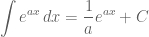
\displaystyle \int e^{ax}\,dx=\frac{1}{a}e^{ax}+C.

Please find a sample test here.

Note that question 1 is going to be one of Summer 2011 Question 2(a), Summer 2009 Question 6(b)(i) or 6(b)(ii). Question 2 will be taken from the other exam questions that we have done in class or have set as exercises (The only thing that’ll change is the constants will be different for Tests A and B). Question 3 will be a graph question.

Nothing fancy here really just eight integrals to be taken from the exercises on page 23, 32, 36, 39, 42, 44, 48 and 59. The only thing that’ll change is the constants will be different for Tests A and B. Please find your sample here.

I just noticed this says Test A rather than Sample at the top. It is a sample and not what the actual Test A is going to be. Also I will attach a copy of the tables.