
You are currently browsing the category archive for the ‘General’ category.
The purpose of this post is to briefly discuss parallelism and perpendicularity of lines in both a geometric and algebraic setting.
Lines
What is a line? In Euclidean Geometry we usually don’t define a line and instead call it a primitive object (the properties of lines are then determined by the axioms which refer to them). If instead points and line segments – defined by pairs of points 
![[PQ]](https://s0.wp.com/latex.php?latex=%5BPQ%5D&bg=ffffff&fg=545454&s=0&c=20201002)
Geometric Definition Candidate
A line,
, is a set of points with the property that for each pair of points in the line,
,
.
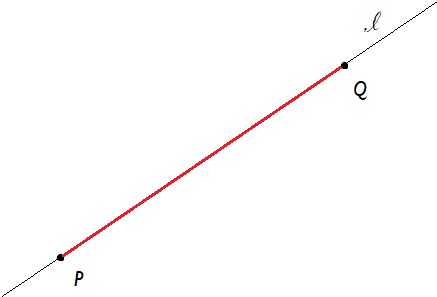
In terms of a picture this just says that when you have a line, that if you take two points in the line (the language in comes from set theory), that the line segment is a subset of the line:
Exercise:
Why is this objectively not a good definition of a line.
Once we move into Cartesian\Coordinate Geometry we can perhaps do a similar trick. We can use line segments, and their lengths to define slope, (slope = rise over run) and then define a line as follows:
Algebraic Definition Candidate
A line,
, the slope is a constant.
This means that if you take two pairs of distinct points in a line 
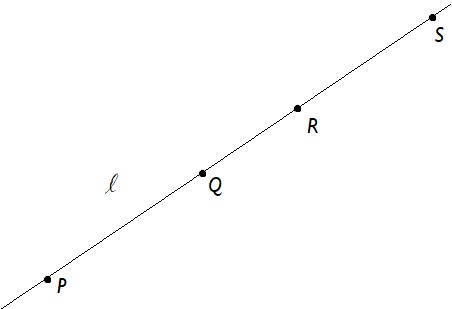
This definition, however, has exactly the same problem as the previous. The definition we use isn’t too important but I do want to use a definition that considers the line a set of points.
The Equation of a Line
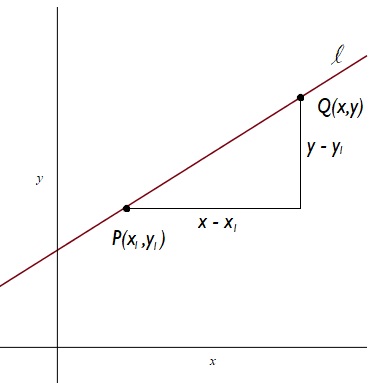
We can use such a definition to derive the equation of a line ‘formula’ for a line of slope 
Suppose first of all that we have an 


“Straight-Line-Graph-Through-The-Origin”
The words of Mr Michael Twomey, physics teacher, in Coláiste an Spioraid Naoimh, I can still hear them.
There were two main reasons to produce this straight-line-graph-through-the-origin:
- to measure some quantity (e.g. acceleration due to gravity, speed of sound, etc.)
- to demonstrate some law of nature (e.g. Newton’s Second Law, Ohm’s Law, etc.)
We were correct to draw this straight-line-graph-through-the origin for measurement, but not always, perhaps, in my opinion, for the demonstration of laws of nature.
The purpose of this piece is to explore this in detail.
Direct Proportion
Two variables 


Occasionally, it might be useful to do as the title here suggests.
Two examples that spring to mind include:
- solving
for
(relative velocity example with
below)
- maximising
without the use of calculus

Note first of all the similarity between:

This identity is in the Department of Education formula booklet.
The only problem is that 

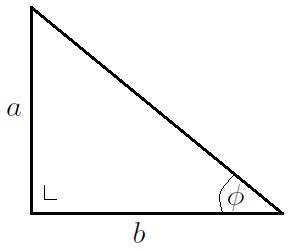
Using Pythagoras Theorem, the hypotenuse is 




Similarly, we have

where 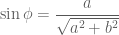
Last semester, teaching some maths to engineers, I decided to play (via email) the Guess 2/3 of the Average game. Two players won (with guesses of 22) and so I needed a tie breaker.
I came up with a hybrid of Monty Hall, not too dissimilar to the game below (the prize was €5).
Rules
In this game, the host presents four doors to the players Alice and Bob:

Behind three of the doors is an empty box, and behind one of the doors is €100.
The host flips a coin and asks the Alice would she like heads or tails. If she is correct, she gets to choose whether to go first or second.
The player that goes first picks a door, then the second player gets a turn, picking a different door.
Then the host opens a door revealing an empty box.
Now the first player has a choice to stay or switch.
The second player then has a choice to stay or switch (the second player can go to where the first player was if the first player switches).
Questions:
- What is the best strategy for the player who goes second:
- if the first player switches?
- if the first player stays?
- Should the person who wins the toss choose to go first or second? What assumptions did you make?
- How much would you pay to play this game? What assumptions did you make?
- If there is a bonus for playing second, how much should the bonus be such that the answer to question 1. is “it doesn’t matter”.
Correlation does not imply causation is a mantra of modern data science. It is probably worthwhile at this point to define the terms correlation, imply, and (harder) causation.
Correlation
For the purposes of this piece, it is sufficient to say that if we measure and record values of variables 


The variables
Causation
Causality is a deep philosophical notion, but, for the purposes of this piece, if there is a relationship between variables
In this case, we write 


This follows on from this post.
Recall the Doubling Mapping 

At the end of the last post we showed that this dynamical system displays sensitivity to initial conditions. Now we show that it displays topological mixing (a chaotic orbit) and density of periodic points.
First we must talk about periodic points.
Periodic Points
Consider, for example, the initial state 


Here we see 
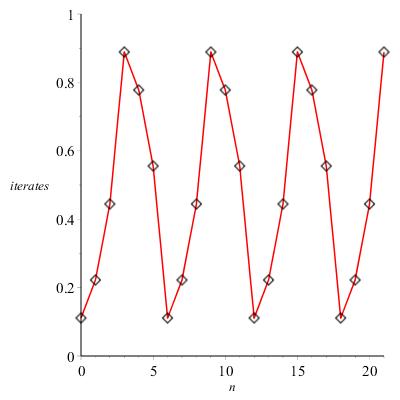
The orbit of 
The orbit of any fraction, e.g. 


and there are only 243 of these and so after 244 iterations, some state must be repeated and so we get locked into a periodic cycle.
If we accept the following:
Proposition
A fraction 

then this is another way to see that fractions are (eventually) periodic. Take for example,

Dynamical Systems
A dynamical system is a set of states 




and in general, the next state is got by applying the iterator function:

The sequence of states

is known as the orbit of 
Such dynamical systems are completely deterministic: if you know the state at any time you know it at all subsequent times. Also, if a state is repeated, for example:

then the orbit is destined to repeated forever because


Example: Savings
Suppose you save in a bank, where monthly you receive 

This can be modeled as a dynamical system.
Let 


Now, in the second month, there is interest on all this:
interest in second month 
we also have the 

and it shouldn’t be too difficult to see that how you get from 

Exercise
Use geometric series to find a formula for 
Weather
If quantum effects are neglected, then weather is a deterministic system. This means that if we know the exact state of the weather at a certain instant (we can even think of the state of the universe – variations in the sun affecting the weather, etc), then we can calculate the state of the weather at all subsequent times.
This means that if we know everything about the state of the weather today at 12 noon, then we know what the weather will be at 12 noon tomorrow…
In school, we learn how a line has an equation… and a circle has an equation… what does this mean?
The short answer is
points
on curve
solutions
however this note explains all of this from first principles, with a particular emphasis on the set-theoretic fundamentals.
Set Theory
A set is a collection of objects. The objects of a set are referred to as the elements or members and if we can list the elements we include them in curly-brackets. For example, call by

We indicate that an object 


Elements are not duplicated and the order doesn’t matter. For example:

This post follows on from this post where the following principle was presented:
Fundamental Principle of Solving ‘Easy’ Equations
Identify what is difficult or troublesome about the equation and get rid of it. As long as you do the same thing to both numbers (the “Lhs” and the “Rhs”), the equation will be replaced by a simpler equation with the same solution.
There are a number of subtleties here: basically sometimes you get extra ‘solutions’ (that are not solutions at all), and sometimes you can lose solutions.
Let us write the squaring function, e.g. 


check out O.K. note that

does not bring us back to where we started.
This problem can be fixed by restricting the allowable inputs to 


The other thing we look out for as much as possible is that we cannot divide by zero.
There are other issues around such as the fact that 


Often, in context, these subtleties are not problematic. For example, equations with no solutions rarely arise and quantities might be positive so that if we have 

In this short note we will explain why we multiply matrices in this “rows-by-columns” fashion. This note will only look at 
First of all we need some objects. Consider the plane 


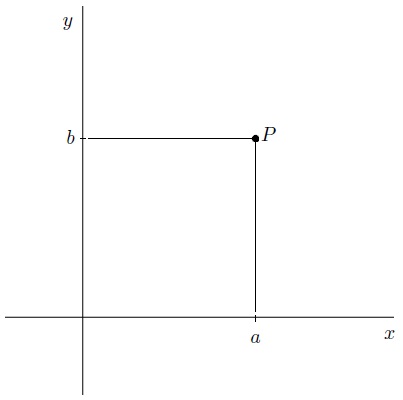
We have two basic operations with points in the plane. We can add them together and we can scalar multiply them according to, if 

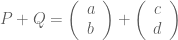


Objects in mathematics that can be added together and scalar-multiplied are said to be vectors. Sets of vectors are known as vector spaces and a feature of vector spaces is that all vectors can be written in a unique way as a sum of basic vectors.

 J.P. McCarthy: Math Page
Recent Comments