
You are currently browsing the category archive for the ‘MS 2001’ category.
The following topics are not covered in Wills’ notes:
- Closed Interval Method (note that Wills does define Critical points – however we define critical points on closed intervals and include the endpoints)
- First Derivative Test
- Asymptotes
Ye have a test Wednesday 08/12/10. Please find attached a Sample
I will not be providing solutions to this sample. If you want solutions please attend the tutorial and ask me to do a question from the sample test.
Everything covered between Test 1 and the end of the year (01/12/10), except applied maximum/ minimum problems and some of curve-sketching (i.e. everything up to definition 4.5 in Wills’ notes MS2001. ) will be examinable. Essentially everything we did from Week 5 to this Monday 22/11/10 inclusive.
Question 1 (a) will have the same format as the sample, Question 1(b) will be taken from the exercise sheets, Question 2 from a past exam paper, and Question 3 will be on definitions & theorems (presented in class and also in Wills’ notes.
Firstly; there will be no MS 2001 lecture on Monday 6 December at 3 p.m. Instead you will have an MS 2003 lecture at this time in WG G 08. The 12 p.m. MS 2003 lecture on Wednesday December 1 in WG G 08 will now be an MS 2001 lecture. Indeed it will be the final MS 2001 lecture as Wednesday 8 December is a test day and the week after is review week. The morning lecture at 9 a.m. on Wednesday 1 December will still go ahead.
On Monday we finished off the section on Implicit Differentiation. We did the example of a circle and emphasised the use of the chain and product rules in this area. We used implicit differentiation techniques to establish the power rule:

for  ,
,  , thus extending the rule we proved for integers. We started a new chapter – Curve Sketching and Max/ Min Problems. We defined local maximum/ minimum and proved that if a function, continuous on a closed interval, takes an absolute max/ min at a point inside the interval, and is differentiable there, then the derivative must be zero.
, , thus extending the rule we proved for integers. We started a new chapter – Curve Sketching and Max/ Min Problems. We defined local maximum/ minimum and proved that if a function, continuous on a closed interval, takes an absolute max/ min at a point inside the interval, and is differentiable there, then the derivative must be zero.In the tutorial we outlined Exercise Sheet 3, Q. 3(i)-(v) by stating where the functions were differentiable and what rule could be used to find the derivative where differentiable. We did Q. 4(i), Q. 10(i),(ii) and finally Q. 12. With a test in three weeks ye need to keep up the work on exercises.
On Wednesday we introduced critical points, the Closed Interval Method and the Second Derivative Test.
Problems
You need to do exercises – all of the following you should be able to attempt. Do as many as you can/ want in the following order of most beneficial:
Wills’ Exercise Sheets
Use the Closed Interval Method to do Q. 8 (i), (iii) from
http://euclid.ucc.ie/pages/staff/wills/teaching/ms2001/exercise1.pdf
Q. 14-17 from http://euclid.ucc.ie/pages/staff/wills/teaching/ms2001/exercise3.pdf
Q. 2 from http://euclid.ucc.ie/pages/staff/wills/teaching/ms2001/exercise4.pdf
Other Exercise Sheets
Section 4 Q. 1-3 from Problems
Past Exam Papers
Those questions in bold are to be done using the Closed Interval Method. Those questions in italic request the critical points of a function 
![f:[a,b]\rightarrow \mathbb{R}](https://s0.wp.com/latex.php?latex=f%3A%5Ba%2Cb%5D%5Crightarrow+%5Cmathbb%7BR%7D&bg=ffffff&fg=545454&s=0&c=20201002)

Q. 2(a) from http://booleweb.ucc.ie/ExamPapers/exams2010/MathsStds/MS2001Sum2010.pdf
Q . 2, 3(b) from http://booleweb.ucc.ie/ExamPapers/exams2009/MathsStds/MS2001s09.pdf
Q. 3(b) from http://booleweb.ucc.ie/ExamPapers/exams2009/MathsStds/Autumn/MS2001A09.pdf
Q. 2(ii), 4 from http://booleweb.ucc.ie/ExamPapers/exams2007/Maths_Stds/MS2001Sum2007.pdf
Q. 6(a) from http://booleweb.ucc.ie/ExamPapers/exams2006/Maths_Stds/MS2001Sum06.pdf
Q. 4(a), 6(a) from http://booleweb.ucc.ie/ExamPapers/exams2006/Maths_Stds/Autumn/ms2001Aut.pdf
Q. 4(b), 5 from http://booleweb.ucc.ie/ExamPapers/Exams2005/Maths_Stds/MS2001.pdf
Q. 5(b) from http://booleweb.ucc.ie/ExamPapers/Exams2005/Maths_Stds/MS2001Aut05.pdf
Q. 5(a), 6(a) from http://booleweb.ucc.ie/ExamPapers/exams2004/Maths_Stds/ms2001s2004.pdf
Q. 4(a), 6(a) from http://booleweb.ucc.ie/ExamPapers/exams2004/Maths_Stds/MS2001aut.pdf
Q. 3, 4(a), 5(b), 6(b) from http://booleweb.ucc.ie/ExamPapers/exams2003/Maths_Studies/MS2001.pdf
Q. 5(b), 6(a) from http://booleweb.ucc.ie/ExamPapers/exams2003/Maths_Studies/ms2001aut.pdf
Q. 4(c) from http://booleweb.ucc.ie/ExamPapers/exams2001/Maths_studies/MS2001Summer01.pdf
Q. 4(c), 6(a) from http://booleweb.ucc.ie/ExamPapers/exams/Mathematical_Studies/MS2001.pdf
From the Class
1. Prove Proposition 5.1.1 in the case that of 
First thing on Monday we tried to rearrange the Monday 6 December lecture. We failed miserably but someone had the bright idea to swap with MS 2003. I have emailed the lecturer and she agrees in principle so we should have a definite plan soon. The second test is also slated for Wednesday 8 December.
Anyway, we stated and proved Rolle’s Theorem. We stated and proved the Mean Value Theorem and verified the Mean Value Theorem for a quadratic.
In the tutorial nobody asked any questions, so I threw the exercises up on the projector and allowed ye work away. Ye put up your hand if ye wanted assistance. In the end I did questions 5 (iii),(iv) & 6 from http://euclid.ucc.ie/pages/staff/wills/teaching/ms2001/exercise3.pdf.
On Wednesday we proved the intuitively true theorem that the sign of a derivative determines whether the function is increasing or decreasing. We used this theorem to prove that  is increasing on
  ; a corollary of which is the existence of positive
  th roots. We defined rational powers. Finally we introduced the idea of the curve; and showed a few examples on the projector.
is increasing on ; a corollary of which is the existence of positive th roots. We defined rational powers. Finally we introduced the idea of the curve; and showed a few examples on the projector.Problems
You need to do exercises – all of the following you should be able to attempt. Do as many as you can/ want in the following order of most beneficial:
Wills’ Exercise Sheets
Q. 11-13 from http://euclid.ucc.ie/pages/staff/wills/teaching/ms2001/exercise3.pdf
Q. 1 from http://euclid.ucc.ie/pages/staff/wills/teaching/ms2001/exercise4.pdf
Past Exam Papers
Q. 4(b) from http://booleweb.ucc.ie/ExamPapers/exams2008/Maths_Stds/MS2001Sum08.pdf
Q. 4 from http://booleweb.ucc.ie/ExamPapers/Exams2008/MathsStds/MS2001a08.pdf
Q. 4(a) from http://booleweb.ucc.ie/ExamPapers/exams2006/Maths_Stds/MS2001Sum06.pdf
Q. 5(a) from http://booleweb.ucc.ie/ExamPapers/exams2006/Maths_Stds/Autumn/ms2001Aut.pdf
Q 5(a) from http://booleweb.ucc.ie/ExamPapers/exams2004/Maths_Stds/MS2001aut.pdf
Q. 5(a) from http://booleweb.ucc.ie/ExamPapers/exams2003/Maths_Studies/MS2001.pdf
Q. 5(a) from http://booleweb.ucc.ie/ExamPapers/exams2003/Maths_Studies/ms2001aut.pdf
Q. 5(a) from http://booleweb.ucc.ie/ExamPapers/exams2001/Maths_studies/MS2001Summer01.pdf
Q. 5 from http://booleweb.ucc.ie/ExamPapers/exams/Mathematical_Studies/MS2001.pdf
From the Class
1. Prove Proposition 4.2.1 for the case that the minimum, 

2. Drawings can be deceptive! Draw a function that is continuous on a closed interval but not differentiable at any point in the interval. What does your drawing suggest? Now see http://en.wikipedia.org/wiki/Weierstrass_function
3. Prove Proposition 4.2.3 (iii)
The second in-class test will take place on 8 December 2010. Any material presented in class, up to and including 01 December is examinable (although applied maximum and minimum problems won’t be examinable). The test is worth 12.5% of your continuous assesment mark for MS 2001. A sample test shall be posted here on 22 November 2010.
Here we present the proof of the following theorem:
Let 


![\left(\frac{f}{g}\right)'(a)=\frac{f'(a)g(a)-f(a)g'(a)}{[g(a)]^2}](https://s0.wp.com/latex.php?latex=%5Cleft%28%5Cfrac%7Bf%7D%7Bg%7D%5Cright%29%27%28a%29%3D%5Cfrac%7Bf%27%28a%29g%28a%29-f%28a%29g%27%28a%29%7D%7B%5Bg%28a%29%5D%5E2%7D&bg=ffffff&fg=545454&s=0&c=20201002)
Quotient Rule
Remark: In the Leibniz notation,
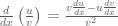
Proof: Let 



![=\frac{g(a)[f(a+h)-f(a)]-f(a)[g(a+h)-g(a)]}{g(a+h)g(a)}](https://s0.wp.com/latex.php?latex=%3D%5Cfrac%7Bg%28a%29%5Bf%28a%2Bh%29-f%28a%29%5D-f%28a%29%5Bg%28a%2Bh%29-g%28a%29%5D%7D%7Bg%28a%2Bh%29g%28a%29%7D&bg=ffffff&fg=545454&s=0&c=20201002)
![\Rightarrow \frac{q(a+h)-q(a)}{h}=\frac{g(a)\left[\frac{f(a+h)-f(a)}{h}\right]-f(a)\left[\frac{g(a+h)-g(a)}{h}\right]}{g(a+h)g(a)}](https://s0.wp.com/latex.php?latex=%5CRightarrow+%5Cfrac%7Bq%28a%2Bh%29-q%28a%29%7D%7Bh%7D%3D%5Cfrac%7Bg%28a%29%5Cleft%5B%5Cfrac%7Bf%28a%2Bh%29-f%28a%29%7D%7Bh%7D%5Cright%5D-f%28a%29%5Cleft%5B%5Cfrac%7Bg%28a%2Bh%29-g%28a%29%7D%7Bh%7D%5Cright%5D%7D%7Bg%28a%2Bh%29g%28a%29%7D&bg=ffffff&fg=545454&s=0&c=20201002)
Letting 
![q'(a)=\left(\frac{f}{g}\right)'(a)=\frac{g(a)f'(a)-f(a)g'(a)}{[g(a)]^2}](https://s0.wp.com/latex.php?latex=q%27%28a%29%3D%5Cleft%28%5Cfrac%7Bf%7D%7Bg%7D%5Cright%29%27%28a%29%3D%5Cfrac%7Bg%28a%29f%27%28a%29-f%28a%29g%27%28a%29%7D%7B%5Bg%28a%29%5D%5E2%7D&bg=ffffff&fg=545454&s=0&c=20201002)

On Monday we proved that if a function is differentiable then it is continuous (today I stated that a rough word explaining differentiable is smooth). We showed that a continuous function need not be differentiable by showing the counterexample  . We presented and proved the sum, scalar, product and quotient rules of differentiation. The proof of the quotient rule is on this page. We did the derivative of and
  for
for  . As a corollary we showed that polynomials are differentiable everywhere. Finally we wrote down the Chain Rule.
. We presented and proved the sum, scalar, product and quotient rules of differentiation. The proof of the quotient rule is on this page. We did the derivative of and for . As a corollary we showed that polynomials are differentiable everywhere. Finally we wrote down the Chain Rule.In the tutorial nobody asked any questions, so I threw the exercises up on the projector and allowed ye work away. Ye put up your hand if ye wanted assistance. In the end I did questions 1 & 2 from http://euclid.ucc.ie/pages/staff/wills/teaching/ms2001/exercise3.pdf.
On Wednesday we wrote down the Chain rule again, stated the proof was up here and gave a very dodgy explanation of why we must multiply by the derivative of the ‘inside’ function. We stated and proved the derivatives of  ,
,  ,
,  ,
,  and
and  (the last two proved non-rigorously). Finally we wrote down Rolle’s Theorem.
, , , and (the last two proved non-rigorously). Finally we wrote down Rolle’s Theorem.Problems
You need to do exercises – all of the following you should be able to attempt. Do as many as you can/ want in the following order of most beneficial:
Wills’ Exercise Sheets
Q. 1-10 from http://euclid.ucc.ie/pages/staff/wills/teaching/ms2001/exercise3.pdf
More exercise sheets
Section 3 from Problems
Past Exam Papers
Q. 1(c), 3(b), 4(b) from http://booleweb.ucc.ie/ExamPapers/exams2010/MathsStds/MS2001Sum2010.pdf
Q . 1(c), 3(a), 4 from http://booleweb.ucc.ie/ExamPapers/exams2009/MathsStds/MS2001s09.pdf
Q. 1(c), 3(a), 4 from http://booleweb.ucc.ie/ExamPapers/exams2009/MathsStds/Autumn/MS2001A09.pdf
Q. 1(c), 3(b), 4(a) from http://booleweb.ucc.ie/ExamPapers/exams2008/Maths_Stds/MS2001Sum08.pdf
Q. 1(c) from http://booleweb.ucc.ie/ExamPapers/Exams2008/MathsStds/MS2001a08.pdf
Q. 1(c), 3 from http://booleweb.ucc.ie/ExamPapers/exams2007/Maths_Stds/MS2001Sum2007.pdf
Q. 3(b), 4(b), 5(a) from http://booleweb.ucc.ie/ExamPapers/exams2006/Maths_Stds/MS2001Sum06.pdf
Q. 3(b), 4(b) from http://booleweb.ucc.ie/ExamPapers/exams2006/Maths_Stds/Autumn/ms2001Aut.pdf
Q. 3(b), 4(a) from http://booleweb.ucc.ie/ExamPapers/Exams2005/Maths_Stds/MS2001.pdf
Q. 4, 5(a) from http://booleweb.ucc.ie/ExamPapers/Exams2005/Maths_Stds/MS2001Aut05.pdf
Q. 4 from http://booleweb.ucc.ie/ExamPapers/exams2004/Maths_Stds/ms2001s2004.pdf
Q. 4(b) from http://booleweb.ucc.ie/ExamPapers/exams2004/Maths_Stds/MS2001aut.pdf
Q. 4(b) from http://booleweb.ucc.ie/ExamPapers/exams2003/Maths_Studies/MS2001.pdf
Q. 4 from http://booleweb.ucc.ie/ExamPapers/exams2003/Maths_Studies/ms2001aut.pdf
Q. 4, 5(a), 6(a) from http://booleweb.ucc.ie/ExamPapers/exams2002/Maths_Stds/ms2001.pdf
Q. 1(b), 4(b), 5(b) from http://booleweb.ucc.ie/ExamPapers/exams2001/Maths_studies/MS2001Summer01.pdf
Q. 1(b), 4(b) from http://booleweb.ucc.ie/ExamPapers/exams/Mathematical_Studies/MS2001.pdf
From the Class
1. Prove Proposition 4.1.4 (ii)
2. Prove Proposition 4.1.9 (ii)
Test Results
First of all results are down the bottom. You are identified by the last four digits of your student number (last three if the fourth last digit is 0). The scores are itemized as you can see. At the bottom there are some average scores.
If you would like to see your paper or have it discussed please email me.
I have one person who didn’t sign their name, please contact me.
Solutions
| Student No | Q 1(a)/2 | Q 1(b)/3 | Q 2/4 | Q 3/3.5 | Mark out of 12.5 | Percent |
| 9705 | 0 | 3 | 2 | 3.5 | 8.5 | 68 |
| 1351 | 1 | 2.5 | 4 | 2 | 9.5 | 76 |
| 9822 | 2 | 3 | 2 | 2 | 9 | 72 |
| 2081 | 1 | 1 | 0 | 0 | 2 | 16 |
| 6454 | 1 | 3 | 0 | 1 | 5 | 40 |
| 7784 | 1 | 0 | 0 | 1 | 2 | 16 |
| 7238 | 0 | 3 | 0.5 | 0 | 3.5 | 28 |
| 8225 | 0 | 3 | 4 | 2 | 9 | 72 |
| 5757 | 2 | 3 | 4 | 3.5 | 12.5 | 100 |
| 2471 | 1 | 1 | 0 | 3.5 | 5.5 | 44 |
| 869 | 1 | 3 | 0 | 2 | 6 | 48 |
| 1341 | 1 | 1 | 3 | 1 | 6 | 48 |
| 9056 | 1 | 3 | 1.5 | 1 | 5 | 52 |
| 7327 | 1 | 1 | 0 | 2 | 4 | 32 |
| 6188 | 2 | 3 | 0 | 2 | 7 | 56 |
| 7303 | 1 | 2.5 | 2 | 0 | 5.5 | 44 |
| 3831 | 1 | 3 | 4 | 1 | 9 | 72 |
| 3024 | 1 | 0 | 0 | 0 | 1 | 8 |
| 1947 | 0 | 0 | 0 | 2 | 2 | 16 |
| 2332 | 1 | 3 | 0 | 1 | 5 | 40 |
| 9423 | 2 | 1 | 0 | 2 | 5 | 40 |
| 5026 | 0 | 1 | 0 | 1 | 2 | 16 |
| 2366 | 1 | 3 | 4 | 2 | 10 | 80 |
| 2185 | 2 | 3 | 4 | 2 | 11 | 88 |
| 9014 | 1 | 3 | 0 | 2 | 6 | 48 |
| 3921 | 0 | 1 | 0 | 2 | 3 | 24 |
| 166 | 1 | 1 | 2 | 3.5 | 7.5 | 60 |
| 8705 | 0 | 3 | 1 | 2 | 6 | 48 |
| 5321 | 0 | 0 | 0 | 1 | 1 | 8 |
| 1701 | 1 | 2 | 2 | 2 | 7 | 56 |
| 6218 | 2 | 3 | 3 | 0 | 8 | 64 |
| 4967 | 1 | 0 | 0 | 2 | 3 | 24 |
| 4761 | 1 | 3 | 0 | 2 | 6 | 48 |
| 5243 | 0 | 0 | ||||
| 1863 | 2 | 3 | 4 | 1 | 10 | 80 |
| 3995 | 0 | 0 | 0 | 2 | 2 | 16 |
| 5154 | 0 | 0 | 0 | 1 | 1 | 8 |
| 385 | 0 | 3 | 3 | 1 | 7 | 56 |
| 9687 | 1 | 3 | 2 | 1 | 7 | 56 |
| 5642 | 1 | 3 | 4 | 3.5 | 11.5 | 92 |
| 7478 | 2 | 3 | 4 | 2 | 11 | 88 |
| 7029 | 2 | 1 | 0 | 0 | 3 | 24 |
| 8026 | 1 | 0 | 0 | 2 | 3 | 24 |
| 4575 | 2 | 2.5 | 4 | 2 | 10.5 | 84 |
| 3845 | 0 | 1 | 4 | 2 | 7 | 56 |
| 672 | 2 | 3 | 4 | 2 | 11 | 88 |
| 8793 | 1 | 3 | 1 | 1 | 6 | 48 |
| 7144 | 1.5 | 3 | 2 | 1 | 7.5 | 60 |
| 8108 | 0 | 0 | 4 | 1 | 5 | 40 |
| 3631 | 2 | 3 | 4 | 1 | 10 | 80 |
| 6302 | 0 | 0 | 4 | 2 | 6 | 48 |
| 1043 | 1.5 | 1 | 3 | 2 | 7.5 | 60 |
| 5904 | 0 | 3 | 4 | 2 | 9 | 72 |
| 4257 | 2 | 3 | 4 | 3.5 | 12.5 | 100 |
| 9063 | 2 | 3 | 4 | 3.5 | 12.5 | 100 |
| 3673 | 1 | 0 | 2 | 3.5 | 6.5 | 52 |
| 4482 | 1 | 3 | 0 | 2 | 6 | 48 |
| 4645 | 1 | 2.5 | 4 | 2 | 9.5 | 76 |
| 5527 | 0 | 0 | 0 | 1 | 1 | 8 |
| 8172 | 1 | 1 | 4 | 1 | 7 | 56 |
| 6838 | 1 | 3 | 2 | 0 | 6 | 48 |
| 1817 | 1.5 | 3 | 4 | 3.5 | 12 | 96 |
| 9738 | 1 | 1 | 0 | 1 | 3 | 24 |
| 511 | 2 | 3 | 4 | 1 | 10 | 80 |
| 7324 | 2 | 3 | 4 | 2 | 11 | 88 |
| 6511 | 1 | 0 | 0 | 2 | 3 | 24 |
| 492 | 0 | 0 | 0 | 2 | 2 | 16 |
| 9501 | 0 | 0 | 0 | 1 | 1 | 8 |
| 684 | 0 | 0 | ||||
| Average Marks | 0.99 | 1.90 | 1.86 | 1.68 | 6.43 | 51.40 |
| Percentages | 49.63 | 63.18 | 46.46 | 47.97 |
Could the student who used illuminous pink and blue biros on their test please email me with their name and student number. It was a test “A”.
Hopefully. The following note (in progress) might help you understand the power and proper functioning of basic real algebra Short_note_on_algebra

 J.P. McCarthy: Math Page
Recent Comments