
You are currently browsing the category archive for the ‘MS 3011’ category.
I am emailing a link of this to everyone on the class list every week. If you are not receiving these emails or want to have them sent to another email address feel free to email me at jpmccarthymaths@gmail.com and I will add you to the mailing list.
Week 4
On Monday we spoke about cobweb diagrams that are a graphical method of locating fixed points and determining whether they are attracting, repelling or indifferent. At this point you should look at Section 2.4 of these notes (NOT mine).
In Section 3.1, 3.2 & 3.3, the cobweb diagrams suggest that if 


A normal person would have proved this as per page 25 of the notes but I wanted to show you the beautiful contraction mapping principle and do it that way… we did conclude, loosely but correctly,
Theorem The: Contraction Mapping Principle
If 


I mainly wanted to show ye this for the nice pictures! There is one here that I got off the internet but I think our blobs were better:
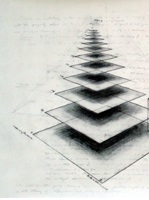
O.K.
In the end what I did was a hodge-podge of the (correct) contraction mapping principle we did on Monday with the proof in the notes of the Fixed Point Dynamics Theorem below which isn’t really satisfactory to me. For next year I will probably try and take this approach but as my proof had a few holes, I am just going to say that you need to know the following:
Theorem: Fixed Point Dynamics
Suppose that 


- If
, then
- If
, then
- If
, then we can make no conclusion and we call
Week 5
In Week 5 we will begin our study of the Logistic Mapping — rabbits!
Exercises
I have emailed ye a copy of the exercises and ye should be able to look at these questions for the Week 5 tutorial.
- 19 — a good question for more understanding for test
- 23-25, 27-29 — good basic practise for the test. Do 25 and you can maybe leave the others
- 26 — more theoretical than other questions of that type. You need to understand parts (a) to (c). These are the three theorems whose proofs are examinable.
The rest of these are not going to be on the test but the exam. If you forget them now don’t forget to look at before the exam to boost understanding. The theory is the same as before
- 30-32 — not examinable on the test but have occurred in Q.2 of the exam. Week 4 theory: same as as 23-25, 27-29
- 33 — full analysis of the dynamical system required using theory of Week 4.
- 34-34 — given the orbit. Find the iterator function and analyse using theory of Week 4.
- 36-37 — Newton-Raphson method is a dynamical system. Analyse using Week 4 theory.
As there are a lot of questions it might make sense to allocate so much time and say do (A)s first, then (B)s then (C)s or whatever.
Test and Other CA
The test will take place on February 12 in Week 6. Everything up to but not including section 3.4 in the typeset notes is examinable: we will have this covered by Februaray 3 but probably January 29. I have emailed ye a copy of a sample test.
The Concept MCQ will still take place in Week 8.
The homework will be given to you towards the end of the semester and I will give ye three weeks to do it. It will probably be on complex numbers and won’t be as long as last year’s homework.
You will be given marks for the best two out of Test, Concept MCQ and Homework.
Math.Stack Exchange
If you find yourself stuck and for some reason feel unable to ask me the question you could do worse than go to the excellent site math.stackexchange.com. If you are nice and polite, and show due deference to these principles you will find that your questions are answered promptly. For example this question about where the OP didn’t understand why roots of 

I am emailing a link of this to everyone on the class list every week. If you are not receiving these emails or want to have them sent to another email address feel free to email me at jpmccarthymaths@gmail.com and I will add you to the mailing list.
Important Tutorial Announcement
If you can’t make the tutorial on account of a clash please email me with the module code of the module the tutorial is clashing with.
Question 13 (c) from Tutorial
Solution: We say that 


Now suppose that 

Now by part (b) the orbit of 

However by part (a),

that is

Week 3
On Monday we proved two facts about periodic orbits (on the bottom of p.12 and the top of p.13 in the course notes)
On Wednesday we learnt how to find the period-2 points of a polynomial mapping. Finding periodic points, say period-2 points means finding points 


Solving this equation is not necessarily that easy but we proved that if 
We also learnt how to find eventually fixed points.
Week 4
In Week 4 we will study attracting fixed points.
Exercises
I have emailed ye a copy of the exercises and ye should be able to look at questions
- 10, 12(17), 16 – 18, 20 – 22
- 13 is hard
- 14 & 15 were done in Monday’s lecture
As there are a lot of questions it might make sense to allocate so much time and say do (A)s first, then (B)s then (C)s or whatever.
Test Postponement and Other CA Information
To give ye adequate time to prepare, the test will take place on February 12 in Week 6. Everything up to but not including section 3.4 in the typeset notes is examinable: we will have this covered by Februaray 3 but probably January 29. I have emailed ye a copy of a sample test.
The Concept MCQ will still take place in Week 8. I have decided not to give ye a sample and I might make it a half hour test rather than an hour. The homework will be given to you towards the end of the semester and I will give ye three weeks to do it. It will probably be on complex numbers and won’t be as long as last year’s homework.
You will be given marks for the best two out of Test, Concept MCQ and Homework.
Math.Stack Exchange
If you find yourself stuck and for some reason feel unable to ask me the question you could do worse than go to the excellent site math.stackexchange.com. If you are nice and polite, and show due deference to these principles you will find that your questions are answered promptly. For example this question about where the OP didn’t understand why roots of
I am emailing a link of this to everyone on the class list every week. If you are not receiving these emails or want to have them sent to another email address feel free to email me at jpmccarthymaths@gmail.com and I will add you to the mailing list.
Course Notes
Have been emailed to you.
Weeks 1 & 2
In the first two weeks we have defined a dynamical system 


where the states 


We looked at some examples of dynamical systems (note there was a small error in the regular savings example but that is not too important).
We studied fixed points. These are states 

So the fixed points of a function
Similarly periodic points are states/ points 


We also noted that a period-2 point would also be period-6 for example:

Here 
Finding periodic points, say period-2 points means finding points
We will look at this problem next week.
Week 3
In Week 3 we will study periodic points in more depth and introduce the idea of an attracting fixed point.
Exercises
I have emailed ye a copy of the exercises and ye should be able to look at questions 1-9 and 11 for next week’s tutorial.
Test
The test will take place on February 5. Everything up to but not including section 3.4 in the typeset notes is examinable: we should have this covered by January 27. I have emailed ye a copy of a sample test.
Math.Stack Exchange
If you find yourself stuck and for some reason feel unable to ask me the question you could do worse than go to the excellent site math.stackexchange.com. If you are nice and polite, and show due deference to these principles you will find that your questions are answered promptly. For example this question about fixed points.
I am emailing a link of this to everyone on the class list every week. If you are not receiving these emails or want to have them sent to another email address feel free to email me at jpmccarthymaths@gmail.com and I will add you to the mailing list.

Review Tutorial/Lecture
Wednesday 1 May at 10:00 in WGB G014.
Feedback
Thank you for your feedback today.
I would make the following comments:
The Homework is hard but fair: ye are final year students. Also I have repeatedly said that I am willing to answer questions about it.
It has everything to do with what we are doing in class (iterator functions, fixed points, orbits, etc.) and ye are supposed to know about the other topics from other modules.
I agree that it might require a lot of thought for 12.5% but when you are finished with it I have no doubt whatsoever that your understanding of the material can only be increased.
More exercise sheets? Agreed — although I didn’t see much evidence of us doing the too-few questions that I was posing weekly.
Regarding getting your tests back: ye have an option to view them but I need to keep them I’m afraid.
Tutorials
Summer 2012: Question 4 (e), (f)
Autumn 2012: Question 4 (d), (f)
Math.Stack Exchange
If you find yourself stuck and for some reason feel unable to ask me the question you could do worse than go to the excellent site math.stackexchange.com. If you are nice and polite, and show due deference to these principles you will find that your questions are answered promptly. For example this question on the Tent Mapping.
Week 12
We summarised our work on roots of unity and illustrated the following result… parts 4 & 5 are not examinable so don’t worry that it wasn’t covered in lectures. In fact as it turned out the proof was a lot harder than I thought… it is not true for all 
Proposition
Suppose that 


Then the dynamical system 
- If
then
.
- If
then
- If
with
then
is eventually periodic.

Suppose now that
4. If 


Then
(In fact, 
5. Suppose now that 


I am emailing a link of this to everyone on the class list every week. If you are not receiving these emails or want to have them sent to another email address feel free to email me at jpmccarthymaths@gmail.com and I will add you to the mailing list.
Weeks 10 & 11
We spoke about complex number multiplication — particularly the geometric aspect including DeMoivre’s Theorem and Roots of Unity. A good summary of what we covered may be found here actually.
We also said that almost all of our dynamical systems theory carries over to when when we have a complex-valued function

rather than a real-valued function
Tutorials
Good questions to look at (some of these have been looked at in tutorials):
Summer 2009 Question 5
Autumn 2009: Question 5
Summer 2008: Question 5
Summer 2012: Question 4 (a) – (e)
Autumn 2012: Question 4 (a) – (d)
Summer 2010: Question 4 (b)
Autumn 2010: Question 3 (a), 4 (a)
Summer 2009: Question 1 (c), (d), 2 (c)
Autumn 2009: Question 1 (c), (d), 2 (c)
Summer 2008: Question 1 (c), (d), 2 (c),
I am emailing a link of this to everyone on the class list every week. If you are not receiving these emails or want to have them sent to another email address feel free to email me at jpmccarthymaths@gmail.com and I will add you to the mailing list.
Test Results
More remarks on these later in the week. Last five digits of student number given.
| S/N | % | Remark |
| 05669 | abs | S/N |
| 34673 | abs | SN |
| 01947 | abs | * |
| 69001 | abs | S/N |
| 27197 | * | |
| 34159 | 100 | |
| 12147 | 100 | |
| 23747 | 100 | |
| 80059 | 100 | |
| 21209 | 100 | |
| 63301 | 100 | |
| 44855 | 100 | |
| 18159 | 100 | |
| 47109 | 96 | |
| 86607 | 96 | |
| 16233 | 96 | |
| 01701 | 96 | |
| 79917 | 92 | |
| 64454 | 92 | |
| 33245 | 92 | |
| 12332 | 88 | |
| 37258 | 84 | |
| 45109 | 84 | |
| 75251 | 80 | |
| 70869 | 76 | |
| 60663 | 72 | |
| 69415 | 72 | |
| 19259 | 68 | |
| 69738 | 68 | |
| 15321 | 64 | |
| 18577 | 64 | |
| 00153 | 64 | |
| 54745 | 60 | |
| 84229 | 60 | |
| 02929 | 60 | |
| 21025 | 56 | |
| 07705 | 52 | |
| 69423 | 52 | |
| 07784 | 48 | |
| 48443 | 48 | |
| 69571 | 48 | |
| Unknown | 44 | |
| 45095 | 36 | |
| 40067 | 36 | |
| 21931 | 28 | |
| 80697 | 24 | |
| 78026 | 24 | |
| 60543 | 24 | |
| 7679 | 16 | not regisd. |
| 06454 | 0 | abs |
| 05587 | 0 | abs |
| 25527 | 0 | abs |
| 67327 | 0 | abs |
| 80133 | 0 | abs |
| 32430 | 0 | abs |
| 70492 | 0 | abs |
| 10684 | 0 | abs |
Tutorial Venue
For the rest of term we are in WGB G03
Week 9
We will finished off our work on the doubling mapping and we began talking about complex numbers.
The marking scheme for Summer 2012 Q. 2 is here and the third page of here. All of the Summer 2012 marking scheme may be found here. As I thought, answering Q. 2 (a), (b), (c) and recognising that they suggested that the Doubling Mapping had, respectively, sensitivity to initial conditions, that the periodic points are dense and a point with a dense orbit was good for 16/25 = 72% > 70% of the marks for that question.
Week 10
This week we will begin to talk about the arithmetic of complex numbers — in particular what it looks like.
Tutorials
There aren’t really any questions that we can do this week that we couldn’t do last week. Perhaps you should spend some time looking at the homework and decide which option you want to take.
I am emailing a link of this to everyone on the class list every week. If you are not receiving these emails or want to have them sent to another email address feel free to email me at jpmccarthymaths@gmail.com and I will add you to the mailing list.
Homework
Yes this homework is difficult. Take inspiration from JFK:
If you have problems interpreting the questions you can ask me in tutorials or on the this webpage. For dealing with your present confusion please be inspired by Mr. Feynmann:
Tutorial Venue
I have applied to get this changed to WGB G03… I didn’t get everything. The timetable is
- This week coming 7 March LL2
- 14 March WGB G03
- 21 March WGB G03
- 28 March WGB G03
Week 8
We finished our study of the tent mapping and began our study of the doubling mapping.
Week 9
We will finish off our work on the doubling mapping and then we will start talking about complex numbers; in particular the geometry of complex arithmetic and complex dynamics.
Complex dynamics is a truly beautiful area of maths that has lovely pictures like these:

Unfortunately we will only be scratching at the surface and won’t quite get this far!
Tutorials
Exercises for Thursday 7 March are to look at the following. Not a whole pile of new stuff covered so some revision.
Summer 2010 Question 3 (b)
Autumn 2010 Question 3(b)
Autumn 2009 Question 3
I am emailing a link of this to everyone on the class list every week. If you are not receiving these emails or want to have them sent to another email address feel free to email me at jpmccarthymaths@gmail.com and I will add you to the mailing list.
Test
I am afraid I am a little on the busy side and ye might be waiting until around March 8 for your results. Just to clarify, I had intended for ye to prove rather than show in question 1; however I wrote show. Therefore if you used Theorem 1 or 2 to answer you will have to get full marks. However at the same time some people understood show as prove. By and large these people are looking at almost 100% but if they drop marks elsewhere, I will give a bonus mark to students who proved in question 1 rather than showed.
Homework
Please find the Homework. Before you open it don’t be too alarmed: you only have to do ONE of the SIX options. All of the options are about dynamical systems & complex numbers in different areas of math:
- Discrete Mathematics, Number Theory & Abstract Algebra
- Probability
- Differential Calculus
- Integral Calculus
- Linear Algebra
- Complex Numbers
Therefore, if you are good at differential calculus, for example, you should have a look at option 3.
All of these questions are unseen to you and — with the exception of Q.6 — all require some knowledge of modules you are doing now or have done before. Although we have been concentrating on real-valued functions on the set of real numbers (i.e. 
I am not going to pretend that this is an easy assignment, but I will say that clear and logical thinking will reveal that the solutions and answers aren’t ridiculously difficult: a keen understanding of the principles of dynamical systems and a good ability in one of the options should see you through.
The final date for submission is 12 April 2013 and you can hand up early if you want. You will be submitting to the big box at the School of Mathematical Science. If I were you I would aim to get it done and dusted early as this is creeping into your study time and is very close to the summer examinations.
Note that you are will be free to collaborate with each other and use references but this must be indicated on your hand-up in a declaration. Evidence of copying or plagiarism (although this is unlikely as these are original problems by and large) will result in divided marks or no marks respectively. You will not receive diminished marks for declared collaboration or referencing although I demand originality of presentation. If you have a problem interpreting any question feel free to approach me, comment on the webpage or email.
Ensure to put your name, student number, module code (MS 3011), and your declaration on your homework.
Tutorial Venue
I have applied to get this changed to WGB G03… I didn’t get everything. The timetable is
- This week coming 28 February LL2
- 7 March LL2
- 14 March WGB G03
- 21 March WGB G03
- 28 March WGB G03
Week 6
We finished describing what a chaotic dynamical system is and began our study of the tent mapping
What next?
We won’t be long finishing off our work on the tent mapping and then we will commence our third special study: of the doubling mapping.
Tutorials
Exercises for Thursday 28 February are to look at the following. Not a whole pile of new stuff covered so some revision.
Autumn 2009 Q. 2(b), 4
Summer 2008, Q. 1(a), 2(a), (b), 3, 6
I am emailing a link of this to everyone on the class list every week. If you are not receiving these emails or want to have them sent to another email address feel free to email me at jpmccarthymaths@gmail.com and I will add you to the mailing list.
Test
Yes test this Monday morning at 10:00. Any questions send me an email or even better comment below.
Homework
Ye will be getting a homework assignment a lá MS2002 last year. I hope to have more information on this next week.
Tutorial Venue
I have applied to get this changed to WGB G03… I didn’t get everything. The timetable is
- This week coming, 21 February WGB G03
- 28 February LL2
- 7 March LL2
- 14 March WGB G03
- 21 March WGB G03
- 28 March WGB G03
Week 5
We continued our study of the Logistic Map given by

where ![x\in[0,1]](https://s0.wp.com/latex.php?latex=x%5Cin%5B0%2C1%5D&bg=ffffff&fg=545454&s=0&c=20201002)
![\mu\in[0,4]](https://s0.wp.com/latex.php?latex=%5Cmu%5Cin%5B0%2C4%5D&bg=ffffff&fg=545454&s=0&c=20201002)


The green line corresponds to attracting fixed points and the red, dashed line to repelling fixed points. The graph is of fixed points vs 
The fact that there are no attracting fixed points for 
We studied therefore the case where 


We then postulated the existence of more complicated behaviour, chaotic behavior. The first thing we needed was a point with a dense orbit: such a point would necessarily not have any pattern or any periodicity:

What next?
We will finish writing off our definition of what a chaotic dynamical system and do a special study of the tent mapping.
Tutorials
Exercises for Thursday 21 February are to look at the following:
Summer 2011 Question 2(c)
Summer 2010 Question 2(b), (c)
Summer 2009 Question 2(b), 3(d), 4(c)
I understand that ye are busy with the test on Monday but after this I would strongly urge you to look at these problems and also the ones from Week 5
I am emailing a link of this to everyone on the class list every week. If you are not receiving these emails or want to have them sent to another email address feel free to email me at jpmccarthymaths@gmail.com and I will add you to the mailing list.
Tutorial Venue
I have applied to get this changed to WGB G03… I didn’t get everything. The timetable is
- This week coming, 14 February LL2
- Next week, 21 February WGB G03
- 28 February LL2
- 7 March LL2
- 14 March WGB G03
- 21 March WGB G03
- 28 March WGB G03
Test
The test will now take place on Monday week February 18. Everything up to but not including section 3.4 in the typeset notes is examinable. We have everything for the test covered. Please find a sample test and the test I gave last year in your typeset notes.
The following theorems from the notes are examinable: Theorem 1 & Theorem 2 (very bottom of page 12 and start of page 13 — called Theorem 1 & 2 on the board). Also the Fixed-Point Factor-Theorem (which was called such on the board. It is not in the notes but is found here https://jpmccarthymaths.com/2012/02/26/ms3011-homework/#comment-331). When I say examinable you should be able to
- state the theorem
- prove the theorem
- understand the theorem and the proof
Learning off the proof letter by letter won’t do you!
Week 5
In week 5 we did a couple of questions that used the theory that we developed in the first few weeks.
Then we began our study of the Logistic Family. We postulated the equation as a model of population growth with two assumptions. We showed how the population could be written as a dynamical system and showed that when the growth-rate parameter 


We will continue this study next week.
Exercises
Exercises for Thursday 14 February are to look at the following:
Sample Test & Actual Test in written notes
Autumn 2012: Question 2(a), 3 (a)
Summer 2011: Question 2(a), (b), (d), 4
Summer 2009: Question 4 (a), (b)

 J.P. McCarthy: Math Page
Recent Comments